







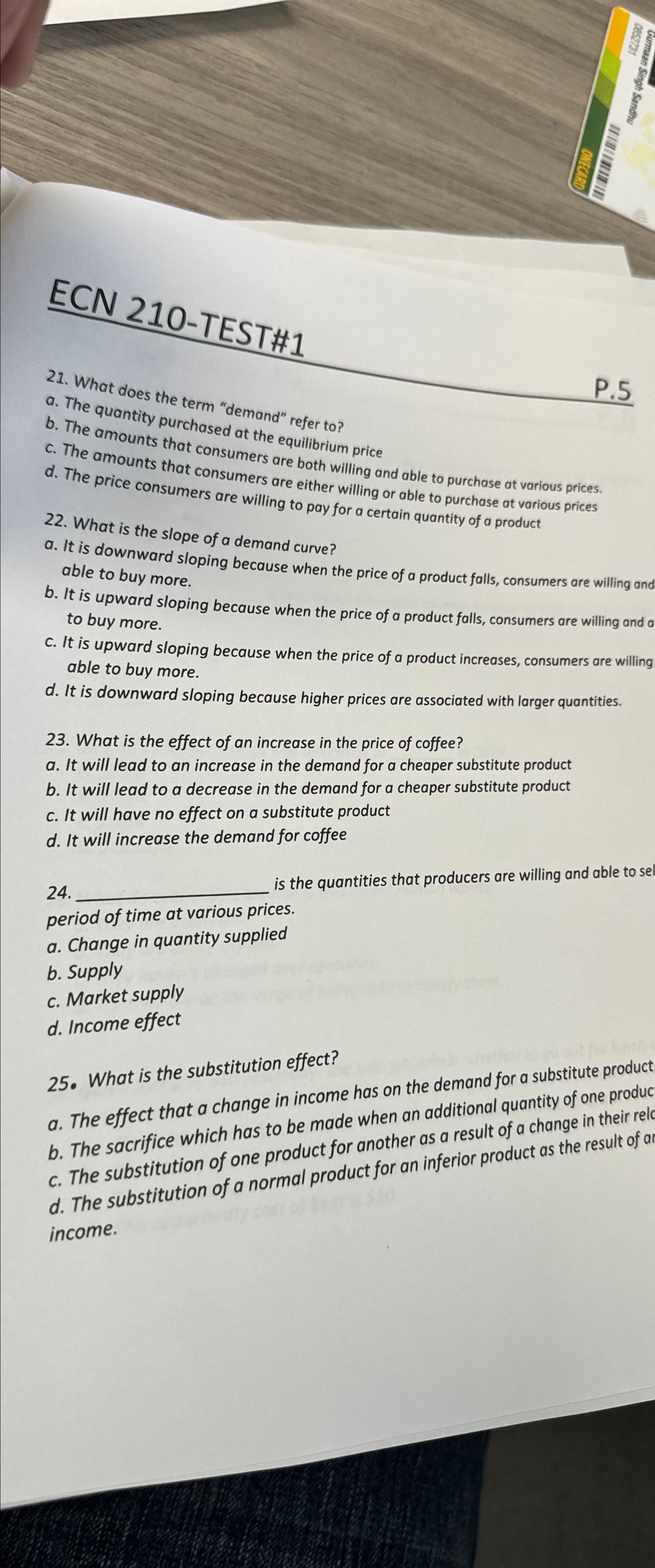
Question: ECN 2 1 0 - TESTH 1 P . 5 2 1 . What does the term demand refer to ? a . The quantity
ECN TESTH
P
What does the term "demand" refer to
a The quantity purchased at the equilibrium price
b The amounts that consumers are both willing and able to purchase at various prices.
c The amounts that consumers are either willing or able to purchase at various prices
d The price consumers are willing to pay for a certain quantity of a product
What is the slope of a demand curve?
a It is downward sloping because when the price of a product falls, consumers are willing and able to buy more.
b It is upward sloping because when the price of a product falls, consumers are willing and a to buy more.
c It is upward sloping because when the price of a product increases, consumers are willing able to buy more.
d It is downward sloping because higher prices are associated with larger quantities.
What is the effect of an increase in the price of coffee?
a It will lead to an increase in the demand for a cheaper substitute product
b It will lead to a decrease in the demand for a cheaper substitute product
c It will have no effect on a substitute product
d It will increase the demand for coffee
is the quantities that producers are willing and able to se period of time at various prices.
a Change in quantity supplied
b Supply
c Market supply
d Income effect
What is the substitution effect?
a The effect that a change in income has on the demand for a substitute product
The sacrifice which has to be made when an additional quantity of one produc
c The substitution of one product for another as a result of a change in their rel
d The substitution of a normal product for an inferior product as the result of a income.
Step by Step Solution
There are 3 Steps involved in it
1 Expert Approved Answer
Step: 1 Unlock

Question Has Been Solved by an Expert!
Get step-by-step solutions from verified subject matter experts
Step: 2 Unlock
Step: 3 Unlock
 Study Help