







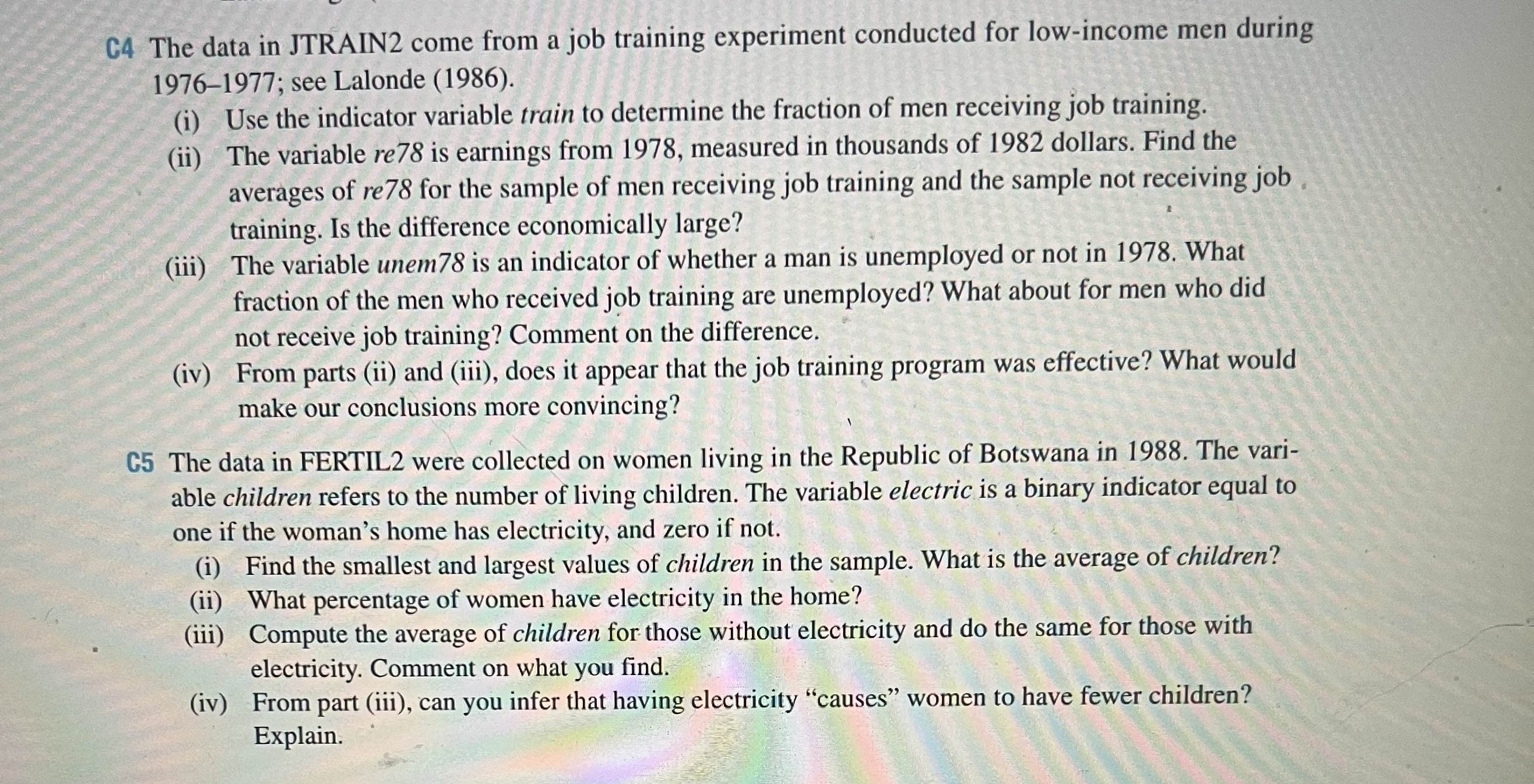
Question: Econometrics could you solve the problems? and show step by step, and provide formulas if you use it C4 The data in JTRAIN2 come from
Econometrics
could you solve the problems? and show step by step, and provide formulas if you use it
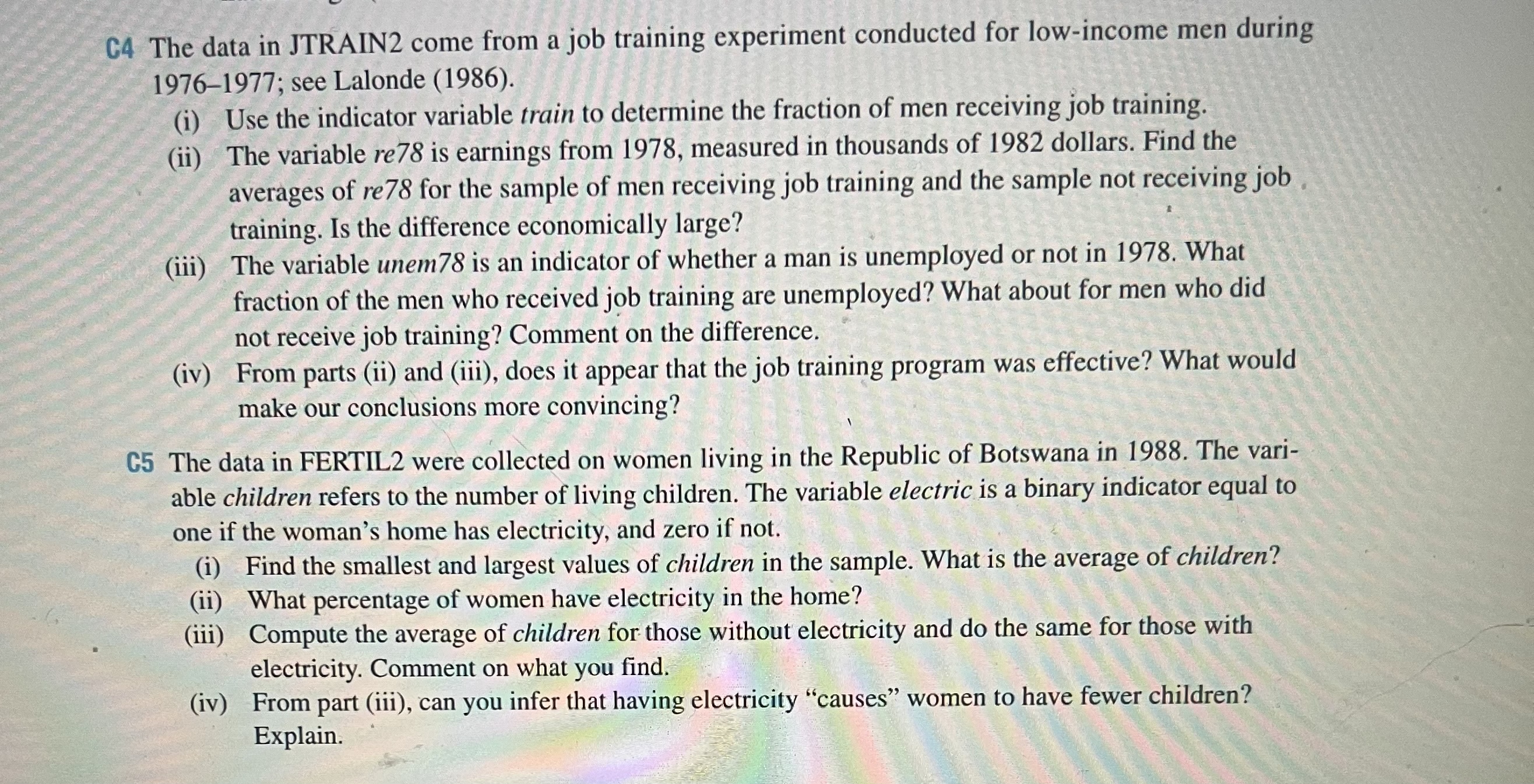
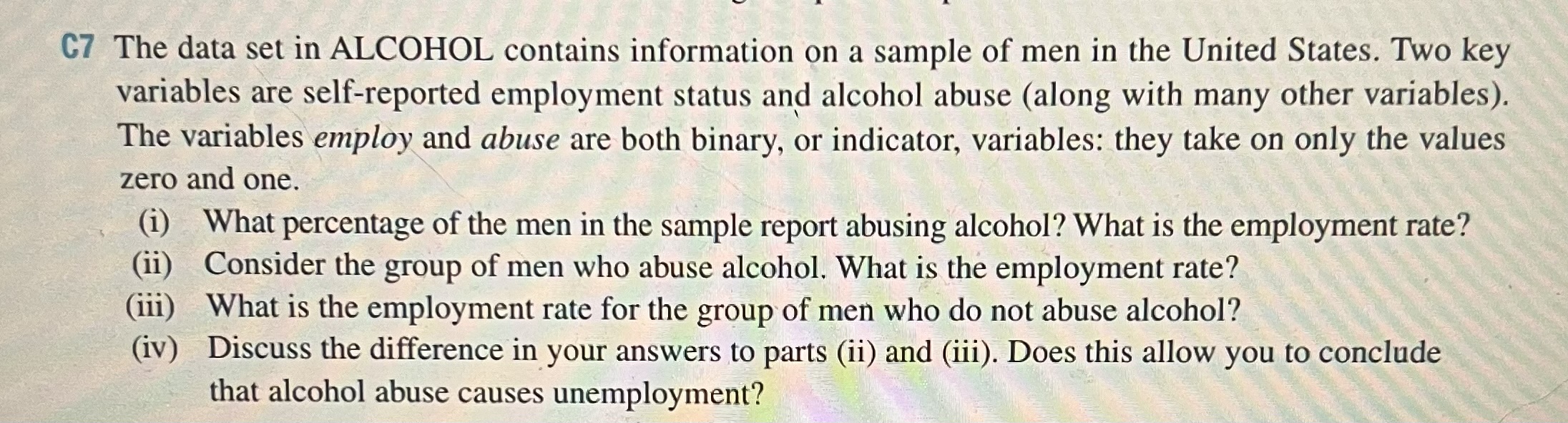
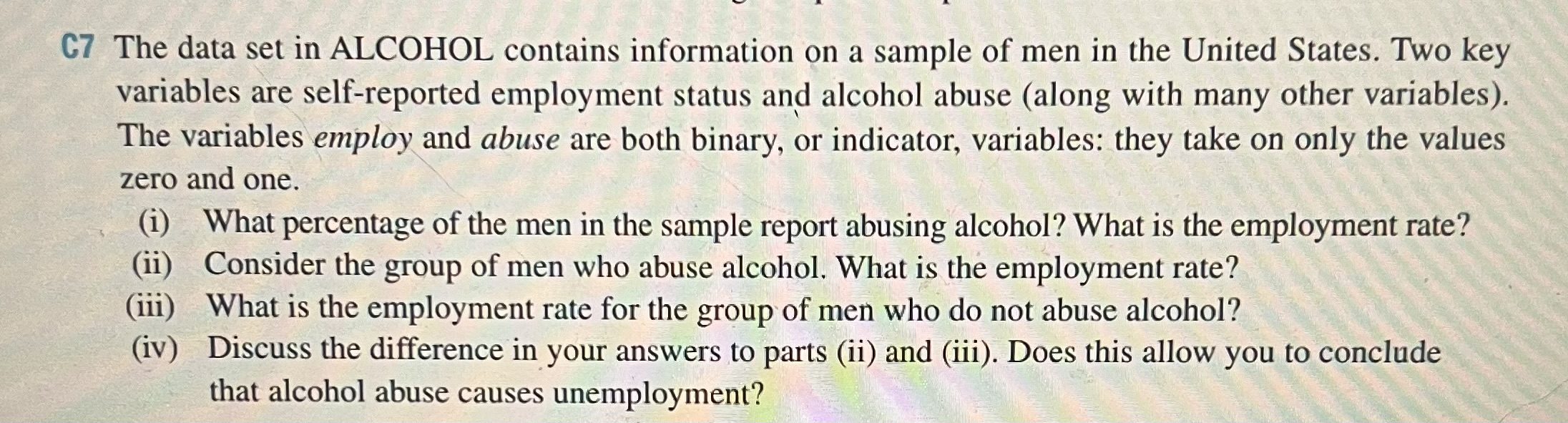
C4 The data in JTRAIN2 come from a job training experiment conducted for low-income men during 1976-1977; see Lalonde (1986). (i) Use the indicator variable train to determine the fraction of men receiving job training. (ii) The variable re78 is earnings from 1978, measured in thousands of 1982 dollars. Find the averages of re78 for the sample of men receiving job training and the sample not receiving job training. Is the difference economically large? (iii) The variable unem78 is an indicator of whether a man is unemployed or not in 1978. What fraction of the men who received job training are unemployed? What about for men who did not receive job training? Comment on the difference. (iv) From parts (ii) and (iii), does it appear that the job training program was effective? What would make our conclusions more convincing? C5 The data in FERTIL2 were collected on women living in the Republic of Botswana in 1988. The vari- able children refers to the number of living children. The variable electric is a binary indicator equal to one if the woman's home has electricity, and zero if not. (i) Find the smallest and largest values of children in the sample. What is the average of children? (ii) What percentage of women have electricity in the home? (iii) Compute the average of children for those without electricity and do the same for those with electricity. Comment on what you find. (iv) From part (iii), can you infer that having electricity "causes" women to have fewer children? Explain.C7 The data set in ALCOHOL contains information on a sample of men in the United States. Two key variables are self-reported employment status and alcohol abuse (along with many other variables). The variables employ and abuse are both binary, or indicator, variables: they take on only the values zero and one. (1) What percentage of the men in the sample report abusing alcohol? What is the employment rate? (i1) Consider the group of men who abuse alcohol. What is the employment rate? (i1) What is the employment rate for the group of men who do not abuse alcohol? () Discuss the difference in your answers to parts (ii) and (iii). Does this allow you to conclude that alcohol abuse causes unemployment
Step by Step Solution
There are 3 Steps involved in it

Get step-by-step solutions from verified subject matter experts
 Study Help