







Question: Econometrics Problem Set No. 8 Problem One (to be done before the lab session) Do Problem (a) and (b) of 8.4 on pages 322 to
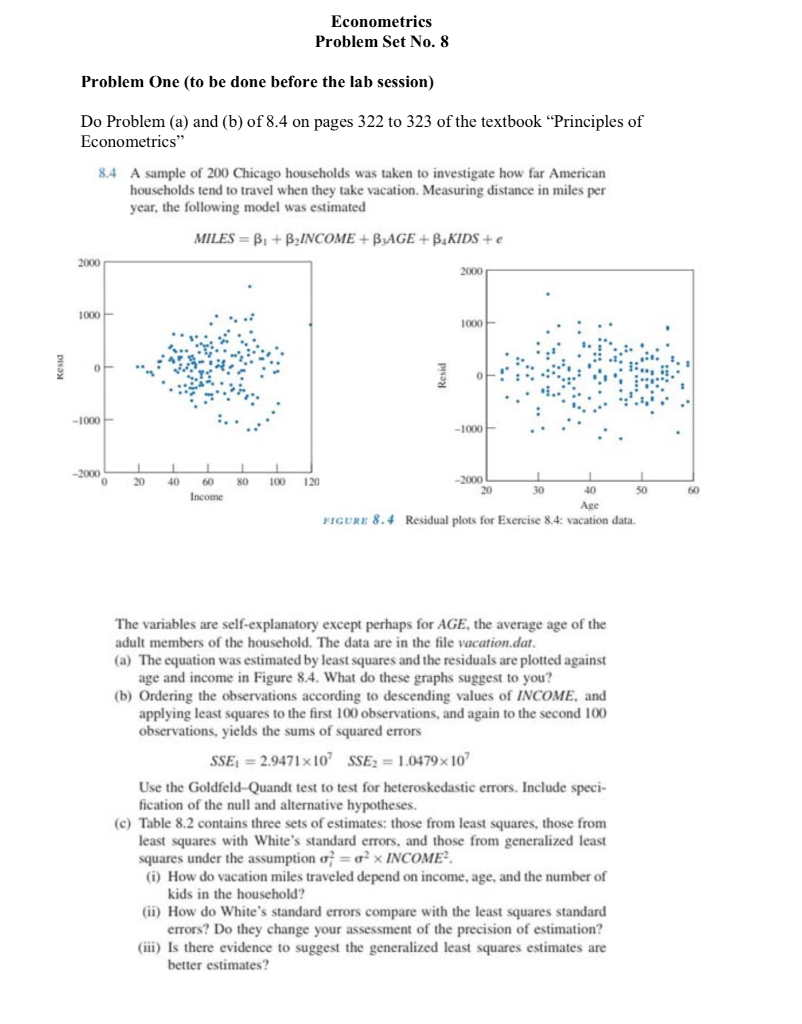
Econometrics Problem Set No. 8 Problem One (to be done before the lab session) Do Problem (a) and (b) of 8.4 on pages 322 to 323 of the textbook Principles of Econometrics" 8.4 A sample of 200 Chicago households was taken to investigate how far American households tend to travel when they take vacation. Measuring distance in miles per year, the following model was estimated MILES = B: + B2INCOME + BAGE+B.KIDS + 2000 10 Resid of Resid -1000 -1000 .. . -2000 LLLL 0 20 40 60 Income 80 100 120 -2000 20 30 40 50 60 Aze FIGURE 8.4 Residual plots for Exercise 8.4: vacation data The variables are self-explanatory except perhaps for AGE, the average age of the adult members of the household. The data are in the file vacation.dar. (a) The equation was estimated by least squares and the residuals are plotted against age and income in Figure 8.4. What do these graphs suggest to you? (b) Ordering the observations according to descending values of INCOME, and applying least squares to the first 100 observations, and again to the second 100 observations, yields the sums of squared errors SSE; = 2.9471 x 10⁷ SSE2 = 1.0479x10⁷ Use the Goldfeld-Quandt test to test for heteroskedastic errors. Include speci- fication of the null and alternative hypotheses. (c) Table 8.2 contains three sets of estimates: those from least squares, those from least squares with White's standard errors, and those from generalized least squares under the assumption of = ?X INCOME (i) How do vacation miles traveled depend on income, age, and the number of kids in the household? (ii) How do White's standard errors compare with the least squares standard errors? Do they change your assessment of the precision of estimation? (iii) Is there evidence to suggest the generalized least squares estimates are better estimates? Econometrics Problem Set No. 8 Problem One (to be done before the lab session) Do Problem (a) and (b) of 8.4 on pages 322 to 323 of the textbook Principles of Econometrics" 8.4 A sample of 200 Chicago households was taken to investigate how far American households tend to travel when they take vacation. Measuring distance in miles per year, the following model was estimated MILES = B: + B2INCOME + BAGE+B.KIDS + 2000 10 Resid of Resid -1000 -1000 .. . -2000 LLLL 0 20 40 60 Income 80 100 120 -2000 20 30 40 50 60 Aze FIGURE 8.4 Residual plots for Exercise 8.4: vacation data The variables are self-explanatory except perhaps for AGE, the average age of the adult members of the household. The data are in the file vacation.dar. (a) The equation was estimated by least squares and the residuals are plotted against age and income in Figure 8.4. What do these graphs suggest to you? (b) Ordering the observations according to descending values of INCOME, and applying least squares to the first 100 observations, and again to the second 100 observations, yields the sums of squared errors SSE; = 2.9471 x 10⁷ SSE2 = 1.0479x10⁷ Use the Goldfeld-Quandt test to test for heteroskedastic errors. Include speci- fication of the null and alternative hypotheses. (c) Table 8.2 contains three sets of estimates: those from least squares, those from least squares with White's standard errors, and those from generalized least squares under the assumption of = ?X INCOME (i) How do vacation miles traveled depend on income, age, and the number of kids in the household? (ii) How do White's standard errors compare with the least squares standard errors? Do they change your assessment of the precision of estimation? (iii) Is there evidence to suggest the generalized least squares estimates are better estimates
Step by Step Solution
There are 3 Steps involved in it

Get step-by-step solutions from verified subject matter experts
 Study Help