



Question: Economics question 3. Consider the case where a consumer's consumption set is the open or closed first quadrant of the plane and preferences are strictly
Economics question
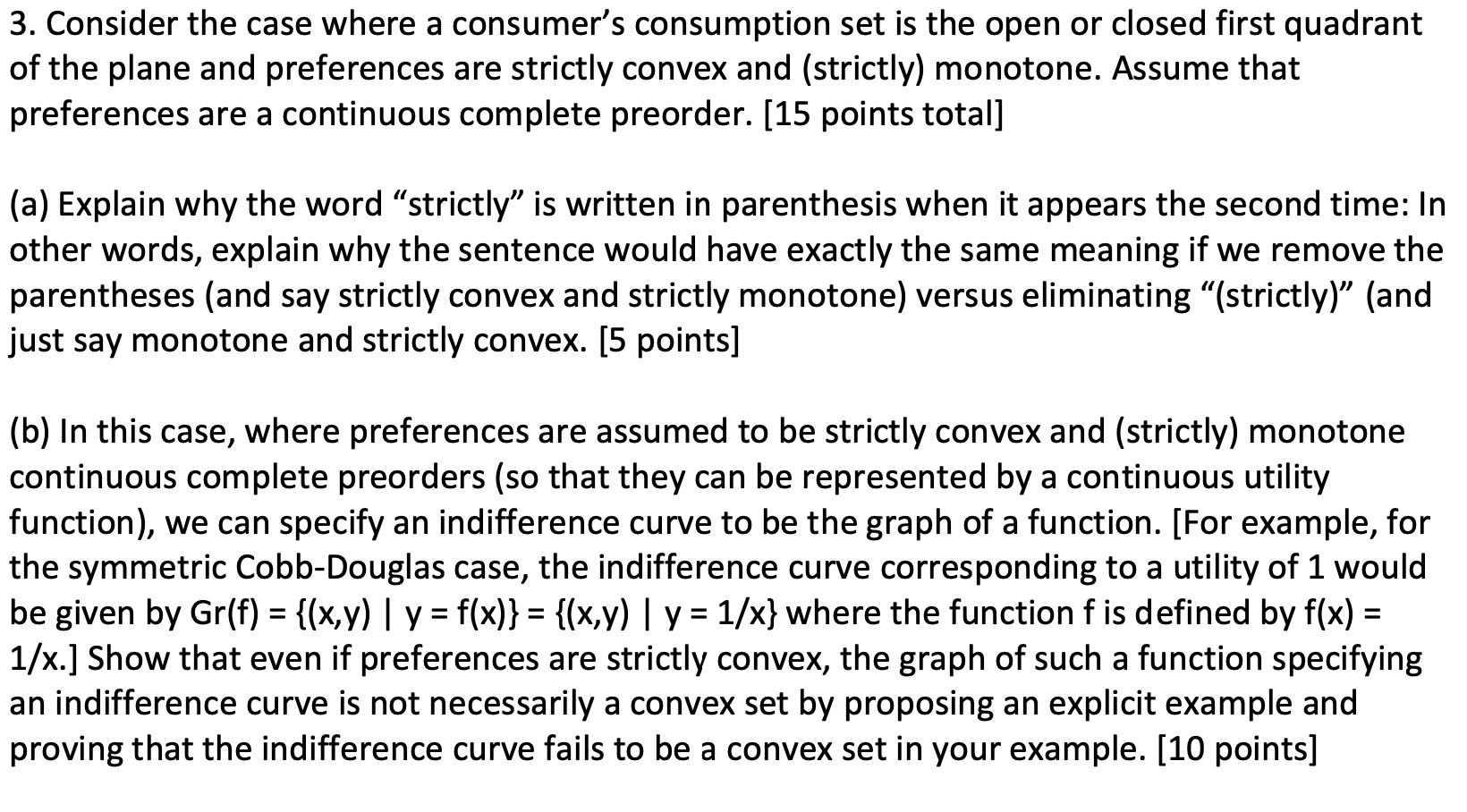
3. Consider the case where a consumer's consumption set is the open or closed first quadrant of the plane and preferences are strictly convex and (strictly) monotone. Assume that preferences are a continuous complete preorder. [15 points total] (a) Explain why the word "strictly\" is written in parenthesis when it appears the second time: In other words, explain why the sentence would have exactly the same meaning if we remove the parentheses (and say strictly convex and strictly monotone) versus eliminating "(strictly)\" (and just say monotone and strictly convex. [5 points] (b) In this case, where preferences are assumed to be strictly convex and (strictly) monotone continuous complete preorders (so that they can be represented by a continuous utility function), we can specify an indifference curve to be the graph of a function. [For example, for the symmetric CobbDouglas case, the indifference curve corresponding to a utility of 1 would be given by Gr(f) = {(x,y) | y = f(x)} = {(x,y) | y = 1/x} where the function f is defined by f(x) = 1/x.] Show that even if preferences are strictly convex, the graph of such a function specifying an indifference curve is not necessarily a convex set by proposing an explicit example and proving that the indifference curve fails to be a convex set in your example. [10 points]
Step by Step Solution
There are 3 Steps involved in it

Get step-by-step solutions from verified subject matter experts