







Question: EDITED: Product Offering: Cardboard Window Blind Considering the various window blinds available (i.e. Wood blind, Paper Blind, Vinyl etc.). I have decided to make a
EDITED:
Product Offering: Cardboard Window Blind
Considering the various window blinds available (i.e. Wood blind, Paper Blind, Vinyl etc.). I have decided to make a Cardboard Window Blind as my Product for my Term Project
My target market Persona, will be Immigrant students (graduate and Undergraduate) from India, China, Ghana and as well locals from Canada who love easy to use, cheap, customizable eco-friendly aesthetic window blinds alternatives and are new to the University of Alberta.
QUESTION: Say i am to start this business in 6 months time,
1. Help me perform a hypothetical Bottoms-up back of the envelope market estimation of my offering to estimate the Reachable Market (RM) based on my market customers above.
2. Estimate the Potential Market
3. Estimate the Total market (TM) Size
Kindly use the approach employed below by Guy Kawasaki for a Startup company trying to sell internet access in China.below:
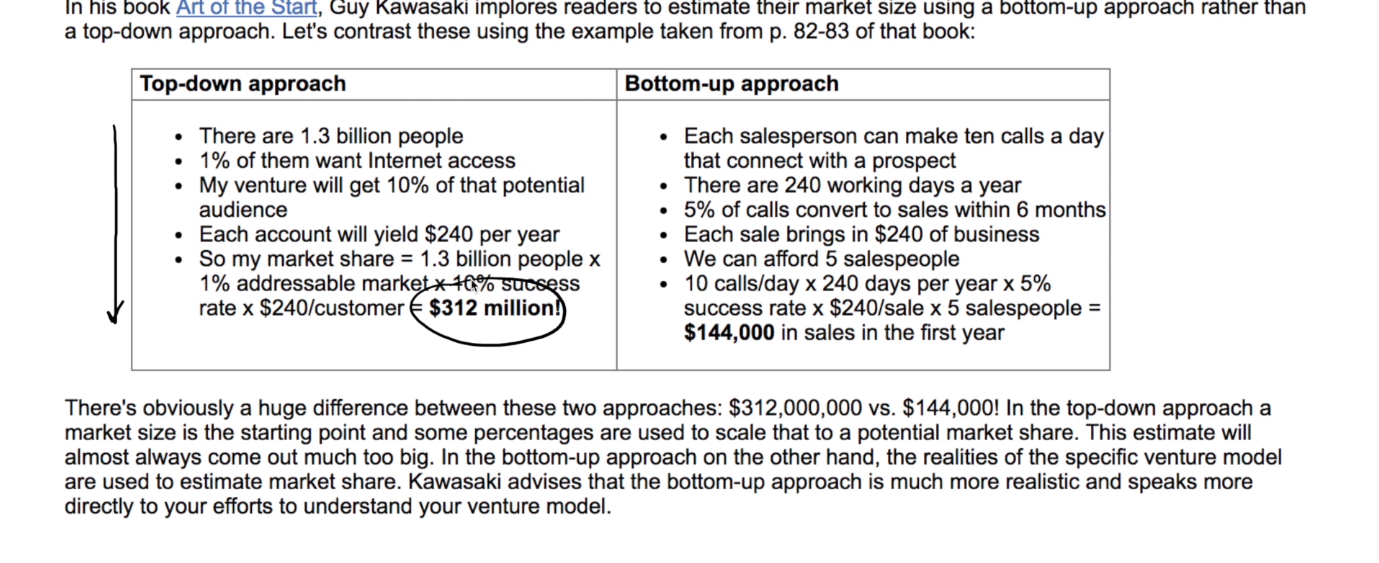
Where $312 million for the example above = Total Market Size and $144000 was the Reachable Market
NOTE: Please feel free to make assumptions of both market size, students etc. Make your own assumptions on the number of foreign students for University of Alberta etc and any other info you think you will need for the calculation,
In his book Art of the Start, Guy Kawasaki implores readers to estimate their market size using a bottom-up approach rather than a top-down approach. Let's contrast these using the example taken from p. 82-83 of that book: Top-down approach Bottom-up approach There are 1.3 billion people 1% of them want Internet access My venture will get 10% of that potential audience Each account will yield $240 per year So my market share = 1.3 billion people x 1% addressable market* 10% sucsess rate x $240/customer $312 million! Each salesperson can make ten calls a day that connect with a prospect There are 240 working days a year 5% of calls convert to sales within 6 months Each sale brings in $240 of business We can afford 5 salespeople 10 calls/day x 240 days per year x 5% success rate x $240/sale x 5 salespeople = $144,000 in sales in the first year There's obviously a huge difference between these two approaches: $312,000,000 vs. $144,000! In the top-down approach a market size is the starting point and some percentages are used to scale that to a potential market share. This estimate will almost always come out much too big. In the bottom-up approach on the other hand, the realities of the specific venture model are used to estimate market share. Kawasaki advises that the bottom-up approach is much more realistic and speaks more directly to your efforts to understand your venture model. In his book Art of the Start, Guy Kawasaki implores readers to estimate their market size using a bottom-up approach rather than a top-down approach. Let's contrast these using the example taken from p. 82-83 of that book: Top-down approach Bottom-up approach There are 1.3 billion people 1% of them want Internet access My venture will get 10% of that potential audience Each account will yield $240 per year So my market share = 1.3 billion people x 1% addressable market* 10% sucsess rate x $240/customer $312 million! Each salesperson can make ten calls a day that connect with a prospect There are 240 working days a year 5% of calls convert to sales within 6 months Each sale brings in $240 of business We can afford 5 salespeople 10 calls/day x 240 days per year x 5% success rate x $240/sale x 5 salespeople = $144,000 in sales in the first year There's obviously a huge difference between these two approaches: $312,000,000 vs. $144,000! In the top-down approach a market size is the starting point and some percentages are used to scale that to a potential market share. This estimate will almost always come out much too big. In the bottom-up approach on the other hand, the realities of the specific venture model are used to estimate market share. Kawasaki advises that the bottom-up approach is much more realistic and speaks more directly to your efforts to understand your venture model
Step by Step Solution
There are 3 Steps involved in it

Get step-by-step solutions from verified subject matter experts
 Study Help