







Question: EE 3 3 1 Lesson 4 3 : DC - DC Conversion Additional Exercise: An idealized buck converter circuit is depicted at right. This buck
EE Lesson : DCDC Conversion
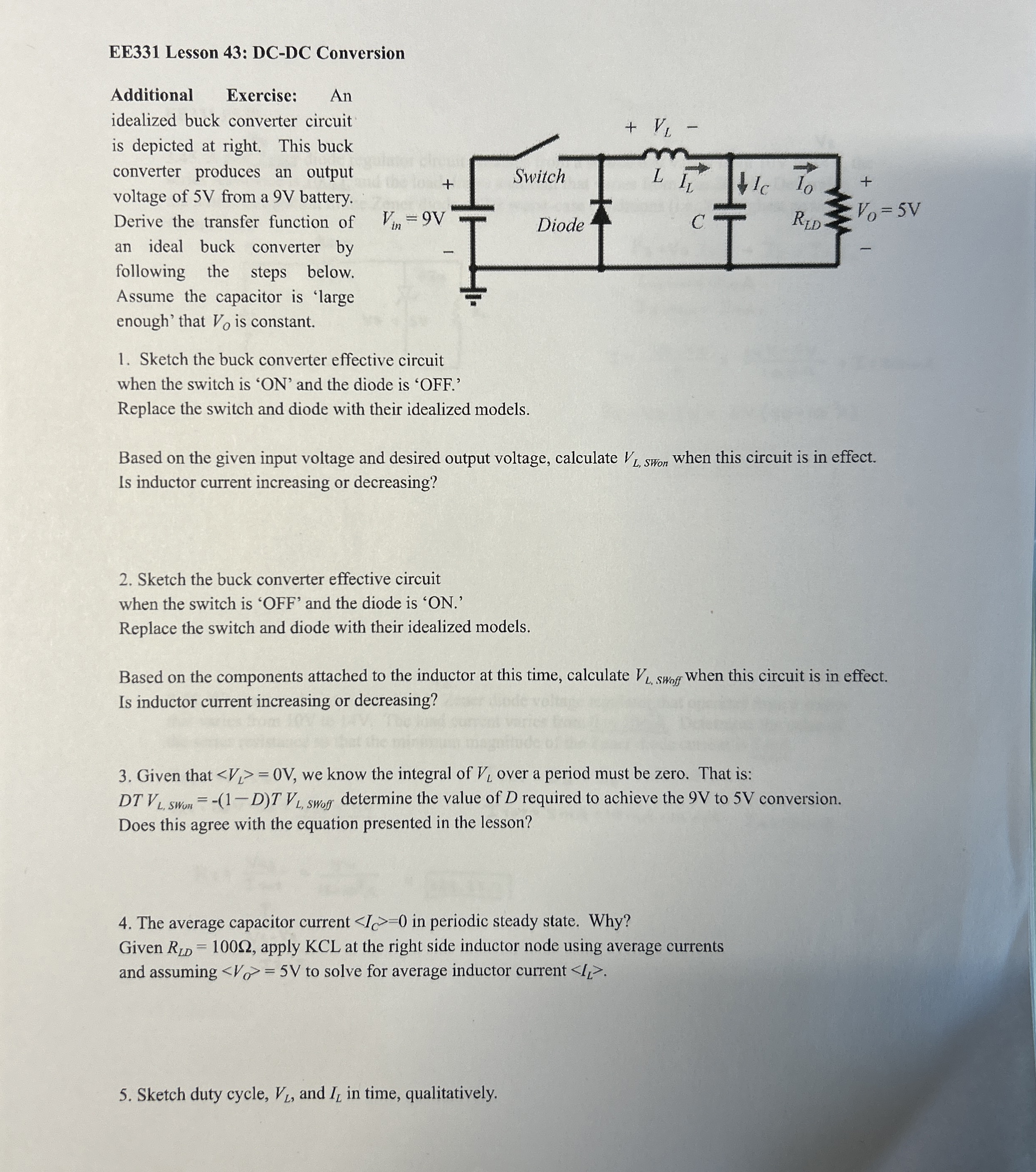
Additional Exercise: An idealized buck converter circuit is depicted at right. This buck converter produces an output voltage of V from a V battery. Derive the transfer function of an ideal buck converter by following the steps below. Assume the capacitor is 'large enough' that is constant.
Sketch the buck converter effective circuit when the switch is ON and the diode is 'OFF.
Replace the switch and diode with their idealized models.
Based on the given input voltage and desired output voltage, calculate when this circuit is in effect. Is inductor current increasing or decreasing?
Sketch the buck converter effective circuit when the switch is 'OFF' and the diode is ON
Replace the switch and diode with their idealized models.
Based on the components attached to the inductor at this time, calculate when this circuit is in effect. Is inductor current increasing or decreasing?
Given that :: we know the integral of over a period must be zero. That is: determine the value of required to achieve the V to V conversion. Does this agree with the equation presented in the lesson?
The average capacitor current in periodic steady state. Why?
Given apply KCL at the right side inductor node using average currents and assuming :: to solve for average inductor current ::
Sketch duty cycle, and in time, qualitatively.
Step by Step Solution
There are 3 Steps involved in it
1 Expert Approved Answer
Step: 1 Unlock

Question Has Been Solved by an Expert!
Get step-by-step solutions from verified subject matter experts
Step: 2 Unlock
Step: 3 Unlock
 Study Help