



Question: Effective leadership subject Read the case study and answer all the questions that follow. Leadership for Digital Transformation Many articles on digital transformation have been
Effective leadership subject
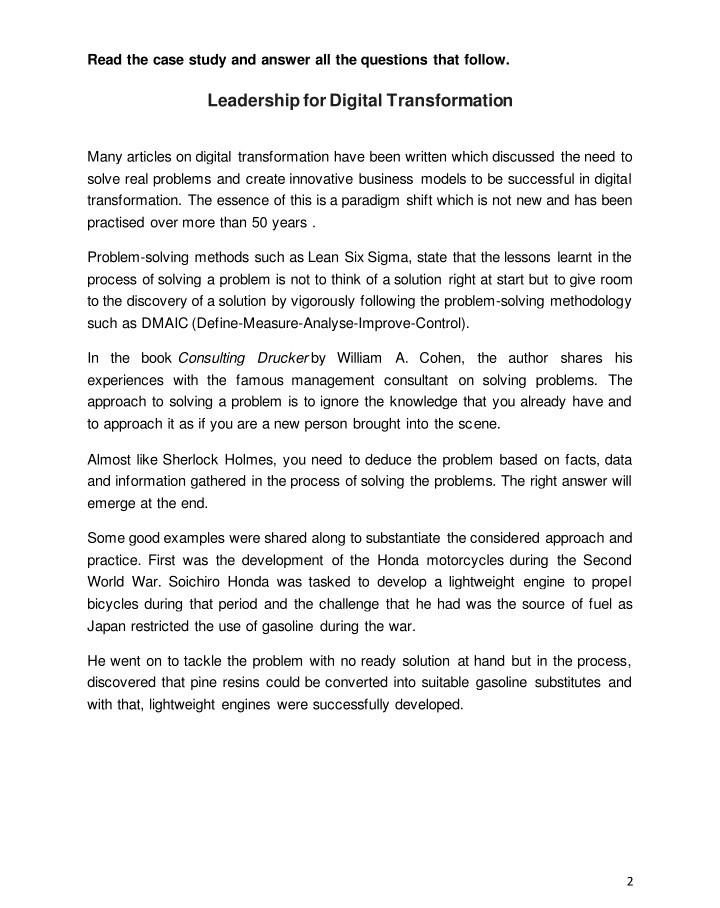
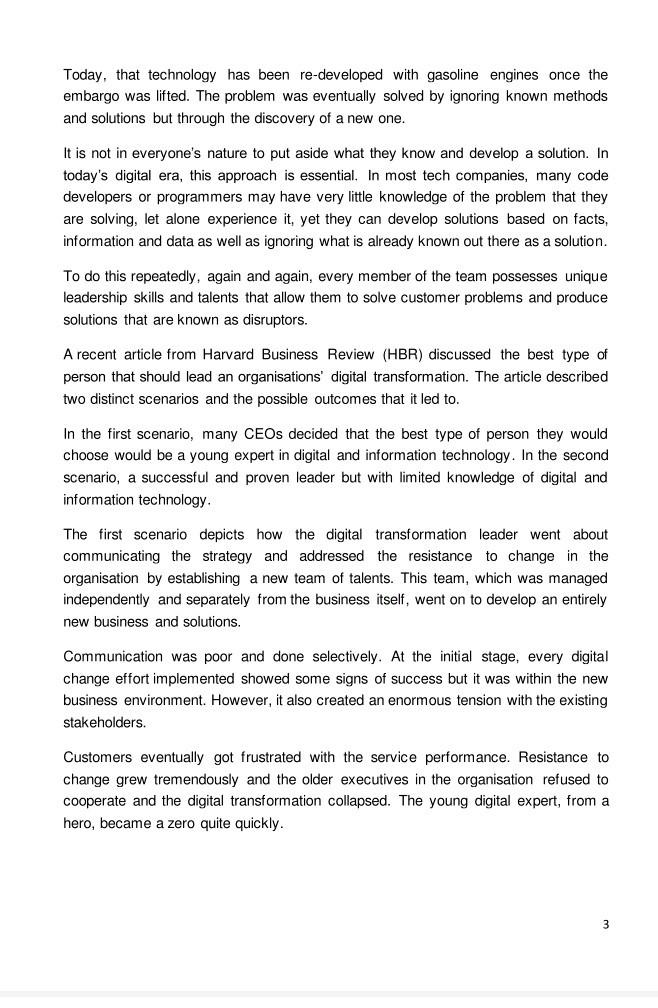
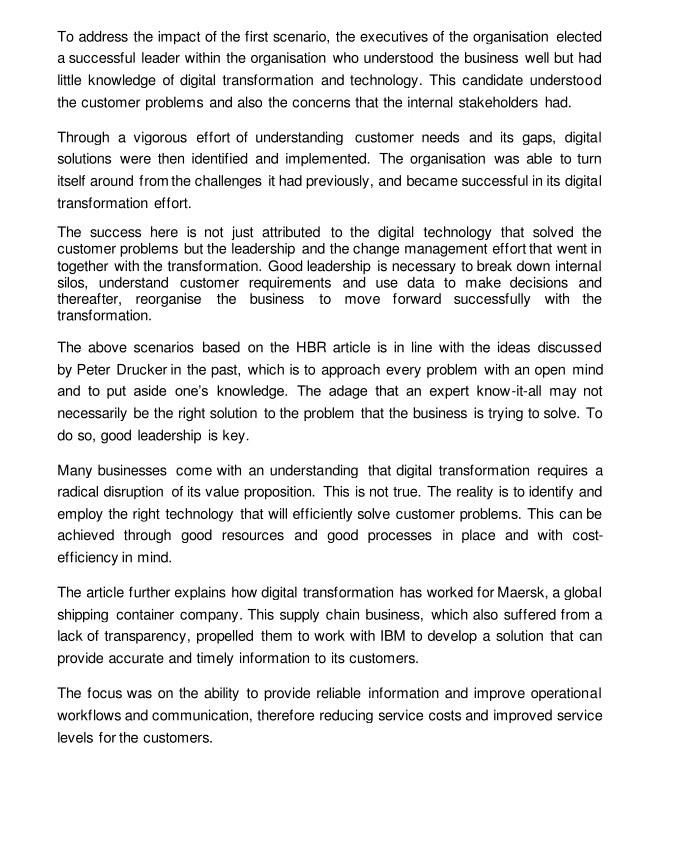
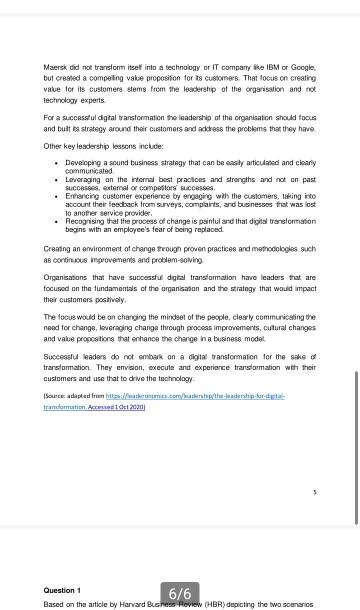
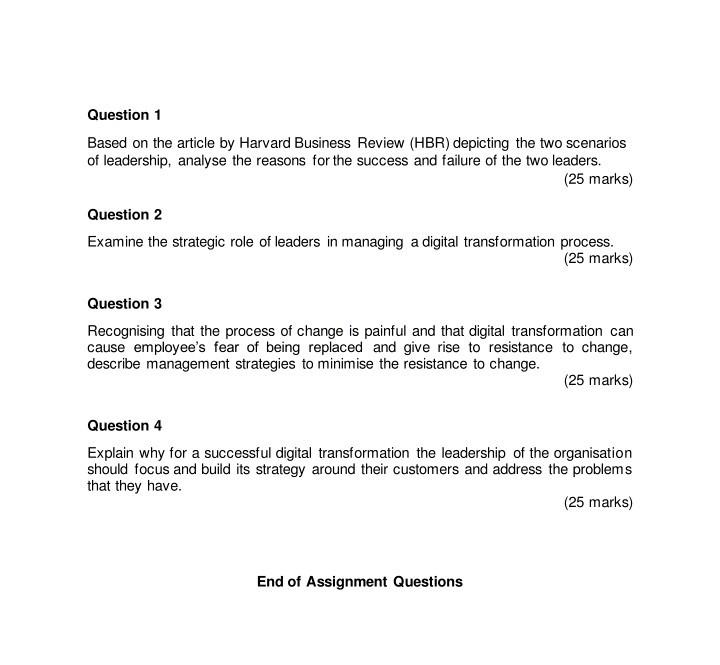
Read the case study and answer all the questions that follow. Leadership for Digital Transformation Many articles on digital transformation have been written which discussed the need to solve real problems and create innovative business models to be successful in digital transformation. The essence of this is a paradigm shift which is not new and has been practised over more than 50 years. Problem-solving methods such as Lean Six Sigma, state that the lessons learnt in the process of solving a problem is not to think of a solution right at start but to give room to the discovery of a solution by vigorously following the problem-solving methodology such as DMAIC (Define-Measure-Analyse-Improve-Control). In the book Consulting Drucker by William A. Cohen, the author shares his experiences with the famous management consultant on solving problems. The approach to solving a problem is to ignore the knowledge that you already have and to approach it as if you are a new person brought into the scene. Almost like Sherlock Holmes, you need to deduce the problem based on facts, data and information gathered in the process of solving the problems. The right answer will emerge at the end. Some good examples were shared along to substantiate the considered approach and practice. First was the development of the Honda motorcycles during the Second World War. Soichiro Honda was tasked to develop a lightweight engine to propel bicycles during that period and the challenge that he had was the source of fuel as Japan restricted the use of gasoline during the war. He went on to tackle the problem with no ready solution at hand but in the process, discovered that pine resins could be converted into suitable gasoline substitutes and with that, lightweight engines were successfully developed. 2 Today, that technology has been re-developed with gasoline engines once the embargo was lifted. The problem was eventually solved by ignoring known methods and solutions but through the discovery of a new one. It is not in everyone's nature to put aside what they know and develop a solution. In today's digital era, this approach is essential. In most tech companies, many code developers or programmers may have very little knowledge of the problem that they are solving, let alone experience it, yet they can develop solutions based on facts, information and data as well as ignoring what is already known out there as a solution. To do this repeatedly, again and again, every member of the team possesses unique leadership skills and talents that allow them to solve customer problems and produce solutions that are known as disruptors. A recent article from Harvard Business Review (HBR) discussed the best type of person that should lead an organisations' digital transformation. The article described two distinct scenarios and the possible outcomes that it led to. In the first scenario, many CEOs decided that the best type of person they would choose would be a young expert in digital and information technology. In the second scenario, a successful and proven leader but with limited knowledge of digital and information technology, The first scenario depicts how the digital transformation leader went about communicating the strategy and addressed the resistance to change in the organisation by establishing a new team of talents. This team, which was managed independently and separately from the business itself, went on to develop an entirely new business and solutions. Communication was poor and done selectively. At the initial stage, every digital change effort implemented showed some signs of success but it was within the new business environment. However, it also created an enormous tension with the existing stakeholders. Customers eventually got frustrated with the service performance. Resistance to change grew tremendously and the older executives in the organisation refused to cooperate and the digital transformation collapsed. The young digital expert, from a hero, became a zero quite quickly. 3 To address the impact of the first scenario, the executives of the organisation elected a successful leader within the organisation who understood the business well but had little knowledge of digital transformation and technology. This candidate understood the customer problems and also the concerns that the internal stakeholders had. Through a vigorous effort of understanding customer needs and its gaps, digital solutions were then identified and implemented. The organisation was able to turn itself around from the challenges it had previously, and became successful in its digital transformation effort. The success here is not just attributed to the digital technology that solved the customer problems but the leadership and the change management effort that went in together with the transformation. Good leadership is necessary to break down internal silos, understand customer requirements and use data to make decisions and thereafter, reorganise the business to move forward successfully with the transformation The above scenarios based on the HBR article is in line with the ideas discussed by Peter Drucker in the past, which is to approach every problem with an open mind and to put aside one's knowledge. The adage that an expert know-it-all may not necessarily be the right solution to the problem that the business is trying to solve. To do so, good leadership is key. Many businesses come with an understanding that digital transformation requires a radical disruption of its value proposition. This is not true. The reality is to identify and employ the right technology that will efficiently solve customer problems. This can be achieved through good resources and good processes in place and with cost- efficiency in mind. The article further explains how digital transformation has worked for Maersk, a global shipping container company. This supply chain business, which also suffered from a lack of transparency, propelled them to work with IBM to develop a solution that can provide accurate and timely information to its customers. The focus was on the ability to provide reliable information and improve operational workflows and communication, therefore reducing service costs and improved service levels for the customers. Maersk did not transtorm itse into a technology or IT company like IBM or Google but created a comparing value proposition for its customers. That focus on creating value for its customers stems from the leadership of the organisation and not technology experts For a successful digtal transformation the leadership of the organisation should focus and built a strategy around their customers and address the problems that they have Other key leadership lessons include: Developing a sound business Strategy that can be easily articulated and clearly communicated . Leveraging on the internal best practices and strengths and not on past SUCCESS. external or competitors' successes Enfancing customer experience by engaging with the customers, 1king into account their feedback from surveys, complaints, and businesses that was lost 10 another service provider Recognising that the process of change is painful and that digital transformation begins with an employee's fear of being replaced. Cresting an environment of change frough proven practices and methodologies such as continuous improvements and problem-solving Organisations that have successful digital transformation have leaders that are focused on the fundamentals of the organisation and the strategy that would impact their customers positively, The focus would be on changing the mindset of the people, clearly communicating the need for change, leveraging change through process improvements, cultural changes and value propositions that enhance the change in a business model Successful leaders do not embark on a digital transformation for the sake o transformation. They envision, execute and experience transformation with their customers and use that to drive the technology Source adapted from htts://them.com/bahaguadership for-digital trammation Access 2000 Question 1 6/6 Based on the article by Harvard Busne Review (HBR) depicting the two scenarios Question 1 Based on the article by Harvard Business Review (HBR) depicting the two scenarios of leadership, analyse the reasons for the success and failure of the two leaders. (25 marks) Question 2 Examine the strategic role of leaders in managing a digital transformation process. (25 marks) Question 3 Recognising that the process of change is painful and that digital transformation can cause employee's fear of being replaced and give rise to resistance to change, describe management strategies to minimise the resistance to change. (25 marks) Question 4 Explain why for a successful digital transformation the leadership of the organisation should focus and build its strategy around their customers and address the problems that they have. (25 marks) End of Assignment QuestionsStep by Step Solution
There are 3 Steps involved in it
1 Expert Approved Answer
Step: 1 Unlock

Question Has Been Solved by an Expert!
Get step-by-step solutions from verified subject matter experts
Step: 2 Unlock
Step: 3 Unlock