



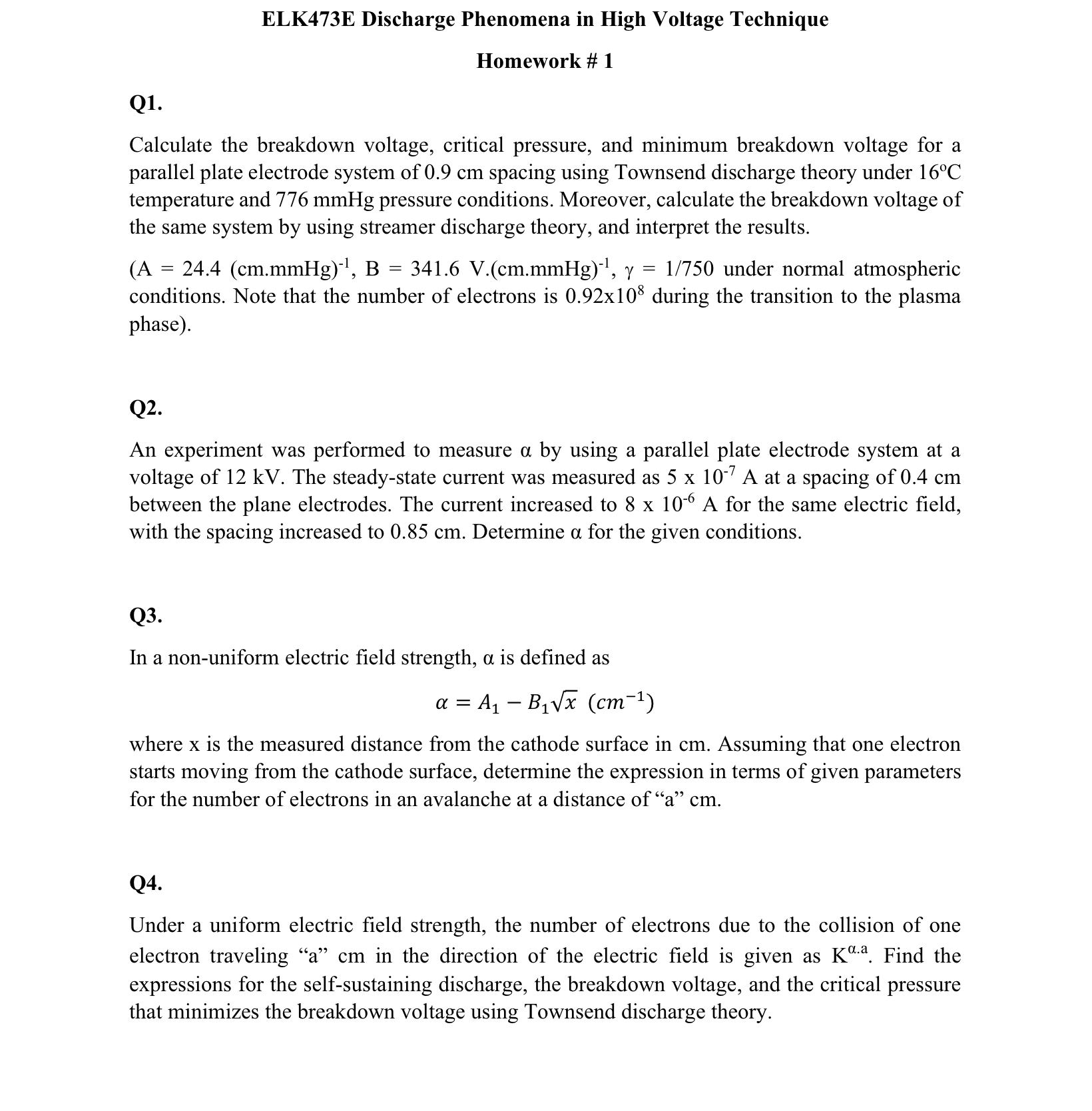
Question: ELK 4 7 3 E Discharge Phenomena in High Voltage Technique Homework # 1 Q 1 . Calculate the breakdown voltage, critical pressure, and minimum
ELKE Discharge Phenomena in High Voltage Technique
Homework #
Q
Calculate the breakdown voltage, critical pressure, and minimum breakdown voltage for a parallel plate electrode system of cm spacing using Townsend discharge theory under temperature and mmHg pressure conditions. Moreover, calculate the breakdown voltage of the same system by using streamer discharge theory, and interpret the results.
under normal atmospheric conditions. Note that the number of electrons is during the transition to the plasma phase
Q
An experiment was performed to measure by using a parallel plate electrode system at a voltage of kV The steadystate current was measured as at a spacing of cm between the plane electrodes. The current increased to A for the same electric field, with the spacing increased to cm Determine for the given conditions.
Q
In a nonuniform electric field strength, is defined as
where x is the measured distance from the cathode surface in cm Assuming that one electron starts moving from the cathode surface, determine the expression in terms of given parameters for the number of electrons in an avalanche at a distance of a cm
Q
Under a uniform electric field strength, the number of electrons due to the collision of one electron traveling a cm in the direction of the electric field is given as Find the expressions for the selfsustaining discharge, the breakdown voltage, and the critical pressure that minimizes the breakdown voltage using Townsend discharge theory.
Step by Step Solution
There are 3 Steps involved in it
1 Expert Approved Answer
Step: 1 Unlock

Question Has Been Solved by an Expert!
Get step-by-step solutions from verified subject matter experts
Step: 2 Unlock
Step: 3 Unlock