







Question: EM A model for circuits Part 3: Multiple batteries TellUs On HOOMA HW-26 . Consider the circuit shown at right, which is a variant of
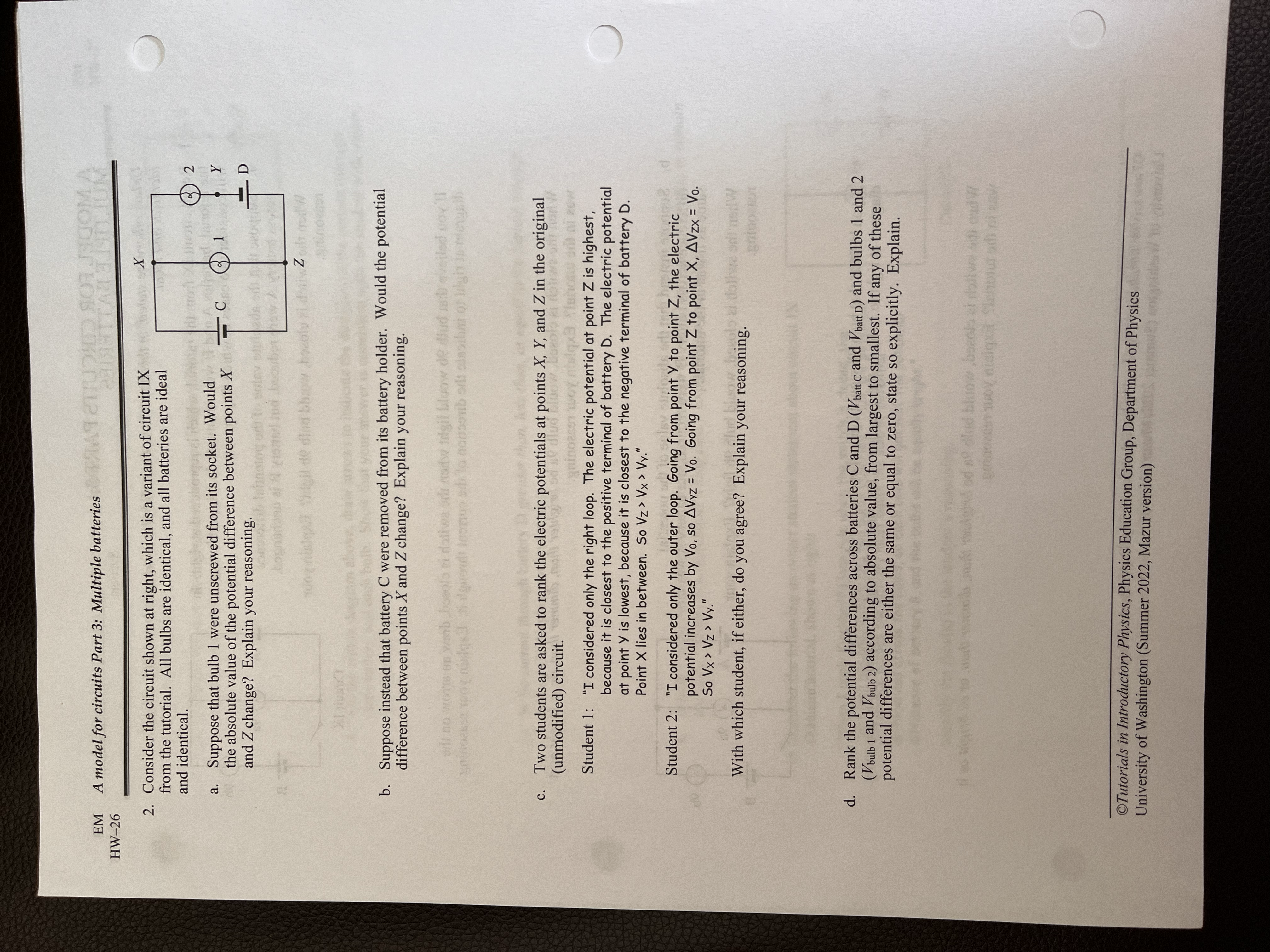
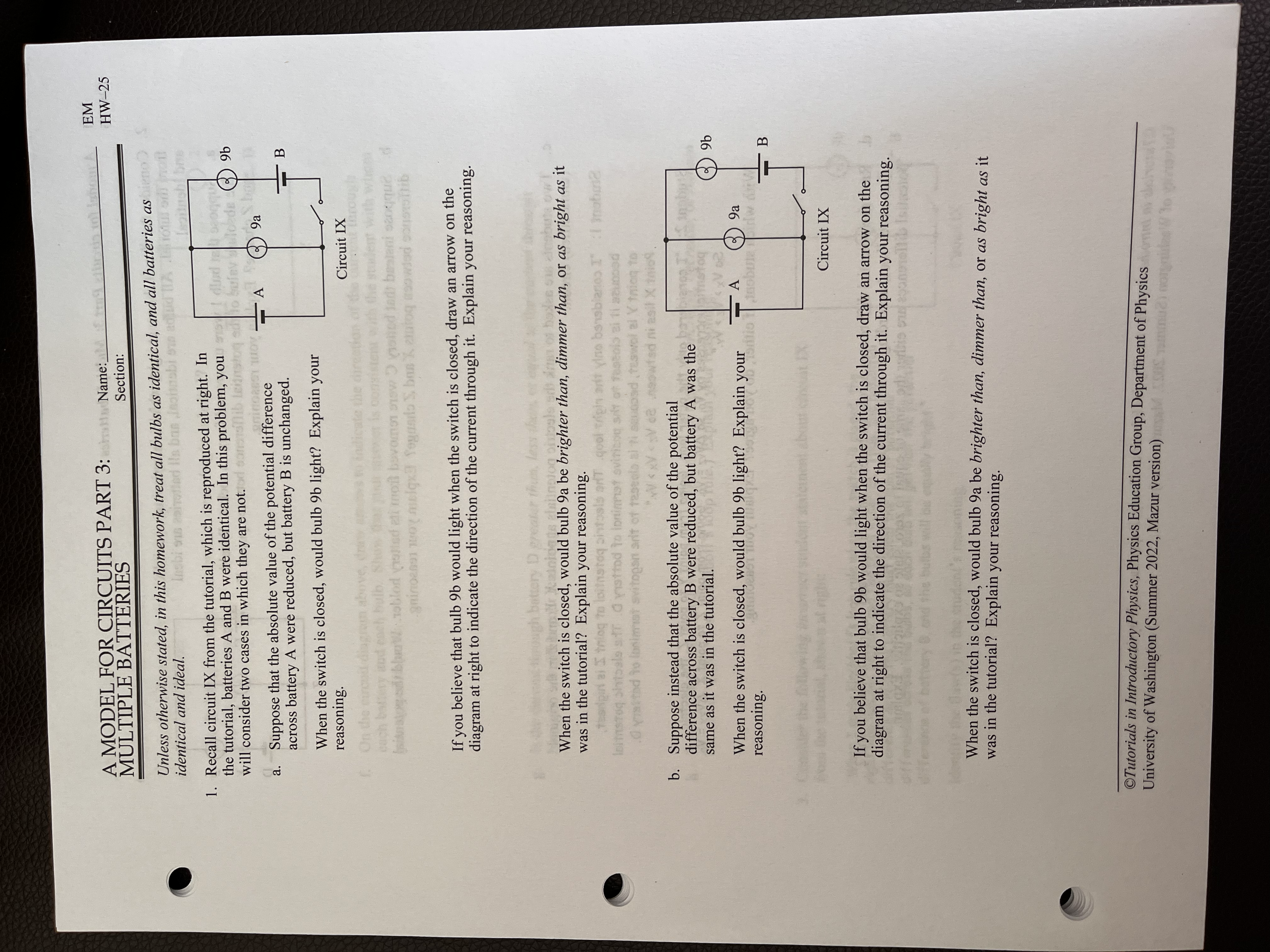
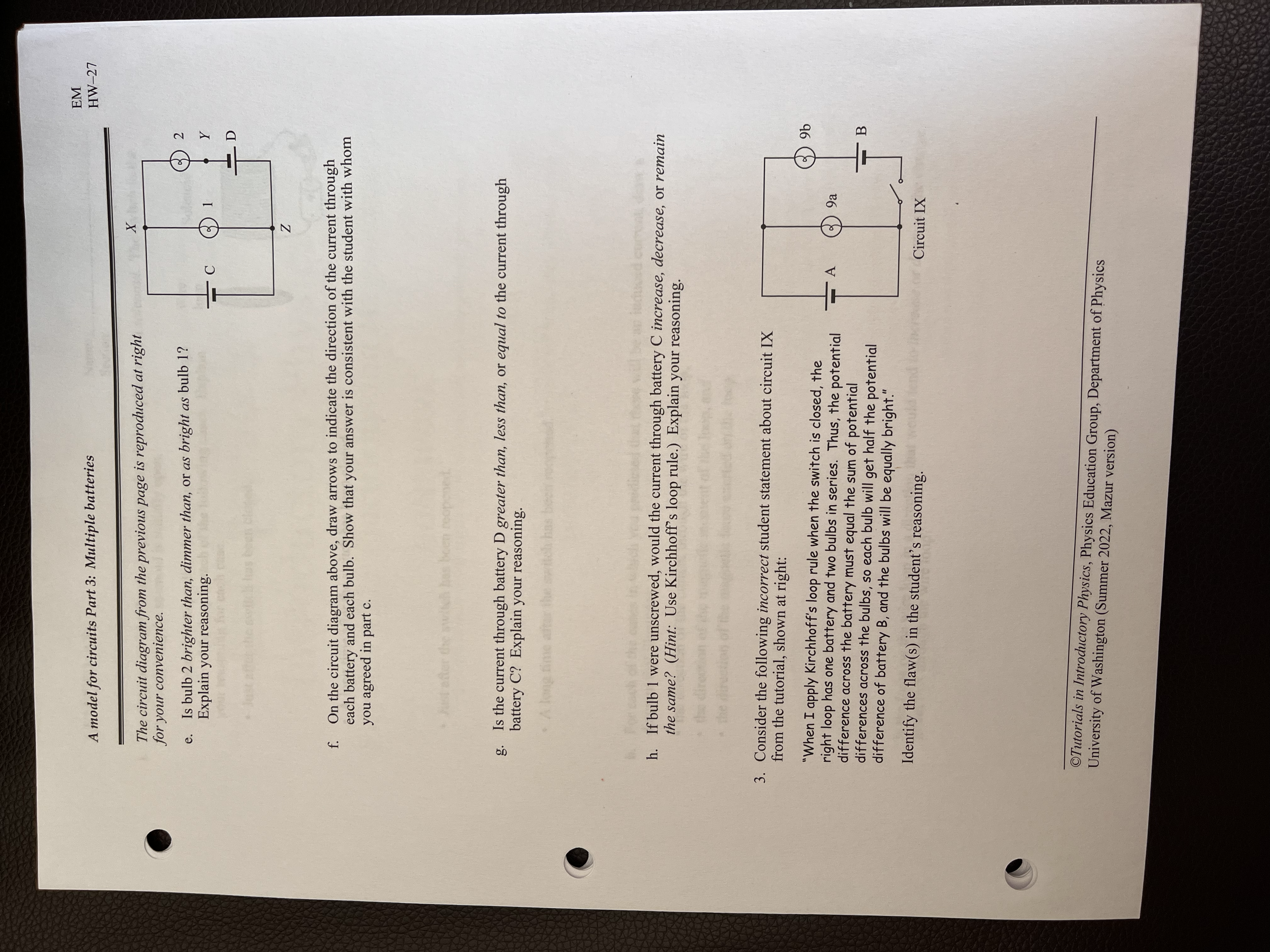
EM A model for circuits Part 3: Multiple batteries TellUs On HOOMA HW-26 . Consider the circuit shown at right, which is a variant of circuit IX from the tutorial. All bulbs are identical, and all batteries are ideal and identical. ( of ) N a. Suppose that bulb 1 were unscrewed from its socket. Would C ( of ) the absolute value of the potential difference between points X and Z change? Explain your reasoning. leinotor of to anlay off edn offl 10 Asgradon a d visited Jud beguber soy niagara Shagil de dind bhirow .boeolo zi dosi Suppose instead that battery C were removed from its battery holder. Would the potential difference between points X and Z change? Explain your reasoning. Sill no wortis on wirb beeolo gi oliwa ondi nodw frigil blow de did ward oveiled boy TI c. Two students are asked to rank the electric potentials at points X, Y, and Z in the original (unmodified) circuit. Student 1: "I considered only the right loop. The electric potential at point Z is highest, because it is closest to the positive terminal of battery D. The electric potential O at point y is lowest, because it is closest to the negative terminal of battery D. Point X lies in between. So Vz > Vx > Vy." Student 2: "I considered only the outer loop. Going from point Y to point Z, the electric potential increases by Vo, so AVyz = Vo. Going from point Z to point X, AVzx = Vo So Vx > Vz > Vy." With which student, if either, do you agree? Explain your reasoning. d. Rank the potential differences across batteries C and D (Wbatt c and batt D) and bulbs 1 and 2 (Vbulb 1 and Vbulb 2) according to absolute value, from largest to smallest. If any of these potential differences are either the same or equal to zero, state so explicitly. Explain. Tutorials in Introductory Physics, Physics Education Group, Department of Physics University of Washington (Summer 2022, Mazur version)A MODEL FOR CIRCUITS PART 3: Name: EM HW-25 MULTIPLE BATTERIES Section: Unless otherwise stated, in this homework, treat all bulbs as identical, and all batteries as identical and ideal. 1. Recall circuit IX from the tutorial, which is reproduced at right. In the tutorial, batteries A and B were identical. In this problem, you I durd se 9b will consider two cases in which they are not. oaust 1010 -A 9a a. Suppose that the absolute value of the potential difference across battery A were reduced, but battery B is unchanged. When the switch is closed, would bulb 9b light? Explain your reasoning Circuit IX each battery and each bulb, Shes of ent with wings .gninoansi mog melqx] Segundo S ban & amptog asowed songtofib If you believe that bulb 9b would light when the switch is closed, draw an arrow on the diagram at right to indicate the direction of the current through it. Explain your reasoning. When the switch is closed, would bulb 9a be brighter than, dimmer than, or as bright as it was in the tutorial? Explain your reasoning. gool thigh ant ylno borisblartoo I" :I Inobie Isfinsrog shisals aff G vistfed 10 loninst svirizog sly of festols ai fi seunged Gymited To lusimar svitopsn art of tassels al fi stunned , teawol al Y trion to V V ce .nowfed ni asif X trios Suppose instead that the absolute value of the potential difference across battery B were reduced, but battery A was the same as it was in the tutorial. 9b When the switch is closed, would bulb 9b light? Explain your A 9a reasoning. Circuit IX If you believe that bulb 9b would light when the switch is closed, draw an arrow on the diagram at right to indicate the direction of the current through it. Explain your reasoning. When the switch is closed, would bulb 9a be brighter than, dimmer than, or as bright as it was in the tutorial? Explain your reasoning. Tutorials in Introductory Physics, Physics Education Group, Department of Physics University of Washington (Summer 2022, Mazur version)EM A model for circuits Part 3: Multiple batteries HW-27 The circuit diagram from the previous page is reproduced at right for your convenience. . Is bulb 2 brighter than, dimmer than, or as bright as bulb 1? Explain your reasoning. - C ) 1 N On the circuit diagram above, draw arrows to indicate the direction of the current through each battery and each bulb. Show that your answer is consistent with the student with whom you agreed in part c. . Is the current through battery D greater than, less than, or equal to the current through battery C? Explain your reasoning. h. If bulb 1 were unscrewed, would the current through battery C increase, decrease, or remain the same? (Hint: Use Kirchhoff's loop rule.) Explain your reasoning. 3. Consider the following incorrect student statement about circuit IX from the tutorial, shown at right: 2 ) "When I apply Kirchhoff's loop rule when the switch is closed, the right loop has one battery and two bulbs in series. Thus, the potential - A () ya difference across the battery must equal the sum of potential differences across the bulbs, so each bulb will get half the potential difference of battery B, and the bulbs will be equally bright." Identify the flaw(s) in the student's reasoning. Circuit IX Tutorials in Introductory Physics, Physics Education Group, Department of Physics University of Washington (Summer 2022, Mazur version)
Step by Step Solution
There are 3 Steps involved in it

Get step-by-step solutions from verified subject matter experts
 Study Help