EMOTICON/EMOJI USE EXAMPLE:
Your project team has just been reprimanded by the boss for
missing a deadline. Your colleagues left the meeting grumbling
about being criticized in public after working nights and week-
ends, and you fear that morale will slip.
You could craft an inspirational message to soothe the
bruised egos and get the team's energy turned around in
positive direction. However, writing such a message could be
risky because world-weary teammates might just brush it off
as *happytalk" and resent you for trying to be a cheerlcader:
Alternatively, you could suggest that your colleagues
lighten up and stay focused on the ultimate goal of the proj-
ct. However, you already know char telling grumpy people ro
cheer up is a surefire way to make most of them even grumpier
Instead, you opt for a quick bit of gentle sarcasm
designed to help release the negative emotions in a collegial
way When you ger back to your desk, you write the following
instant message
Well, let's pick up the pleces of our shattered ives
and move on -/
'The over-the top phrasing is a subtle way to remind excryon
that the criticism wasn't all that traumatic, and that wink.
ing emoticon tells everyone to lighten up without actually
saying so- The apparent sarcasm connects with people who
are marinating in their negative emotions, but it's really a pep
talk disguised as sarcasm.
Then you worry that the emoticon will seem unprotes-
sional, so you replace it with a simple period:
Well, let's pick up the pieces of our shattered lives
and move on.
Oops. That one minor change to make the message more pro-
fessional turned it into a statement of resigned sadness. You
search your keyboard for any acceptable symbol that might
heip:
Well, let's pick up the pieces of our shattered lives
ano move ont
Great, now you've managed ro sound bitter and demanding
at the same time.
Given the difficulry of communicating emotional nuance
in lean media such as messaging and email, are emoticons
really all that bad? The answer depends on the situation, your
relationship with your audience, and the company culture.
Until emoticons become more widely accepted in business
communication, it's wise to err on the side of caution.
CAREER APPLICATIONS
: As a manager, what reaction would you have to job appli-
cants who use cmoticons in their email messages?
-Are emoticons just a generational difference in perspec-
tive, or is there more to the issuc? Explain your answer,
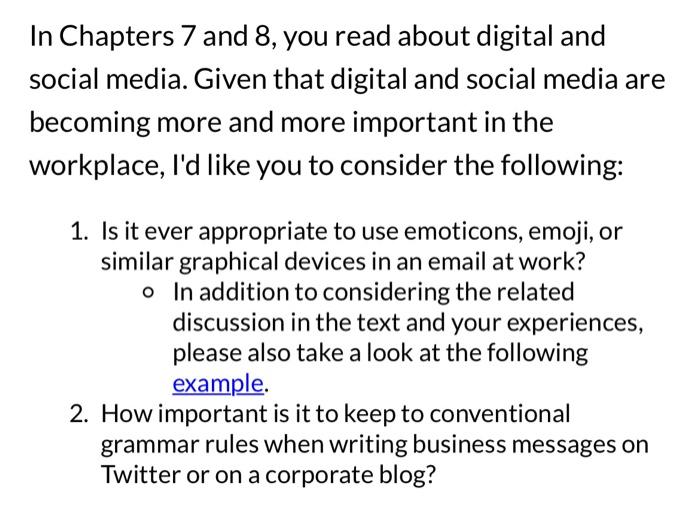
n Chapters 7 and 8 , you read about digital and ocial media. Given that digital and social media are ecoming more and more important in the vorkplace, I'd like you to consider the following: 1. Is it ever appropriate to use emoticons, emoji, or similar graphical devices in an email at work? - In addition to considering the related discussion in the text and your experiences, please also take a look at the following example. 2. How important is it to keep to conventional grammar rules when writing business messages on Twitter or on a corporate blog? n Chapters 7 and 8 , you read about digital and ocial media. Given that digital and social media are ecoming more and more important in the vorkplace, I'd like you to consider the following: 1. Is it ever appropriate to use emoticons, emoji, or similar graphical devices in an email at work? - In addition to considering the related discussion in the text and your experiences, please also take a look at the following example. 2. How important is it to keep to conventional grammar rules when writing business messages on Twitter or on a corporate blog