







Question: Endogenous Technical Change 1. Consider a two-sector (REaD) growth model similar to the one discussed in class . Let L be the size of the
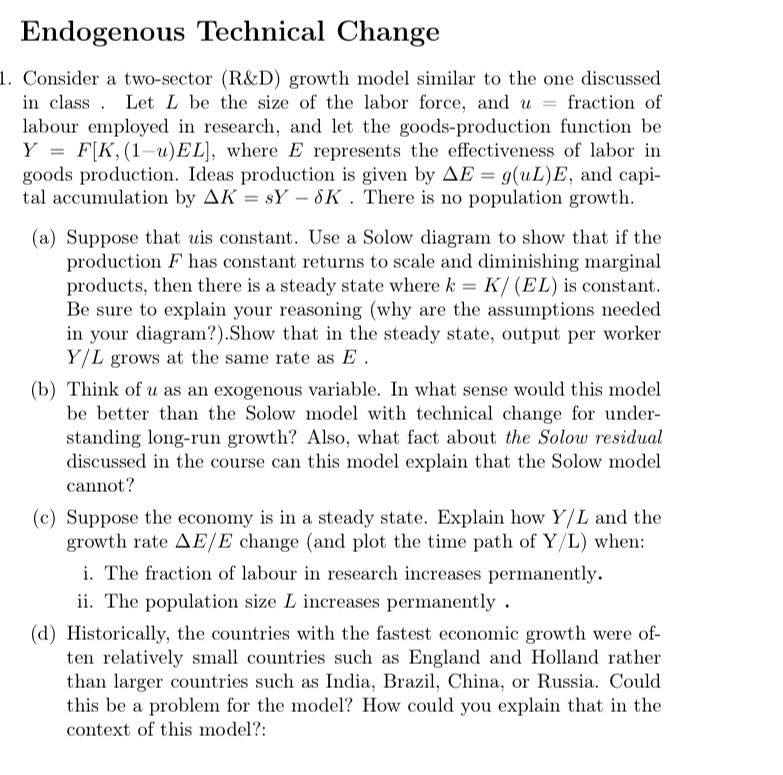
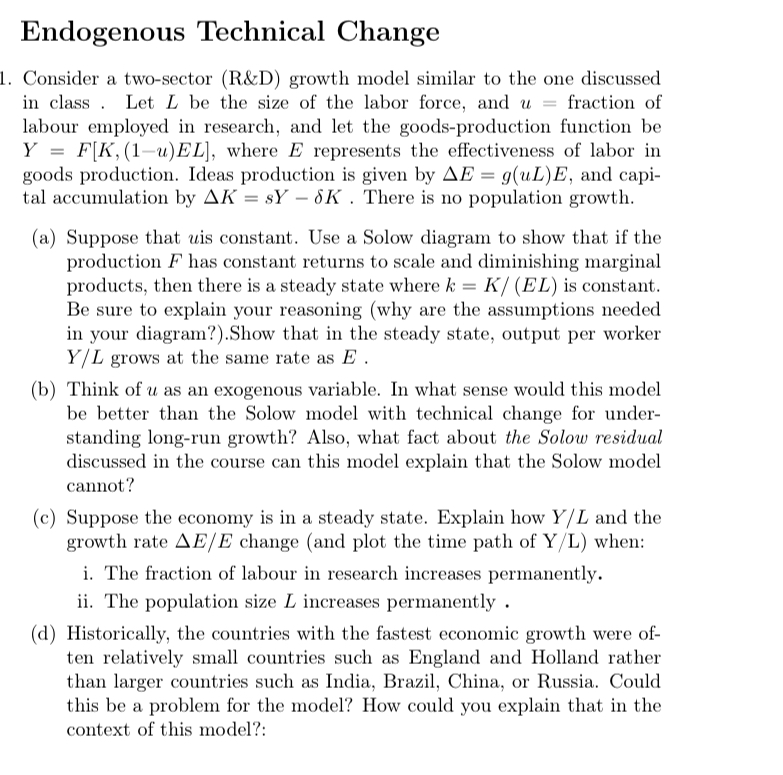
Endogenous Technical Change 1. Consider a two-sector (REaD) growth model similar to the one discussed in class . Let L be the size of the labor force, and a - fraction of labour employed in research, and let the goods-production function be Y = F[K,{1a)EL], where E represents the effectiveness of labor in goods production. Ideas production is given by LEE = g(aL)E, and capi- tal accumulation by riff = 31/ 6K . There is no population growth. (a) (b) {C} (01} Suppose that uis constant. Use a Solow diagram to show that if the production F has constant returns to scale and diminishing marginal products, then there is a steady state where k = Kf {EL} is constant. Be sure to explain your reasoning {why are the assumptions needed in your diagram'?).Show that in the steady state, output per worker YfL grows at the same rate as E . Think of a as an exogenous variable. In what sense would this model be better than the Solow model with teclmical change for under- standing long-run growth?I Also, what fact about the Salem residual discussed in the course can this model explain that the Solow model cannot? Suppose the economy is in a steady state. Explain how Y/L and the growth rate rhE/E change (and plot the time path of Y ,1\" L) when: i. The fraction of labour in research increases permanently. ii. The population size L increases permanently . Historically, the countries with the fastest economic growth were of- ten relatively small countries such as England and Holland rather than larger countries such as India, Brazil, China, or Russia. Could this be a problem for the model's1 How could you explain that in the context of this model'l
Step by Step Solution
There are 3 Steps involved in it

Get step-by-step solutions from verified subject matter experts
 Study Help