







Question: Engineering Intern Training Agritech's engineering intern training manager must decide how to best train the new interns to satisfy the requirements for skilled recruits at
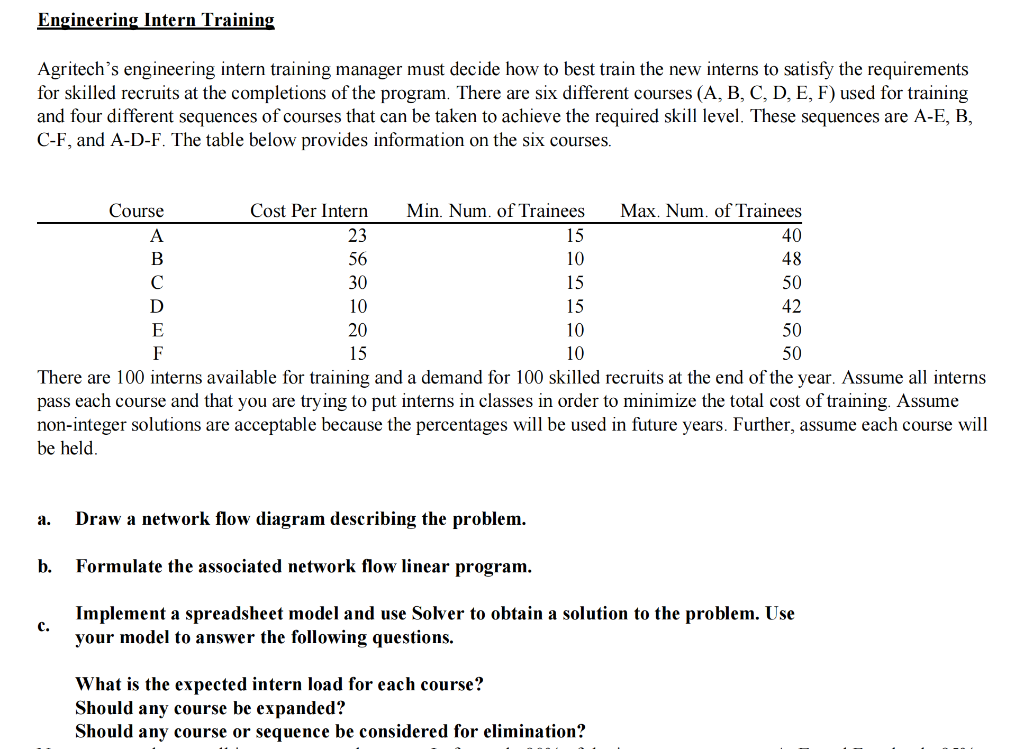
Engineering Intern Training Agritech's engineering intern training manager must decide how to best train the new interns to satisfy the requirements for skilled recruits at the completions of the program. There are six different courses (A, B, C, D, E, F) used for training and four different sequences of courses that can be taken to achieve the required skill level. These sequences are A-E, B, C-F, and A-D-F. The table below provides information on the six courses. Cost Per Intern Min. Num. of Trainees Max. Num. of Trainees Course A 23 15 40 B 56 10 48 30 15 50 D 10 15 42 E 20 10 50 F 15 10 50 There are 100 interns available for training and a demand for 100 skilled recruits at the end of the year. Assume all interns pass each course and that you are trying to put interns in classes in order to minimize the total cost of training. Assume non-integer solutions are acceptable because the percentages will be used in future years. Further, assume each course will be held. a. Draw a network flow diagram describing the problem. b. Formulate the associated network flow linear program. C. Implement a spreadsheet model and use Solver to obtain a solution to the problem. Use your model to answer the following questions. What is the expected intern load for each course? Should any course be expanded? Should any course or sequence be considered for elimination? Engineering Intern Training Agritech's engineering intern training manager must decide how to best train the new interns to satisfy the requirements for skilled recruits at the completions of the program. There are six different courses (A, B, C, D, E, F) used for training and four different sequences of courses that can be taken to achieve the required skill level. These sequences are A-E, B, C-F, and A-D-F. The table below provides information on the six courses. Cost Per Intern Min. Num. of Trainees Max. Num. of Trainees Course A 23 15 40 B 56 10 48 30 15 50 D 10 15 42 E 20 10 50 F 15 10 50 There are 100 interns available for training and a demand for 100 skilled recruits at the end of the year. Assume all interns pass each course and that you are trying to put interns in classes in order to minimize the total cost of training. Assume non-integer solutions are acceptable because the percentages will be used in future years. Further, assume each course will be held. a. Draw a network flow diagram describing the problem. b. Formulate the associated network flow linear program. C. Implement a spreadsheet model and use Solver to obtain a solution to the problem. Use your model to answer the following questions. What is the expected intern load for each course? Should any course be expanded? Should any course or sequence be considered for elimination
Step by Step Solution
There are 3 Steps involved in it

Get step-by-step solutions from verified subject matter experts
 Study Help