







Question: Enhancing Sales Performance Through Data Visualization Company Background: Industry: Retail Company: Stellar Electronics, a mid - sized electronics retailer with stores across the US Challenge:
Enhancing Sales Performance Through Data Visualization
Company Background:
Industry: Retail
Company: Stellar Electronics, a midsized electronics retailer with stores across the US
Challenge: Declining sales and profitability in certain regions despite an overall growing market.
Problem Statement:
Stellar Electronics noticed a downward trend in sales in specific regions, but the exact causes were unclear. The company's leadership suspected a combination of poor marketing effectiveness, inventory management issues, and regional economic factors. However, without clear insights, they struggled to make datadriven decisions.
Objective:
The goal was to identify the root causes of the sales decline and implement corrective actions by leveraging data visualization tools to analyze and communicate complex data effectively.
What insights did the visualizations reveal about the root causes of the sales decline?
Identify the specific issues uncovered through the data visualizations.
How did these insights lead to actionable strategies for the company?
Discuss how the visualized data guided the company's decisionmaking process.
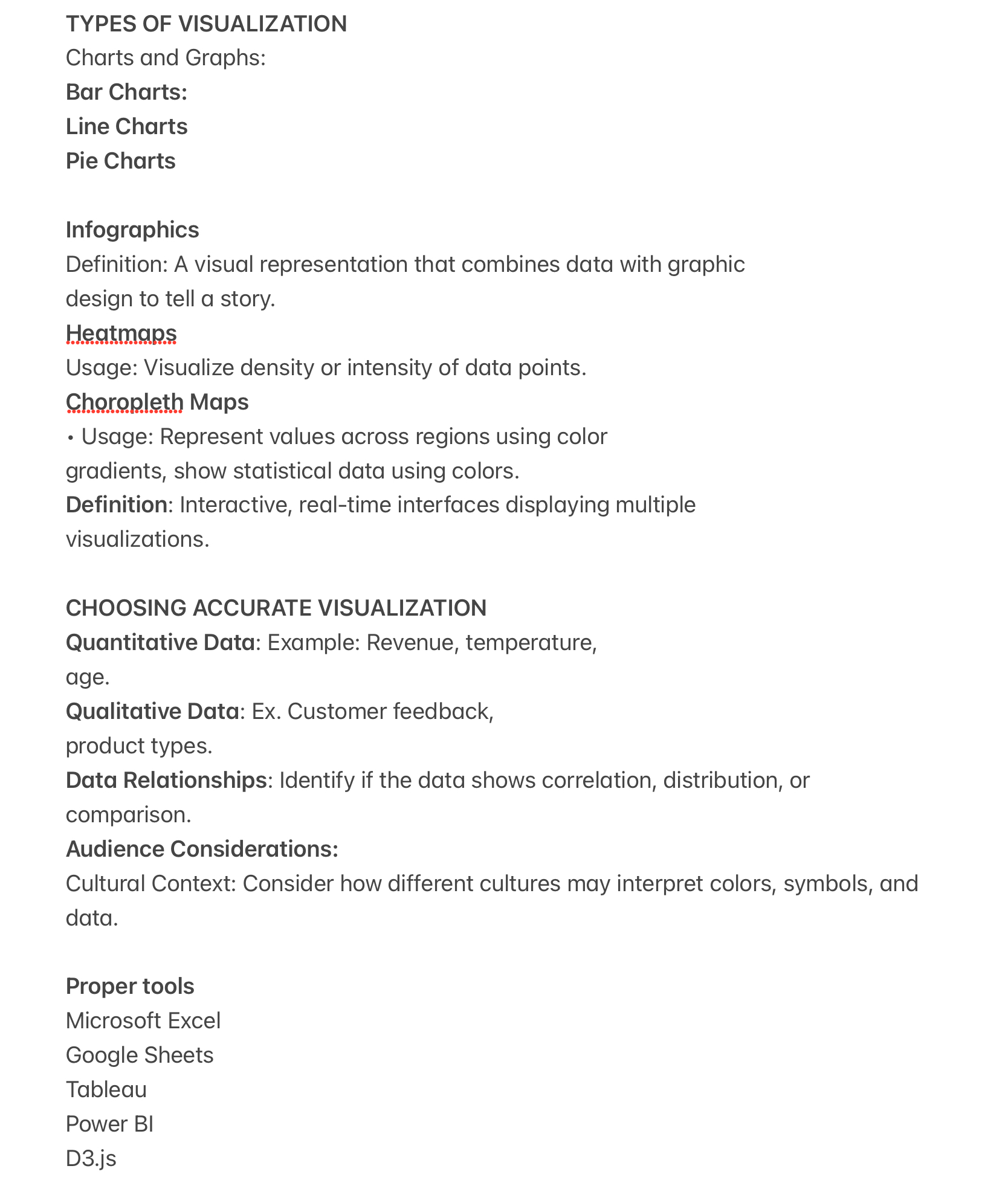
Please answer not directly not generalize, look to the picture attach for reference ty
TYPES OF VISUALIZATION
Charts and Graphs:
Bar Charts:
Line Charts
Pie Charts
Infographics
Definition: A visual representation that combines data with graphic
design to tell a story.
Heatmaps
Usage: Visualize density or intensity of data points.
Choropleteth Maps
Usage: Represent values across regions using color
gradients, show statistical data using colors.
Definition: Interactive, realtime interfaces displaying multiple
visualizations.
CHOOSING ACCURATE VISUALIZATION
Quantitative Data: Example: Revenue, temperature,
age.
Qualitative Data: Ex Customer feedback,
product types.
Data Relationships: Identify if the data shows correlation, distribution, or
comparison.
Audience Considerations:
Cultural Context: Consider how different cultures may interpret colors, symbols, and
data.
Proper tools
Microsoft Excel
Google Sheets
Tableau
Power BI
Djs
Step by Step Solution
There are 3 Steps involved in it
1 Expert Approved Answer
Step: 1 Unlock

Question Has Been Solved by an Expert!
Get step-by-step solutions from verified subject matter experts
Step: 2 Unlock
Step: 3 Unlock
 Study Help