







Question: Entity Weak Entity Rolationship Indentifying Rolnionship Attribune Key Attribute Multiwed Abu os Composite Attribute Dorivod Anybuto E Tot Persation of ER N E. E Cardinalty
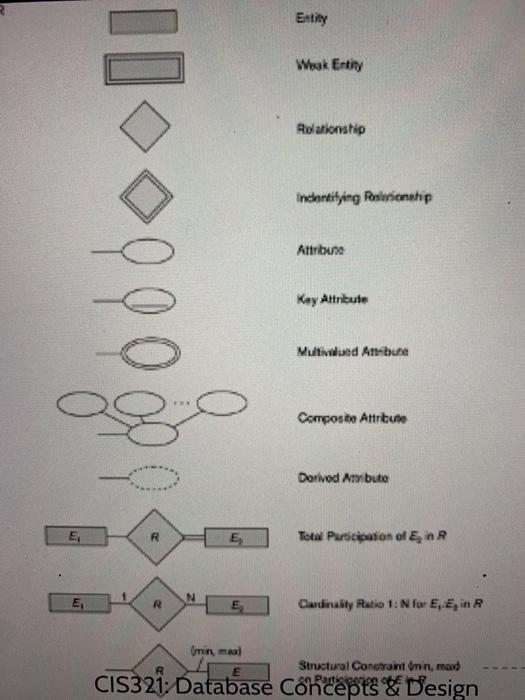
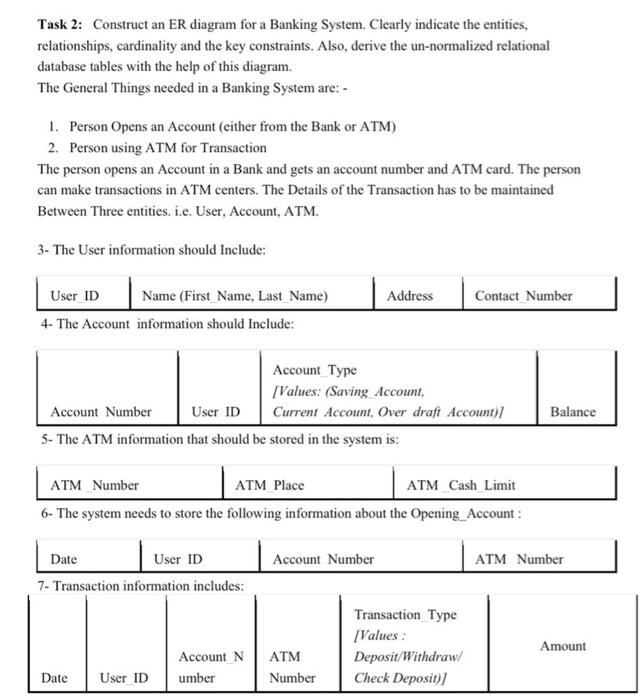
Entity Weak Entity Rolationship Indentifying Rolnionship Attribune Key Attribute Multiwed Abu os Composite Attribute Dorivod Anybuto E Tot Persation of ER N E. E Cardinalty Ratio 1: Nia EE in R minmaal E Structural Contraint onn, maxd CIS321: Database Concepts & Design Task 2: Construct an ER diagram for a Banking System. Clearly indicate the entities, relationships, cardinality and the key constraints. Also, derive the un-normalized relational database tables with the help of this diagram. The General Things needed in a Banking System are: - 1. Person Opens an Account (either from the Bank or ATM) 2. Person using ATM for Transaction The person opens an Account in a Bank and gets an account number and ATM card. The person can make transactions in ATM centers. The Details of the Transaction has to be maintained Between Three entities. i.e. User, Account, ATM. 3- The User information should Include: Address Contact Number User ID Name (First Name, Last Name) 4- The Account information should Include: Balance Account Type (Values: (Saving Account, Account Number User ID Current Account, Over draft Account) 5- The ATM information that should be stored in the system is: ATM Number 1 ATM Place ATM Cash Limit 6- The system needs to store the following information about the Opening_Account: Account Number ATM Number Date User ID 7- Transaction information includes: Transaction Type [Values: Deposit/Withdraw Check Deposit) Amount Account N ATM Number Date User ID umber
Step by Step Solution
There are 3 Steps involved in it

Get step-by-step solutions from verified subject matter experts
 Study Help