







Question: We want to develop the relational database schema based on a below EER-Diagram for an UNIVERSITY database. First, answer to the following small problems to
We want to develop the relational database schema based on a below EER-Diagram for an UNIVERSITY database.
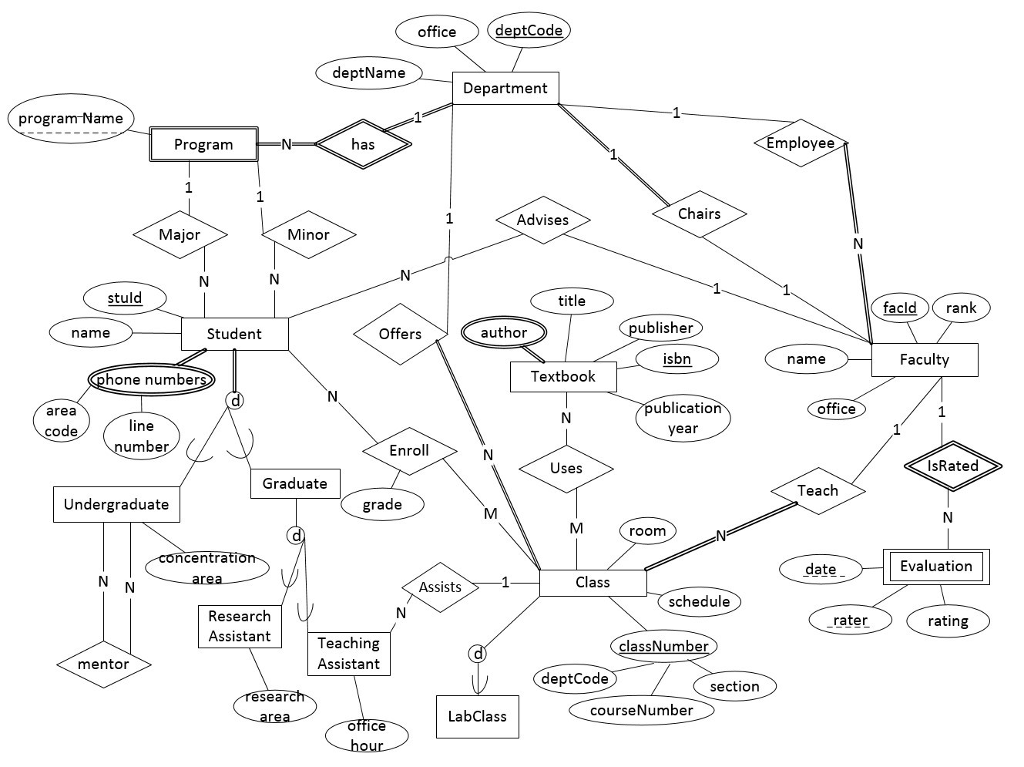
First, answer to the following small problems to understand the basic mapping rules.
NOTE: 1) Each relation sachem should have a primary key (PK) when you answer.
If available, denote a possible foreign key(s) (e.g., FK, FK1, K2).
To present the reference table of the foreign key, use an arrow.
It is not required to specify the domain constraint (e.g., data type and length) of each attribute.
(Composite Attribute) Show the CLASS relation schema with classNumber(deptCode, courseNumber, section), room and schedule attributes. Do not need to include the relationship context relevant to the Class entity.
(Multi-valued Attribute) Show the TEXTBOOK relation schema and its relevant relation schema with title, publisher, isbn, publication year, and author. Notice that author is not a simple, single attribute. Do not need to include the relationship context relevant to the Textbook entity.
(Weak Entity) Show the FACULTY relation with facId, rank, name, and office attributes, and the EVALUATION relation with the evaluation entity attributes and a possible key attribute (PK).
(Weak Entity) Show relation schemas which implement the PROGRAM and DEPARTMENT
entity types. Do not need to include other relationships in the two entities except has relationship.
(Complex Attribute) Show relation schemas which implement the STUDENT relation with stuId, name, and phone numbers attributes, and major and minor relationships.
(Sub Entity Type) Show the STUDENT relation with stuId, name, and credits,
UNDERGRADUATE and GRADUATE relations, and further, relations for sub entity types of
Graduate, i.e., Research Assistant and Teaching Assistant. Do not need to include other relationship context relevant to those entities, e.g., Assists relationship between Teaching Assistant and Class entities.
(Unary Relationship) Show relation schemas which implement the mentor relationship in Undergraduate entity.
(1:N Relationship) Show the relation schemas for Department entity with deptName, office and deptCode attributes, Faculty with facId, rank, lastName, firstName and office attributes, and Employee relationship. Also present the total(mandatory) participation (i.e., min cardinality = 1) constraint with NOT NULL option. Do not need to include other relationship context relevant to Department and Employee.
(1:1 Relationship) Show the relation schemas related to the chair relationship between Department and Faculty.
(N:M Relationship) Show the relation schemas for Student entity with stuId, lastName, firstName and credits attributes, Class with classNumber(deptCode, courseNumber, section), room and schedule attributes, and Enroll relationship with grade attribute. Do not need to include other relationship context relevant to Student and Class.
Finally, develop the entire relational database schema for the UNIVERSITY database. Give proper names for relations and attributes. Clearly specify the primary key (PK) of each relation, and foreign keys (e.g., FK, FK1, K2) if available. To present the reference table of a foreign key, use an arrow. It is not required to specify the domain constraint (e.g., data type and length) per attribute.
office deptName Department program Name Program has mployee Chairs Advises Major Minor stuld title facld( rank Student Offers author ublisher name isbn name Faculty hone number Textbook ublicatio office area line code year umber Enroll Uses IsRated Graduate Teach Undergraduate grade room ncentrati date Evaluation Class Assists schedule Research Assistant rater rating Teaching Assistant classNumber mentor deptCode section esear courseNumber LabClass office
Step by Step Solution
There are 3 Steps involved in it

Get step-by-step solutions from verified subject matter experts
 Study Help