



Question: Entries for Bed Debt Expense under the Direct Write-Off and Allowance Methods The following selected transactions were taken from the records of Shipway Company for
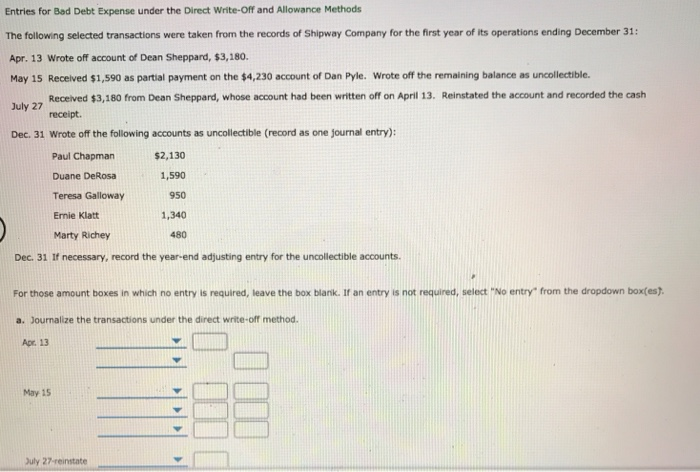
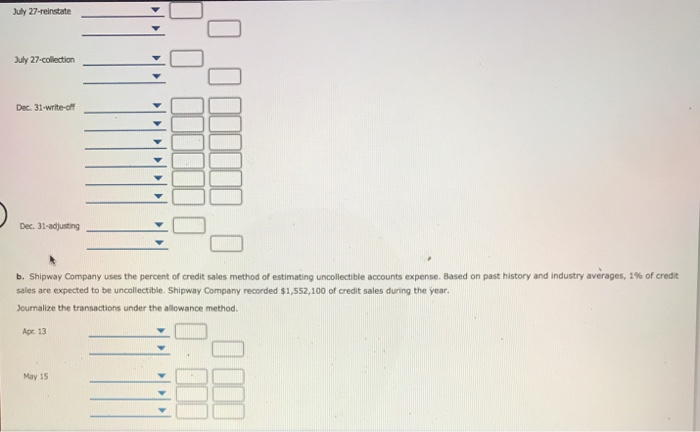
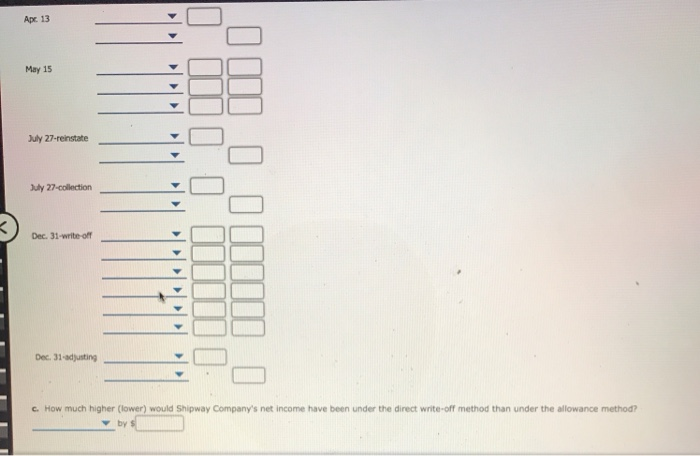
Entries for Bed Debt Expense under the Direct Write-Off and Allowance Methods The following selected transactions were taken from the records of Shipway Company for the first year of its operations ending December 31: Apr. 13 Wrote off account of Dean Sheppard, $3,180. May 15 Received $1,590 as partial payment on the $4,230 account of Dan Pyle. Wrote off the remaining balance as uncollectible. Received $3,180 from Dean Sheppard, whose account had been written off on April 13. Reinstated the account and recorded the cash July 27 receipt. Dec 31 Wrote off the following accounts as uncollectible (record as one journal entry) Paul Chapman $2,130 Duane DeRosa 1,590 Teresa Galloway 950 Ernie Klatt 1,340 Marty Richey 480 Dec. 31 If necessary, record the year-end adjusting entry for the uncollectible accounts. For those amount boxes in which no entry is required, leave the box blank. If an entry is not required, select "No entry from the dropdown box(es). a. Journalize the transactions under the direct write-off method. Apr. 13 May 15 July 27-reinstate July 27-reinstate July 27-collection Dec. 31-write-off mil. I O Dec. 31-adjusting b. Shipway Company uses the percent of credit sales method of estimating uncollectible accounts expense. Based on past history and industry averages, 1% of credit sales are expected to be uncollectible. Shipway Company recorded $1,552,100 of credit sales during the year. Journalize the transactions under the allowance method. May 15 Apr 13 May 15 July 27-reinstate July 27-collection DO O DI I Om 1l Dec. 31-write-off Dec. 31-adjusting c. How much higher (lower) would Shipway Company's net income have been under the direct write-off method than under the allowance method
Step by Step Solution
There are 3 Steps involved in it

Get step-by-step solutions from verified subject matter experts