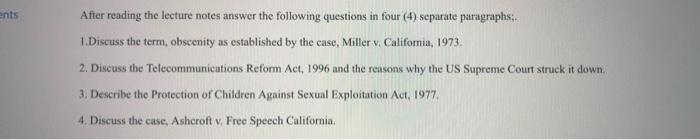
Question: ents After reading the lecture notes answer the following questions in four (4) separate paragraphs: 1. Discuss the term, obscenity as established by the case,
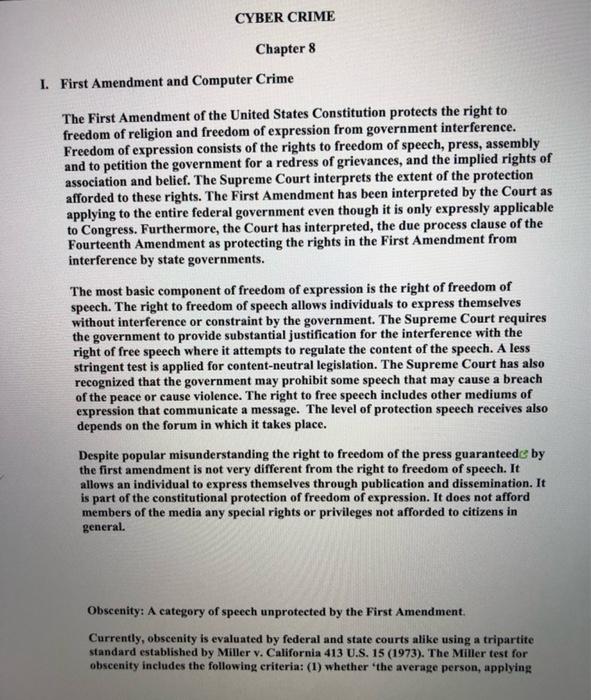
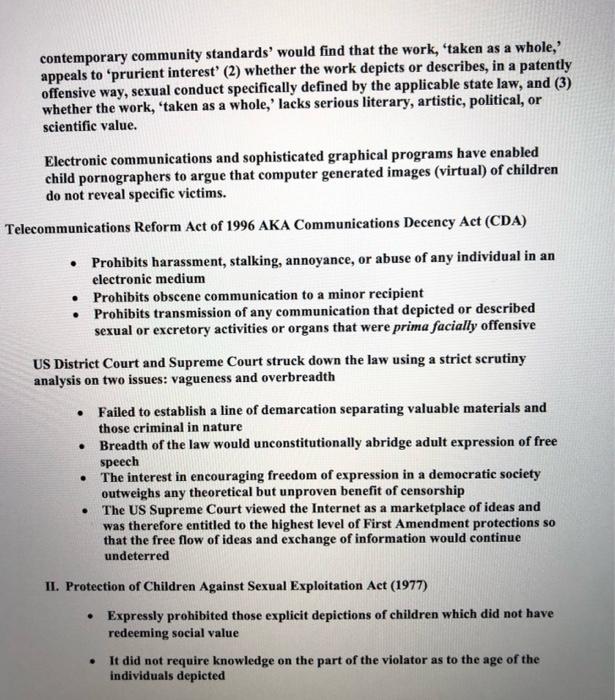
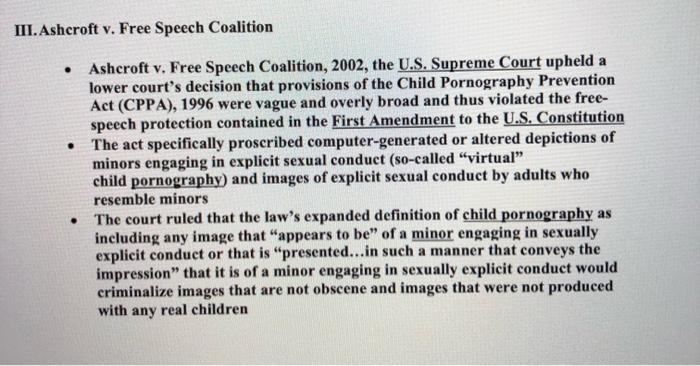
ents After reading the lecture notes answer the following questions in four (4) separate paragraphs: 1. Discuss the term, obscenity as established by the case, Miller v. Califomia, 1973. 2. Discuss the Telecommunications Reform Act, 1996 and the reasons why the US Supreme Court struck it down 3. Describe the Protection of Children Against Sexual Exploitation Act, 1977. 4. Discuss the case, Ashcroft v. Free Speech California. CYBER CRIME Chapter 8 I. First Amendment and Computer Crime The First Amendment of the United States Constitution protects the right to freedom of religion and freedom of expression from government interference. Freedom of expression consists of the rights to freedom of speech, press, assembly and to petition the government for a redress of grievances, and the implied rights of association and belief. The Supreme Court interprets the extent of the protection afforded to these rights. The First Amendment has been interpreted by the Court as applying to the entire federal government even though it is only expressly applicable to Congress. Furthermore, the Court has interpreted, the due process clause of the Fourteenth Amendment as protecting the rights in the First Amendment from interference by state governments. The most basic component of freedom of expression is the right of freedom of speech. The right to freedom of speech allows individuals to express themselves without interference or constraint by the government. The Supreme Court requires the government to provide substantial justification for the interference with the right of free speech where it attempts to regulate the content of the speech. A less stringent test is applied for content-neutral legislation. The Supreme Court has also recognized that the government may prohibit some speech that may cause a breach of the peace or cause violence. The right to free speech includes other mediums of expression that communicate a message. The level of protection speech receives also depends on the forum in which it takes place. Despite popular misunderstanding the right to freedom of the press guaranteedc by the first amendment is not very different from the right to freedom of speech. It allows an individual to express themselves through publication and dissemination. It is part of the constitutional protection of freedom of expression. It does not afford members of the media any special rights or privileges not afforded to citizens in general. Obscenity: A category of speech unprotected by the First Amendment. Currently, obscenity is evaluated by federal and state courts alike using a tripartite standard established by Miller v. California 413 U.S. 15 (1973). The Miller test for obscenity includes the following criteria: (1) whether the average person, applying contemporary community standards' would find that the work, 'taken as a whole, appeals to 'prurient interest' (2) whether the work depicts or describes, in a patently offensive way, sexual conduct specifically defined by the applicable state law, and (3) whether the work, 'taken as a whole,' lacks serious literary, artistic, political, or scientific value. Electronic communications and sophisticated graphical programs have enabled child pornographers to argue that computer generated images (virtual) of children do not reveal specific victims. Telecommunications Reform Act of 1996 AKA Communications Decency Act (CDA) Prohibits harassment, stalking, annoyance, or abuse of any individual in an electronic medium Prohibits obscene communication to a minor recipient Prohibits transmission of any communication that depicted or described sexual or excretory activities or organs that were prima facially offensive US District Court and Supreme Court struck down the law using a strict scrutiny analysis on two issues: vagueness and overbreadth . . Failed to establish a line of demarcation separating valuable materials and those criminal in nature Breadth of the law would unconstitutionally abridge adult expression of free speech The interest in encouraging freedom of expression in a democratic society outweighs any theoretical but unproven benefit of censorship The US Supreme Court viewed the Internet as a marketplace of ideas and was therefore entitled to the highest level of First Amendment protections so that the free flow of ideas and exchange of information would continue undeterred . II. Protection of Children Against Sexual Exploitation Act (1977) Expressly prohibited those explicit depictions of children which did not have redeeming social value . It did not require knowledge on the part of the violator as to the age of the individuals depicted III. Ashcroft v. Free Speech Coalition Ashcroft v. Free Speech Coalition, 2002, the U.S. Supreme Court upheld a lower court's decision that provisions of the Child Pornography Prevention Act (CPPA), 1996 were vague and overly broad and thus violated the free- speech protection contained in the First Amendment to the U.S. Constitution The act specifically proscribed computer-generated or altered depictions of minors engaging in explicit sexual conduct (so-called "virtual" child pornography) and images of explicit sexual conduct by adults who resemble minors The court ruled that the law's expanded definition of child pornography as including any image that appears to be" of a minor engaging in sexually explicit conduct or that is presented...in such a manner that conveys the impression" that it is of a minor engaging in sexually explicit conduct would criminalize images that are not obscene and images that were not produced with any real children