Question: Eric Christopher, Associate Director for Global HR De- velopment at Tex-Mark, was sitting in his car in an early-morning traffic jam. He had thought that
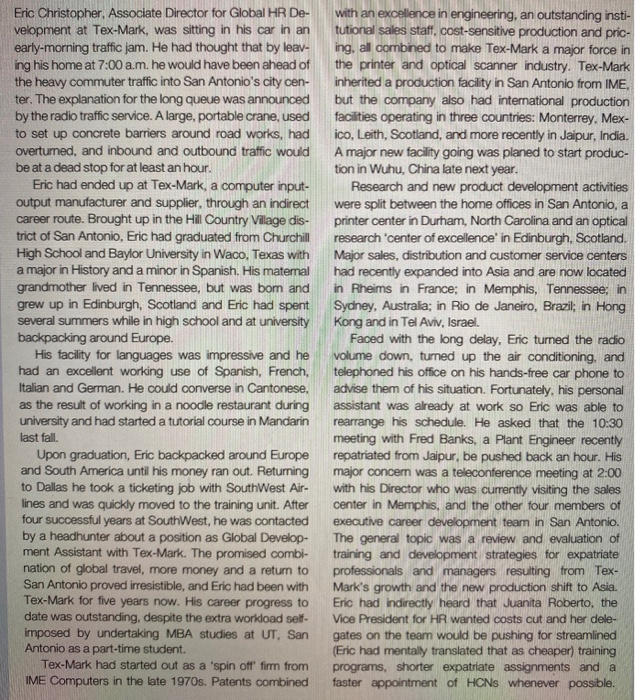
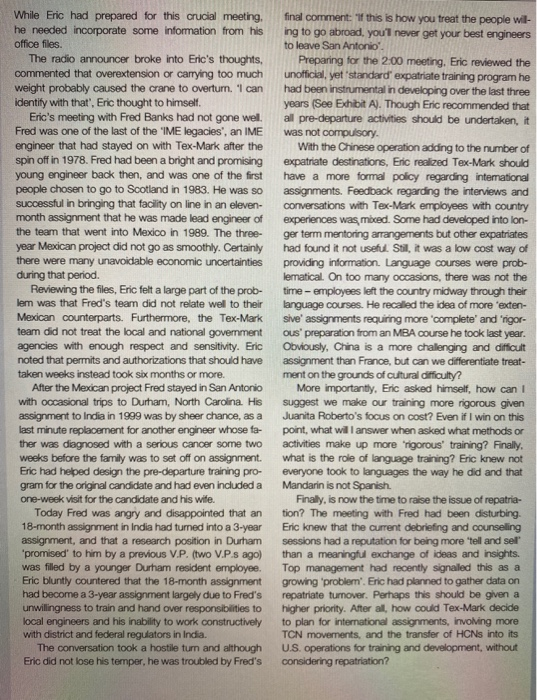
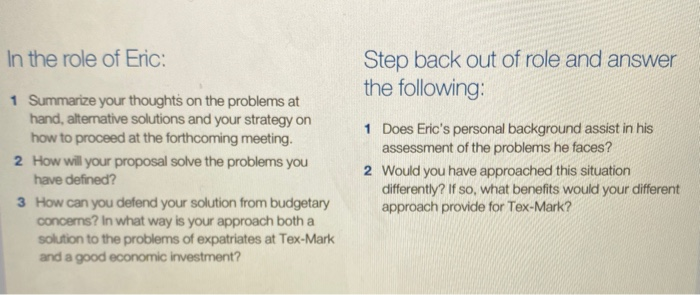
Eric Christopher, Associate Director for Global HR De- velopment at Tex-Mark, was sitting in his car in an early-morning traffic jam. He had thought that by leav- ing his home at 7:00 a.m. he would have been ahead of the heavy commuter traffic into San Antonio's city cen- ter. The explanation for the long queue was announced by the radio traffic service. A large, portable crane, used to set up concrete barriers around road works, had overtured, and inbound and outbound traffic would be at a dead stop for at least an hour. Eric had ended up at Tex-Mark, a computer input- output manufacturer and supplier, through an indirect career route. Brought up in the Hill Country Village dis- trict of San Antonio, Eric had graduated from Churchill High School and Baylor University in Waco, Texas with a major in History and a minor in Spanish. His maternal grandmother lived in Tennessee, but was bom and grew up in Edinburgh, Scotland and Eric had spent several summers while in high school and at university backpacking around Europe. His facility for languages was impressive and he had an excellent working use of Spanish, French, Italian and German. He could converse in Cantonese, as the result of working in a noodle restaurant during university and had started a tutorial course in Mandarin last fall Upon graduation, Eric backpacked around Europe and South America until his money ran out. Returning to Dallas he took a ticketing job with Southwest Air- lines and was quickly moved to the training unit. After four successful years at SouthWest, he was contacted by a headhunter about a position as Global Develop- ment Assistant with Tex-Mark. The promised combi- nation of global travel, more money and a return to San Antonio proved irresistible, and Eric had been with Tex-Mark for five years now. His career progress to date was outstanding, despite the extra workload self- imposed by undertaking MBA studies at UT, San Antonio as a part-time student. Tex-Mark had started out as a 'spin off' firm from IME Computers in the late 1970s. Patents combined with an excellence in engineering, an outstanding insti- tutional sales staff, cost-sensitive production and pric- ing, all combined to make Tex-Mark a major force in the printer and optical scanner industry. Tex-Mark inherited a production facility in San Antonio from IME, but the company also had international production facilities operating in three countries: Monterrey, Mex- ico, Leith, Scotland, and more recently in Jaipur, India. A major new facility going was planed to start produc- tion in Wuhu, China late next year. Research and new product development activities were split between the home offices in San Antonio, a printer center in Durham, North Carolina and an optical research center of excellence' in Edinburgh, Scotland. Major sales, distribution and customer service centers had recently expanded into Asia and are now located in Rheims in France; in Memphis, Tennessee; in Sydney, Australia; in Rio de Janeiro, Brazil; in Hong Kong and in Tel Aviv, Israel. Faced with the long delay, Eric turned the radio volume down, turned up the air conditioning, and telephoned his office on his hands-free car phone to advise them of his situation. Fortunately, his personal assistant was already at work so Eric was able to rearrange his schedule. He asked that the 10:30 meeting with Fred Banks, a Plant Engineer recently repatriated from Jaipur, be pushed back an hour. His major concern was a teleconference meeting at 2:00 with his Director who was currently visiting the sales center in Memphis, and the other four members of executive career development team in San Antonio. The general topic was a review and evaluation of training and development strategies for expatriate professionals and managers resulting from Tex- Mark's growth and the new production shift to Asia. Eric had indirectly heard that Juanita Roberto, the Vice President for HR wanted costs cut and her dele- gates on the team would be pushing for streamlined (Eric had mentally translated that as cheaper) training programs, shorter expatriate assignments and a faster appointment of HCNs whenever possible. While Eric had prepared for this crucial meeting, he needed incorporate some information from this office files The radio announcer broke into Eric's thoughts, commented that overextension or carrying too much weight probably caused the crane to overturn. I can identify with that', Eric thought to himself Eric's meeting with Fred Banks had not gone well Fred was one of the last of the 'IME legacies', an IME engineer that had stayed on with Tex-Mark after the spin off in 1978. Fred had been a bright and promising young engineer back then, and was one of the first people chosen to go to Scotland in 1983. He was so successful in bringing that facility on line in an eleven- month assignment that he was made lead engineer of the team that went into Mexico in 1989. The three- year Mexican project did not go as smoothly. Certainly there were many unavoidable economic uncertainties during that period. Reviewing the files, Eric felt a large part of the prob- lem was that Fred's team did not relate well to their Mexican counterparts. Furthermore, the Tex-Mark team did not treat the local and national government agencies with enough respect and sensitivity. Eric noted that permits and authorizations that should have taken weeks instead took six months or more. After the Mexican project Fred stayed in San Antonio with occasional trips to Durham, North Carolina His assignment to India in 1999 was by sheer chance, as a last minute replacement for another engineer whose fa- ther was diagnosed with a serious cancer some two weeks before the family was to set off on assignment. Eric had helped design the pre-departure training pro- gram for the original candidate and had even included a one-week visit for the candidate and his wife. Today Fred was angry and disappointed that an 18-month assignment in India had turned into a 3-year assignment, and that a research position in Durham promised to him by a previous V.P. (two V.P.s ago) was filled by a younger Durham resident employee. Eric bluntly countered that the 18-month assignment had become a 3-year assignment largely due to Fred's unwillingness to train and hand over responsibilities to local engineers and his inability to work constructively with district and federal regulators in India. The conversation took a hostile turn and although Eric did not lose his temper, he was troubled by Fred's final comment: If this is how you treat the people wil ing to go abroad, you'll never get your best engineers to leave San Antonio Preparing for the 200 meeting. Eric reviewed the unofficial, yet standard' expatriate training program he had been instrumental in developing over the last three years (See Exhibit A). Though Eric recommended that all pre-departure activities should be undertaken, it was not compulsory. With the Chinese operation adding to the number of expatriate destinations, Eric realized Tex-Mark should have a more formal policy regarding international assignments. Feedback regarding the interviews and conversations with Tex-Mark employees with country experiences was moved. Some had developed into lon- ger term mentoring arrangements but other expatriates had found it not useful. Still, it was a low cost way of providing information Language courses were prob- lematical. On too many occasions, there was not the time-employees left the country midway through their language courses. He recalled the idea of more 'exten- sive' assignments requiring more complete" and "rigor- ous preparation from an MBA course he took last year. Obviously, China is a more challenging and difficult assignment than France, but can we differentiate treat- ment on the grounds of cultural difficulty? More importantly, Eric asked himself, how can I suggest we make our training more rigorous given Juanita Roberto's focus on cost? Even if I win on this point, what will answer when asked what methods or activities make up more rigorous' training? Finally, what is the role of language training? Eric knew not everyone took to languages the way he did and that Mandarin is not Spanish Finally, is now the time to raise the issue of repatria- tion? The meeting with Fred had been disturbing. Eric knew that the current debriefing and counseling sessions had a reputation for being more tell and sell than a meaningful exchange of ideas and insights. Top management had recently signalled this as a growing problem'. Eric had planned to gather data on repatriate turnover. Perhaps this should be given a higher priority. After all, how could Tex-Mark decide to plan for international assignments, involving more TCN movements, and the transfer of HCNs into its U.S. operations for training and development, without considering repatriation? In the role of Eric: 1 Summarize your thoughts on the problems at hand, alternative solutions and your strategy on how to proceed at the forthcoming meeting. 2 How will your proposal solve the problems you have defined? 3 How can you defend your solution from budgetary concerns? In what way is your approach both a solution to the problems of expatriates at Tex-Mark and a good economic investment? Step back out of role and answer the following: 1 Does Eric's personal background assist in his assessment of the problems he faces? 2 Would you have approached this situation differently? If so, what benefits would your different approach provide for Tex-Mark









 Study Help