



Question: Estimate the linear separation (in kilometers) of two objects at a distance of 1.8 x 10⁷ km that can just be resolved by an
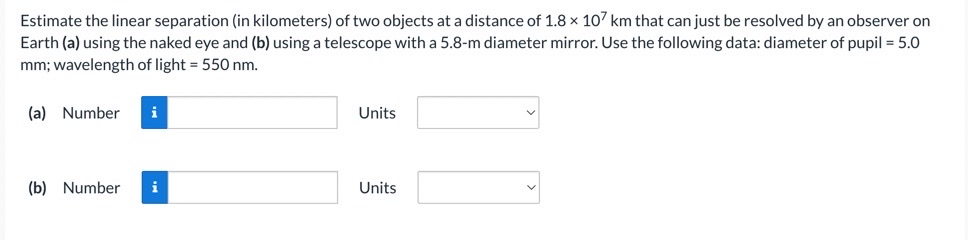
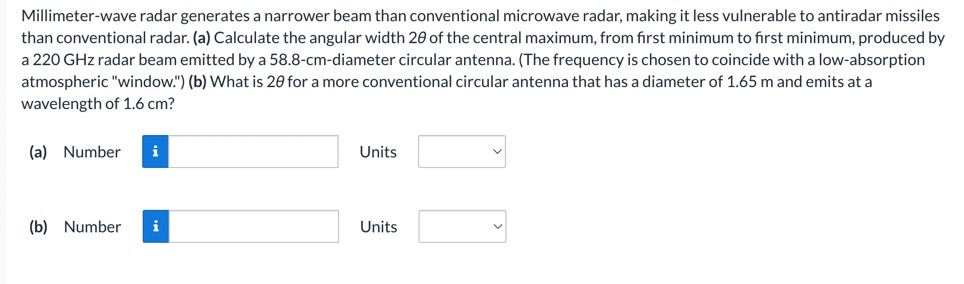

Estimate the linear separation (in kilometers) of two objects at a distance of 1.8 x 10⁷ km that can just be resolved by an observer on Earth (a) using the naked eye and (b) using a telescope with a 5.8-m diameter mirror. Use the following data: diameter of pupil = 5.0 mm; wavelength of light = 550 nm. (a) Number i Units (b) Number i Units Millimeter-wave radar generates a narrower beam than conventional microwave radar, making it less vulnerable to antiradar missiles than conventional radar. (a) Calculate the angular width 20 of the central maximum, from first minimum to first minimum, produced by a 220 GHz radar beam emitted by a 58.8-cm-diameter circular antenna. (The frequency is chosen to coincide with a low-absorption atmospheric "window.") (b) What is 20 for a more conventional circular antenna that has a diameter of 1.65 m and emits at a wavelength of 1.6 cm? (a) Number i Units (b) Number i Units A slit 0.780 mm wide is illuminated by light of wavelength 558 nm. We see a diffraction pattern on a screen 3.07 m away. What is the distance in millimeters between the first two diffraction minima on the same side of the central diffraction maximum? Number i Units
Step by Step Solution
There are 3 Steps involved in it

Get step-by-step solutions from verified subject matter experts