







Question: Estimate the minimum expected relative standard deviation, RSD (%), for interlaboratory results when the analyte concentration is 1 wt%, 1 part per million, or 10
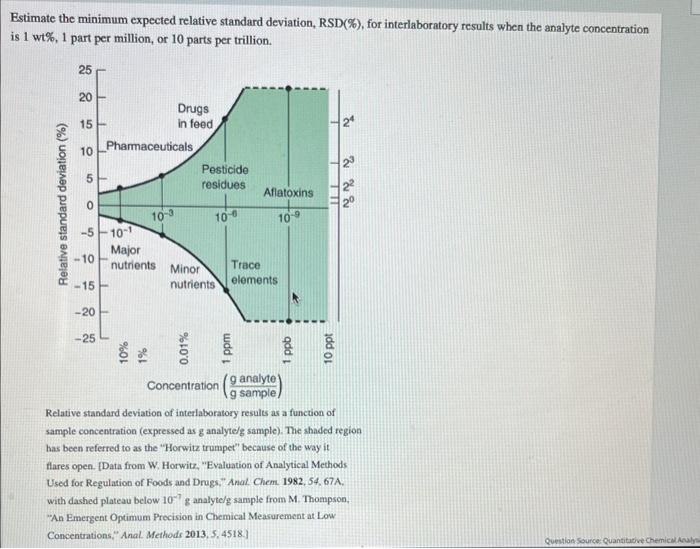
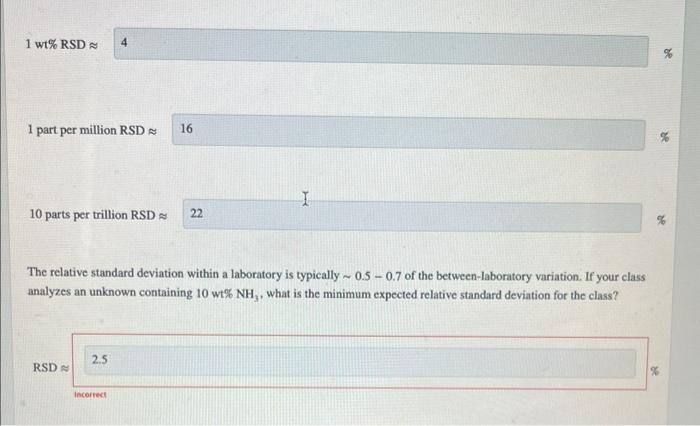
Estimate the minimum expected relative standard deviation, RSD (%), for interlaboratory results when the analyte concentration is 1 wt\%, 1 part per million, or 10 parts per trillion. (g sample) Relative standard deviation of interlaboratory resuls as a function of sample concentration (expressed as g analyte/g sample). The shaded region has been referred to as the "Horwitz trumpet' because of the way it flares open. [Data from W. Horwitz, "Evaluation of Analytical Mechods Used for Regulation of Foods and Drugs, "AnaL Chem. 1982, 54, 67A. with dashed plateau below 107g analyte/g sample from M. Thompson. "An Emergent Optimum Precision in Chemical Measurement at Low Concentrations," Anal Methods 2013, 5, 4518.] 1 part per million RSD 10 parts per trillion RSD The relative standard deviation within a laboratory is typically 0.50.7 of the between-laboratory variation. If your class analyzes an unknown containing 10wt%NH3, what is the minimum expected relative standard deviation for the class
Step by Step Solution
There are 3 Steps involved in it

Get step-by-step solutions from verified subject matter experts
 Study Help