







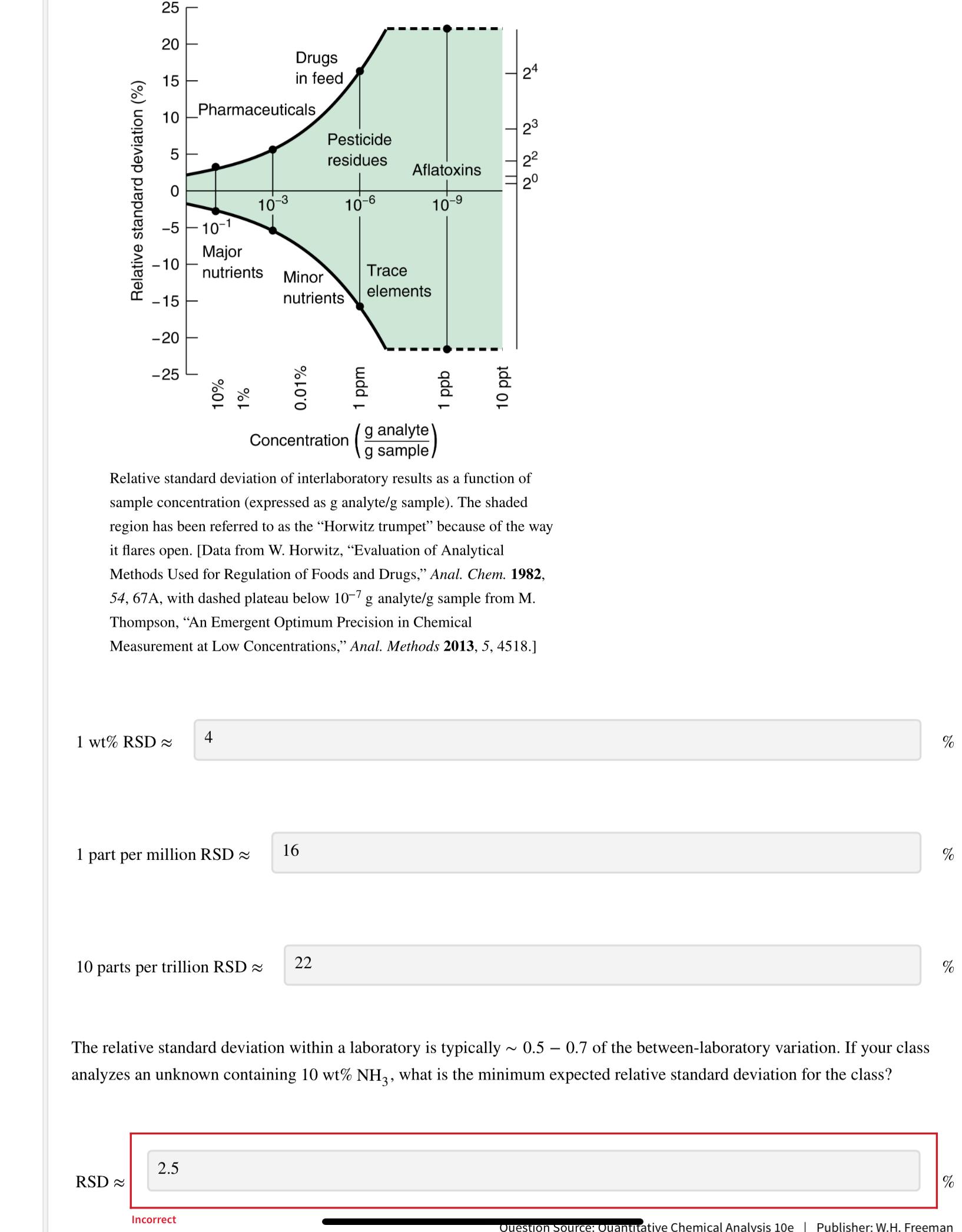
Question: vuIver ualur ' ( ? b a r ( g sample ) ) Relative standard deviation of interlaboratory results as a function of sample concentration
vuIverualur sample
Relative standard deviation of interlaboratory results as a function of sample concentration expressed as g analyteg sample The shaded region has been referred to as the "Horwitz trumpet" because of the way it flares open. Data from W Horwitz, "Evaluation of Analytical Methods Used for Regulation of Foods and Drugs," Anal. Chem. with dashed plateau below analyteg sample from Thompson, An Emergent Optimum Precision in Chemical
Measurement at Low Concentrations," Anal. Methods
~~
part per million ~~
parts per trillion ~~
The relative standard deviation within a laboratory is typically of the betweenlaboratory variation. If your class analyzes an unknown containing what is the minimum expected relative standard deviation for the class?
~~ubrace
Step by Step Solution
There are 3 Steps involved in it
1 Expert Approved Answer
Step: 1 Unlock

Question Has Been Solved by an Expert!
Get step-by-step solutions from verified subject matter experts
Step: 2 Unlock
Step: 3 Unlock
 Study Help