







Question: Estimating Share Value Using the DCF Model Assume following are forecasts of Abercrombie & Fitch's sales, net operating profit after tax (NOPAT), and net operating
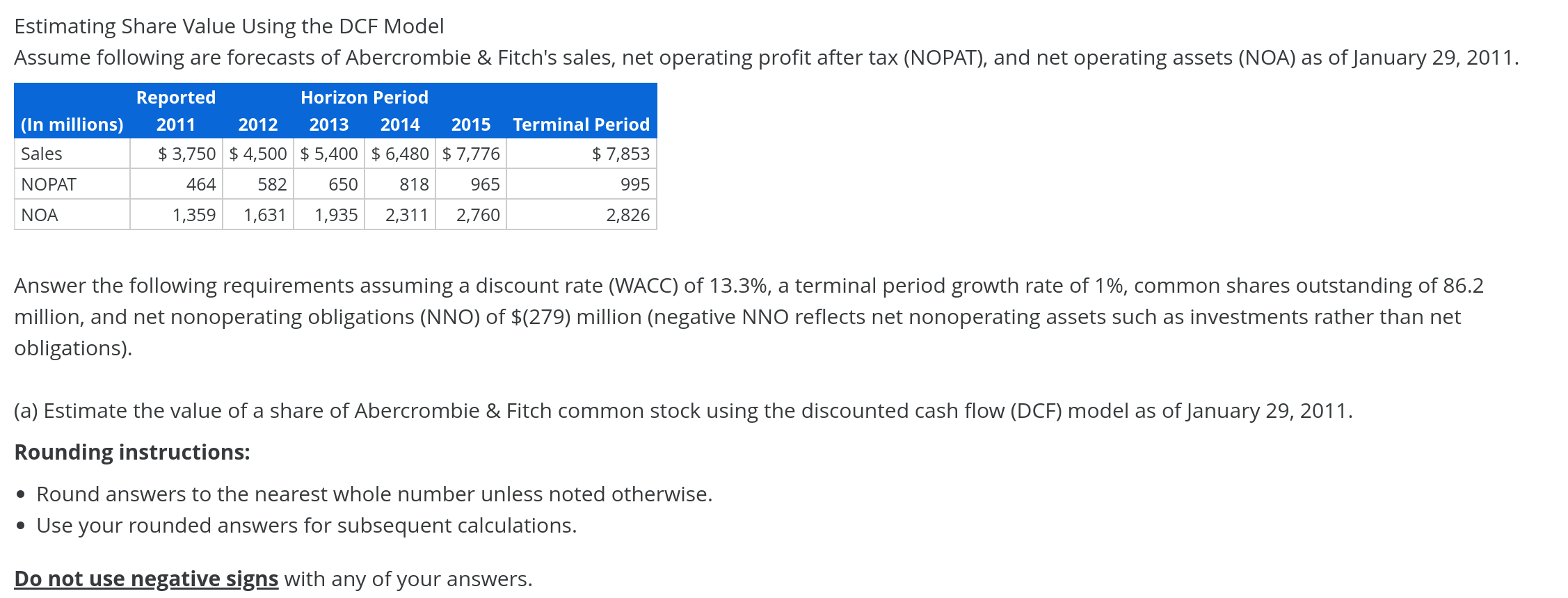
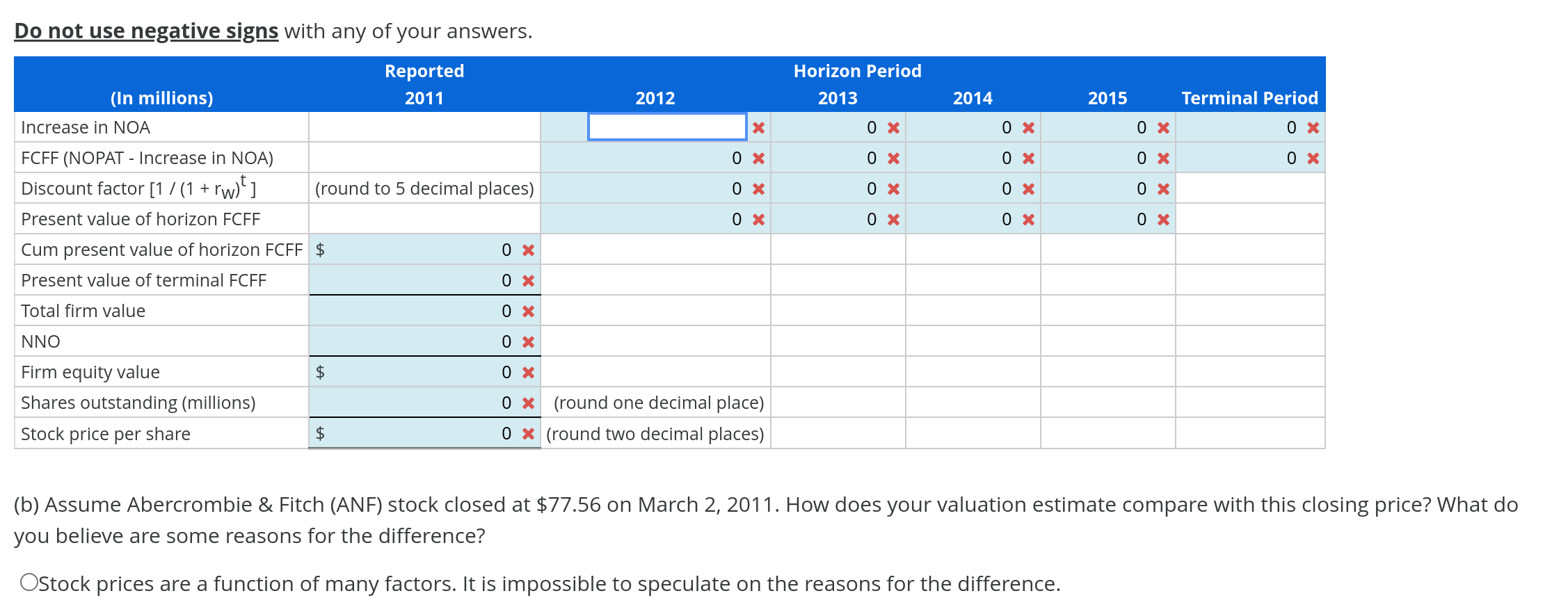
Estimating Share Value Using the DCF Model Assume following are forecasts of Abercrombie & Fitch's sales, net operating profit after tax (NOPAT), and net operating assets (NOA) as of January 29, 2011. Reported Horizon Period (In millions) 2011 2012 2013 2014 2015 Terminal Period Sales $ 3,750 $ 4,500 $ 5,400 $ 6,480 $ 7,776 $ 7,853 NOPAT 464 582 650 818 965 995 NOA 1,359 1,631 1,935 2,311 2,760 2,826 Answer the following requirements assuming a discount rate (WACC) of 13.3%, a terminal period growth rate of 1%, common shares outstanding of 86.2 million, and net nonoperating obligations (NNO) of $(279) million (negative NNO reflects net nonoperating assets such as investments rather than net obligations). (a) Estimate the value of a share of Abercrombie & Fitch common stock using the discounted cash flow (DCF) model as of January 29, 2011. Rounding instructions: Round answers to the nearest whole number unless noted otherwise. Use your rounded answers for subsequent calculations. Do not use negative signs with any of your answers. Do not use negative signs with any of your answers. Horizon Period Reported 2011 2012 2013 2014 2015 Terminal Period (In millions) Increase in NOA x 0 x 0 x 0 x 0 x 0 x 0 x 0 x 0 x 0 x 0 X 0 X 0 X 0 x 0 x 0 x 0 X 0 x FCFF (NOPAT - Increase in NOA) Discount factor [1 /(1 + rwit (round to 5 decimal places) Present value of horizon FCFF Cum present value of horizon FCFF $ 0 X Present value of terminal FCFF 0 X Total firm value 0 X NNO 0 X $ 0 x Firm equity value Shares outstanding (millions) Stock price per share 0 x (round one decimal place) O * (round two decimal places) $ (b) Assume Abercrombie & Fitch (ANF) stock closed at $77.56 on March 2, 2011. How does your valuation estimate compare with this closing price? What do you believe are some reasons for the difference? Ostock prices are a function of many factors. It is impossible to speculate on the reasons for the difference. Estimating Share Value Using the DCF Model Assume following are forecasts of Abercrombie & Fitch's sales, net operating profit after tax (NOPAT), and net operating assets (NOA) as of January 29, 2011. Reported Horizon Period (In millions) 2011 2012 2013 2014 2015 Terminal Period Sales $ 3,750 $ 4,500 $ 5,400 $ 6,480 $ 7,776 $ 7,853 NOPAT 464 582 650 818 965 995 NOA 1,359 1,631 1,935 2,311 2,760 2,826 Answer the following requirements assuming a discount rate (WACC) of 13.3%, a terminal period growth rate of 1%, common shares outstanding of 86.2 million, and net nonoperating obligations (NNO) of $(279) million (negative NNO reflects net nonoperating assets such as investments rather than net obligations). (a) Estimate the value of a share of Abercrombie & Fitch common stock using the discounted cash flow (DCF) model as of January 29, 2011. Rounding instructions: Round answers to the nearest whole number unless noted otherwise. Use your rounded answers for subsequent calculations. Do not use negative signs with any of your answers. Do not use negative signs with any of your answers. Horizon Period Reported 2011 2012 2013 2014 2015 Terminal Period (In millions) Increase in NOA x 0 x 0 x 0 x 0 x 0 x 0 x 0 x 0 x 0 x 0 X 0 X 0 X 0 x 0 x 0 x 0 X 0 x FCFF (NOPAT - Increase in NOA) Discount factor [1 /(1 + rwit (round to 5 decimal places) Present value of horizon FCFF Cum present value of horizon FCFF $ 0 X Present value of terminal FCFF 0 X Total firm value 0 X NNO 0 X $ 0 x Firm equity value Shares outstanding (millions) Stock price per share 0 x (round one decimal place) O * (round two decimal places) $ (b) Assume Abercrombie & Fitch (ANF) stock closed at $77.56 on March 2, 2011. How does your valuation estimate compare with this closing price? What do you believe are some reasons for the difference? Ostock prices are a function of many factors. It is impossible to speculate on the reasons for the difference
Step by Step Solution
There are 3 Steps involved in it

Get step-by-step solutions from verified subject matter experts
 Study Help