Question: eterences Mailings Review View Case Study #1: Purchasing Rationalization Introduction In 2020 a major American chemical company finally completed a year of supply chain reengineering
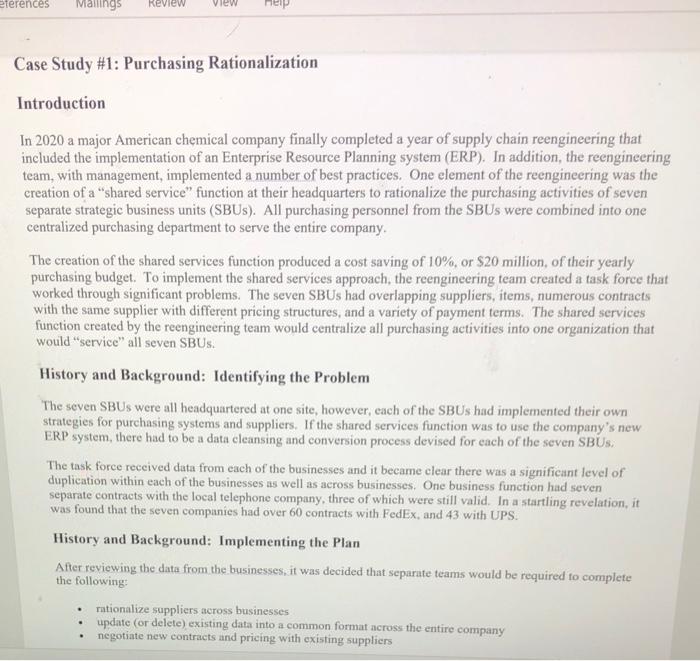
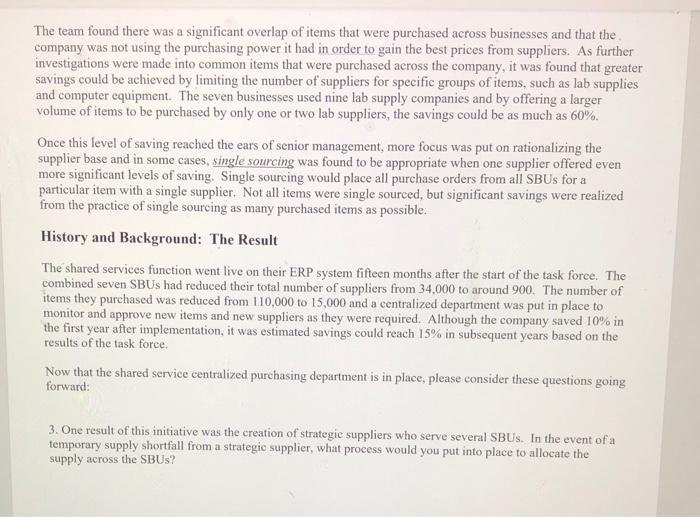
eterences Mailings Review View Case Study #1: Purchasing Rationalization Introduction In 2020 a major American chemical company finally completed a year of supply chain reengineering that included the implementation of an Enterprise Resource Planning system (ERP). In addition, the reengineering team, with management, implemented a number of best practices. One element of the reengineering was the creation of a shared service" function at their headquarters to rationalize the purchasing activities of seven separate strategic business units (SBU). All purchasing personnel from the SBUs were combined into one centralized purchasing department to serve the entire company. The creation of the shared services function produced a cost saving of 10%, or $20 million, of their yearly purchasing budget. To implement the shared services approach, the reengineering team created a task force that worked through significant problems. The seven SBUs had overlapping suppliers, items, numerous contracts with the same supplier with different pricing structures, and a variety of payment terms. The shared services function created by the reengineering team would centralize all purchasing activities into one organization that would "service" all seven SBUS. History and Background: Identifying the Problem The seven SBUs were all headquartered at one site, however, each of the SBUs had implemented their own strategies for purchasing systems and suppliers. If the shared services function was to use the company's new ERP system, there had to be a data cleansing and conversion process devised for each of the seven SBUS, The task force received data from each of the businesses and it became clear there was a significant level of duplication within each of the businesses as well as across businesses. One business function had seven separate contracts with the local telephone company, three of which were still valid. In a startling revelation, it was found that the seven companies had over 60 contracts with FedEx, and 43 with UPS. History and Background: Implementing the Plan After reviewing the data from the businesses, it was decided that separate teams would be required to complete the following: rationalize suppliers across businesses update (or delete) existing data into a common format across the entire company negotiate new contracts and pricing with existing suppliers w The team found there was a significant overlap of items that were purchased across businesses and that the company was not using the purchasing power it had in order to gain the best prices from suppliers. As further investigations were made into common items that were purchased across the company, it was found that greater savings could be achieved by limiting the number of suppliers for specific groups of items, such as lab supplies and computer equipment. The seven businesses used nine lab supply companies and by offering a larger volume of items to be purchased by only one or two lab suppliers, the savings could be as much as 60%. Once this level of saving reached the ears of senior management, more focus was put on rationalizing the supplier base and in some cases, single sourcing was found to be appropriate when one supplier offered even more significant levels of saving. Single sourcing would place all purchase orders from all SBUs for a particular item with a single supplier. Not all items were single sourced, but significant savings were realized from the practice of single sourcing as many purchased items as possible: History and Background: The Result The shared services function went live on their ERP system fifteen months after the start of the task force. The combined seven SBUs had reduced their total number of suppliers from 34,000 to around 900. The number of items they purchased was reduced from 110,000 to 15,000 and a centralized department was put in place to monitor and approve new items and new suppliers as they were required. Although the company saved 10% in the first year after implementation, it was estimated savings could reach 15% in subsequent years based on the results of the task force Now that the shared service centralized purchasing department is in place, please consider these questions going forward: 3. One result of this initiative was the creation of strategic suppliers who serve several SBUs. In the event of a temporary supply shortfall from a strategic supplier, what process would you put into place to allocate the supply across the SBUS









 Study Help