







Question: Ev Heading 2 Heading 3 Normal No Spacing Heading 1 R Program for Contingency Table of Liked x Military Tweet CrossTable(X$liked, X$mil_tweet, digits=3, max.width =
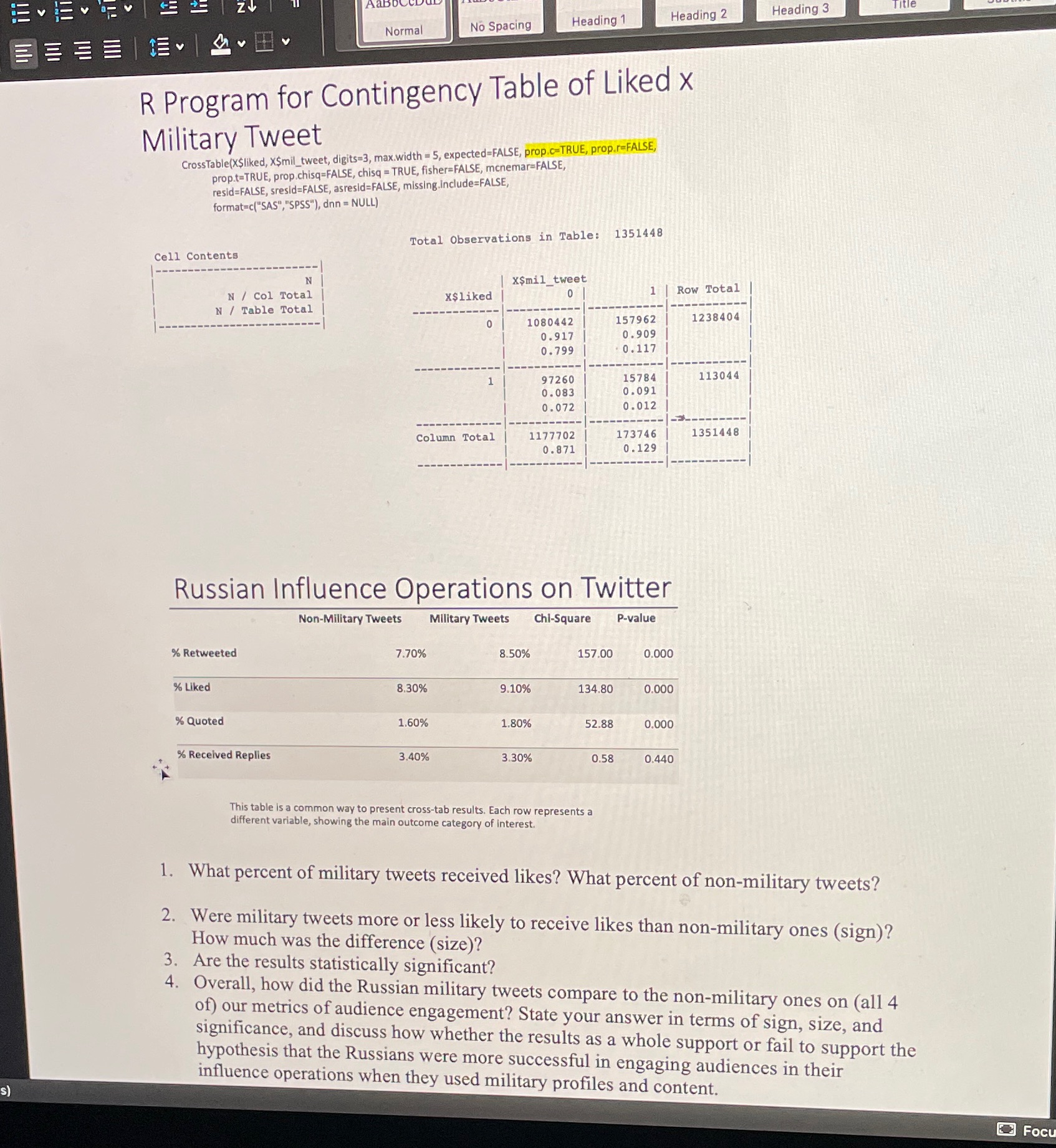
Ev Heading 2 Heading 3 Normal No Spacing Heading 1 R Program for Contingency Table of Liked x Military Tweet CrossTable(X$liked, X$mil_tweet, digits=3, max.width = 5, expected=FALSE, prop.c=TRUE, prop.r=FALSE, prop.t=TRUE, prop.chisq=FALSE, chisq = TRUE, fisher=FALSE, mcnemar=FALSE, resid=FALSE, sresid FALSE, asresideFALSE, missing.include=FALSE format=c("SAS","SPSS"), dnn = NULL) Total Observations in Table: 1351448 Cell Contents X$mil_tweet N / Col Total X$liked Row Total N / Table Total 1080442 157962 1238404 0. 917 0 . 909 0. 799 0. 117 97260 15784 113044 0 . 083 0 . 091 0. 072 0 . 012 Column Total 1177702 173746 1351448 0. 871 0 . 129 Russian Influence Operations on Twitter Non-Military Tweets Military Tweets Chi-Square P-value % Retweeted 7.70% 8.50% 157.00 0.000 % Liked 8.30% 9.10% 134.80 0.000 % Quoted 1.60% 1.80% 52.88 0.000 % Received Replies 3.40% 3.30% 0.58 0.440 This table is a common way to present cross-tab results. Each row represents a different variable, showing the main outcome category of interest. 1. What percent of military tweets received likes? What percent of non-military tweets? 2. Were military tweets more or less likely to receive likes than non-military ones (sign)? How much was the difference (size)? 3. Are the results statistically significant? 4. Overall, how did the Russian military tweets compare to the non-military ones on (all 4 of) our metrics of audience engagement? State your answer in terms of sign, size, and significance, and discuss how whether the results as a whole support or fail to support the hypothesis that the Russians were more successful in engaging audiences in their influence operations when they used military profiles and content. Foct
Step by Step Solution
There are 3 Steps involved in it

Get step-by-step solutions from verified subject matter experts
 Study Help