







Question: Evaluate the following expressions without using a calculator. (a) In(e) (b) In () = (c) en (7) = (d) In- (1) (e) eln(5) Write
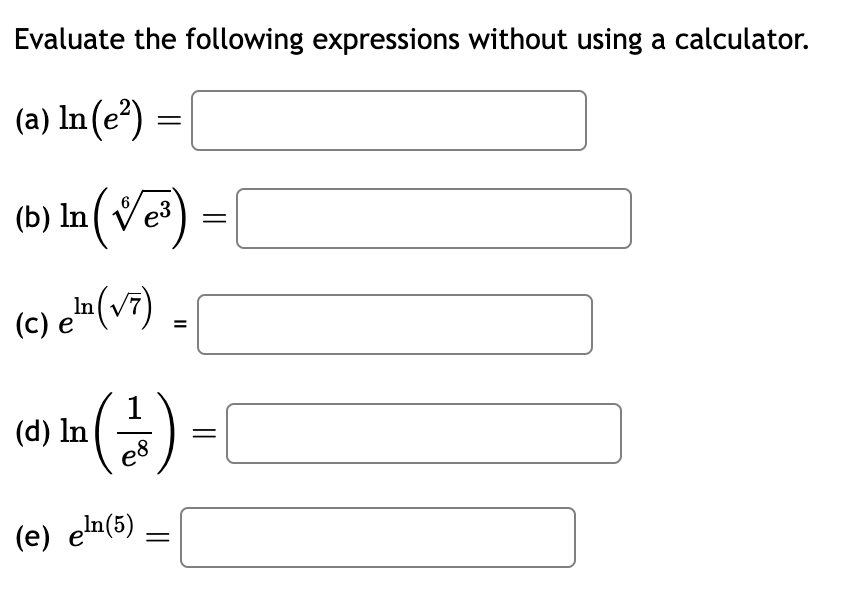
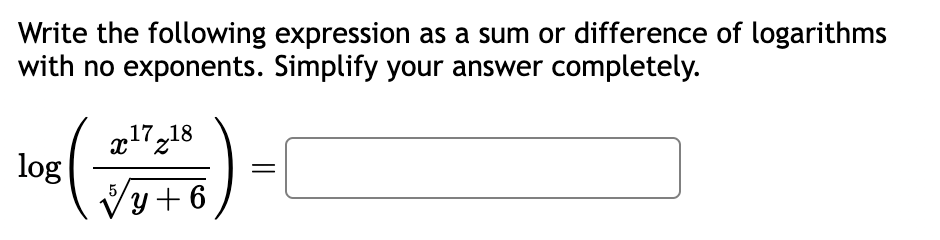
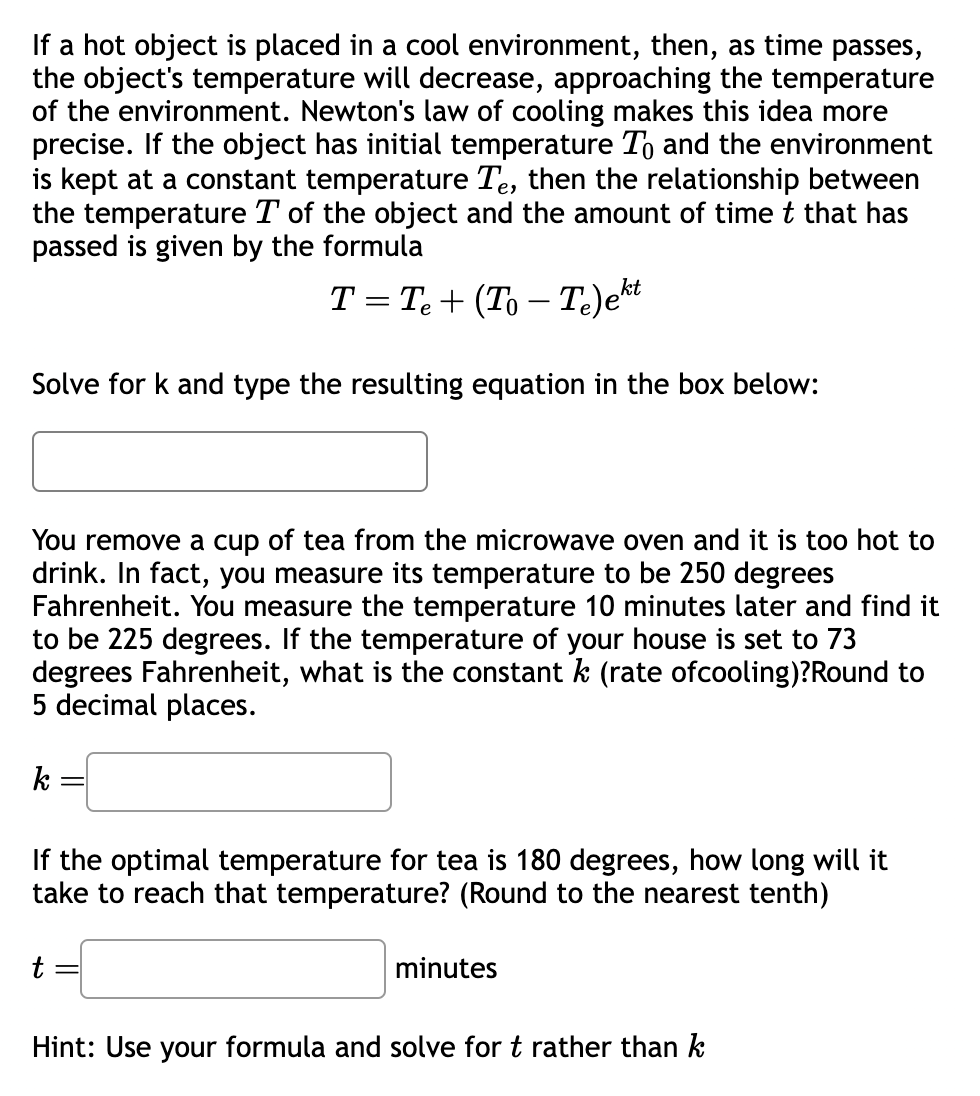
Evaluate the following expressions without using a calculator. (a) In(e) (b) In () = (c) en (7) = (d) In- (1) (e) eln(5) Write the following expression as a sum or difference of logarithms with no exponents. Simplify your answer completely. log 5 x17218 Vy + 6 y+6 If a hot object is placed in a cool environment, then, as time passes, the object's temperature will decrease, approaching the temperature of the environment. Newton's law of cooling makes this idea more precise. If the object has initial temperature To and the environment is kept at a constant temperature Te, then the relationship between the temperature T of the object and the amount of time t that has passed is given by the formula T = Te + (To Te)ekt - Solve for k and type the resulting equation in the box below: You remove a cup of tea from the microwave oven and it is too hot to drink. In fact, you measure its temperature to be 250 degrees Fahrenheit. You measure the temperature 10 minutes later and find it to be 225 degrees. If the temperature of your house is set to 73 degrees Fahrenheit, what is the constant k (rate ofcooling)?Round to 5 decimal places. k - If the optimal temperature for tea is 180 degrees, how long will it take to reach that temperature? (Round to the nearest tenth) t minutes Hint: Use your formula and solve for t rather than k
Step by Step Solution
There are 3 Steps involved in it

Get step-by-step solutions from verified subject matter experts
 Study Help