







Question: Evaluating R&D Projects at WestCom Systems The facility Northwoods Backpackers uses to house its operators can accommodate a maximum of 1 0 stations. WestCom Systems
Evaluating R&D Projects at WestCom Systems
The facility Northwoods Backpackers uses to house its operators can accommodate a maximum of stations.
WestCom Systems Products Company develops computer systems and software products for commercial sale.
Each year it considers and evaluates a number of different R&D projects to undertake. It develops a road map
for each project, in the form of a standardized decision tree that identifies the different decision points in the
R&D process from the initial decision to invest in a project's development through the actual
commercialization of the final product.
The first decision point in the R&D process is whether to fund a proposed project for year. If the decision is
no then there is no resulting cost; if the decision is yes, then the project proceeds at an incremental cost to the
company.
The company establishes specific shortterm, early technical milestones for its projects after year. If the early
milestones are achieved, the project proceeds to the next phase of project development; if the milestones are
not achieved, the project is abandoned. In its planning process, the company develops probability estimates
of achieving and not achieving the early milestones. If the early milestones are
achieved, the project is funded for further development during an extended time frame specific to a project.
At the end of this time frame, a project is evaluated according to a second set of later technical milestones.
Again, the company attaches probability estimates for achieving and not achieving these later milestones. If
the later milestones are not achieved, the project is abandoned.
If the later milestones are achieved, technical uncertainties and problems have been overcome, and the
company next assesses the project's ability to meet its strategic business objectives. At this stage, the company
wants to know if the eventual product coincides with the company's competencies and whether there appears
to be an eventual, clear market for the product. It invests in a product "prelaunch" to ascertain the answers to
these questions. The outcomes of the prelaunch are that either there is a strategic fit or there is not, and the
company assigns probability estimates to each of these two possible outcomes.
If there is not a strategic fit at this point, the project is abandoned, and the company loses its investment in the
prelaunch process. If it is determined that there is a strategic fit, then three possible decisions result: The
company can invest in the product's launch, and a successful or unsuccessful outcome will result, each with
an estimated probability of occurrence; the company can delay the product's launch and at a later date
decide whether to launch or abandon; and if it launches later, the outcomes are success or failure, each
with an estimated probability of occurrence. Also, if the product launch is delayed, there is always a likelihood
that the technology will become obsolete or dated in the near future, which tends to reduce the expected return.
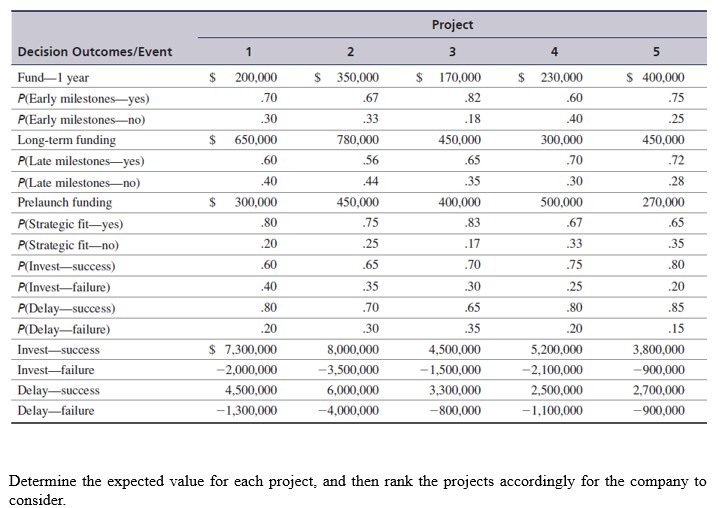
The following table provides the various costs, event probabilities, and investment outcomes for five projects
the company is considering: see table in image
Determine the expected value for each project, and then rank the projects accordingly for the company to consider.
Step by Step Solution
There are 3 Steps involved in it
1 Expert Approved Answer
Step: 1 Unlock

Question Has Been Solved by an Expert!
Get step-by-step solutions from verified subject matter experts
Step: 2 Unlock
Step: 3 Unlock
 Study Help