







Question: Every positive integer n can be written as a sum of distinct powers of two, that is, as a sum of a subset of the
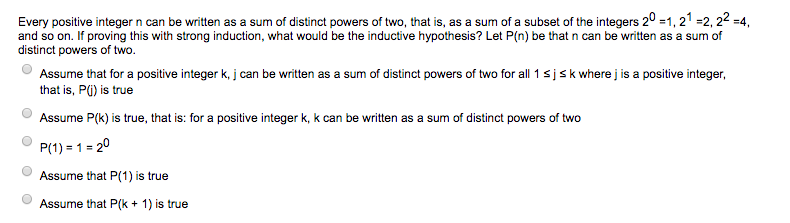
Every positive integer n can be written as a sum of distinct powers of two, that is, as a sum of a subset of the integers 20 -1,21 -2, 22-4, and so on. If proving this with strong induction, what would be the inductive hypothesis? Let P(n) be that n can be written as a sum of distinct powers of two. Assume that for a positive integer k, j can be written as a sum of distinct powers of two for all 1 s j s k where j is a positive integer that is, PG) is true Assume P(k) is true, that is: for a positive integer k, k can be written as a sum of distinct powers of two P(1)-1-20 Assume that P(1) is true Assume that P(k + 1) is true
Step by Step Solution
There are 3 Steps involved in it
1 Expert Approved Answer
Step: 1 Unlock

Question Has Been Solved by an Expert!
Get step-by-step solutions from verified subject matter experts
Step: 2 Unlock
Step: 3 Unlock
 Study Help