







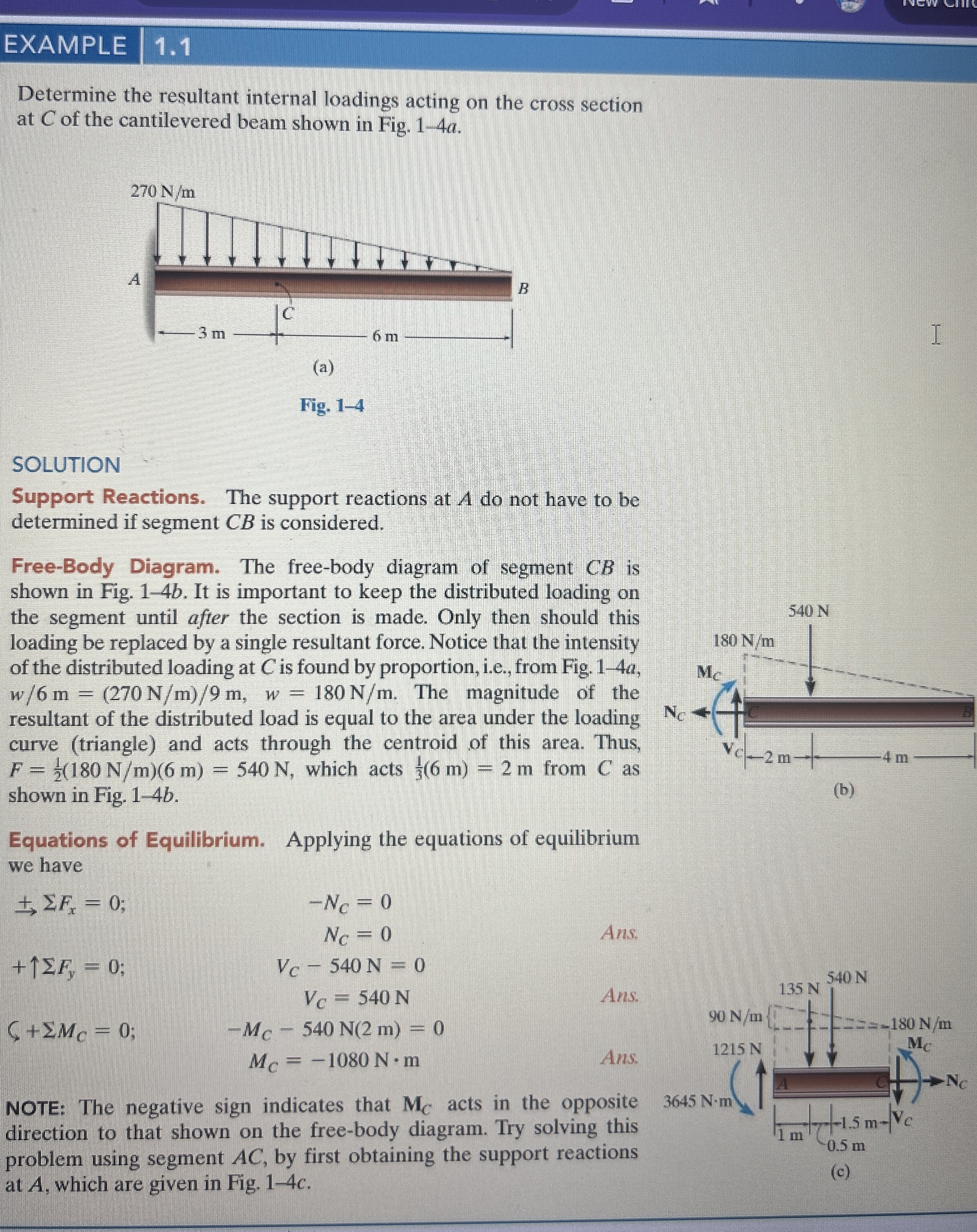
Question: EXAMPLE 1 . 1 Determine the resultant internal loadings acting on the cross section at C of the cantilevered beam shown in Fig. 1 -
EXAMPLE
Determine the resultant internal loadings acting on the cross section at of the cantilevered beam shown in Fig. a
SOLUTION
Support Reactions. The support reactions at do not have to be determined if segment is considered.
FreeBody Diagram. The freebody diagram of segment is shown in Fig. b It is important to keep the distributed loading on the segment until after the section is made. Only then should this loading be replaced by a single resultant force. Notice that the intensity of the distributed loading at is found by proportion, ie from Fig. a The magnitude of the resultant of the distributed load is equal to the area under the loading curve triangle and acts through the centroid of this area. Thus, which acts from as shown in Fig. b
Equations of Equilibrium. Applying the equations of equilibrium we have
;
uarr;
;
Ans.
Ans.
Ans.
NOTE: The negative sign indicates that acts in the opposite direction to that shown on the freebody diagram. Try solving this problem using segment by first obtaining the support reactions at which are given in Fig. c
PLEASE SOLVE FOR A im having trouble getting the MA and FA
Step by Step Solution
There are 3 Steps involved in it
1 Expert Approved Answer
Step: 1 Unlock

Question Has Been Solved by an Expert!
Get step-by-step solutions from verified subject matter experts
Step: 2 Unlock
Step: 3 Unlock
 Study Help