







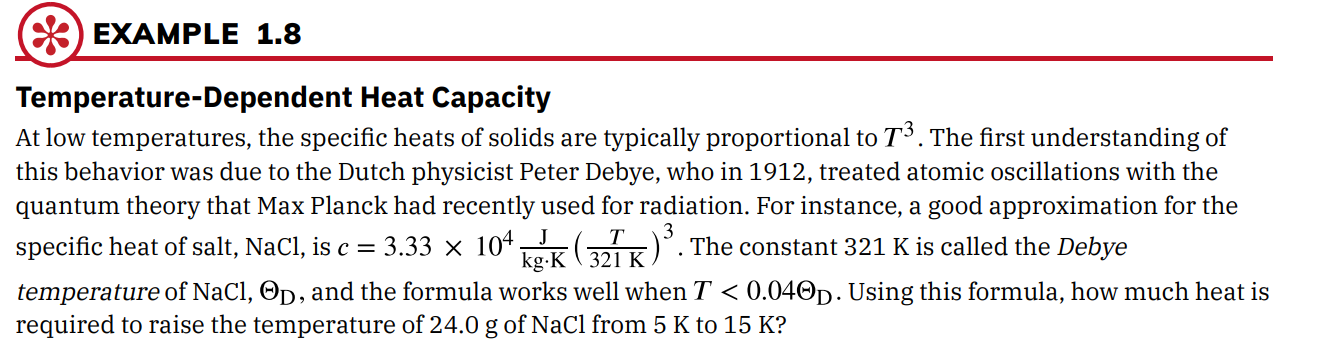
Question: EXAMPLE 1 . 8 Temperature - Dependent Heat Capacity At low temperatures, the specific heats of solids are typically proportional to T 3 . The
EXAMPLE
TemperatureDependent Heat Capacity
At low temperatures, the specific heats of solids are typically proportional to The first understanding of
this behavior was due to the Dutch physicist Peter Debye, who in treated atomic oscillations with the
quantum theory that Max Planck had recently used for radiation. For instance, a good approximation for the
specific heat of salt, NaCl, is The constant is called the Debye
temperature of NaCl, and the formula works well when Using this formula, how much heat is
required to raise the temperature of of NaCl from to
Step by Step Solution
There are 3 Steps involved in it
1 Expert Approved Answer
Step: 1 Unlock

Question Has Been Solved by an Expert!
Get step-by-step solutions from verified subject matter experts
Step: 2 Unlock
Step: 3 Unlock
 Study Help