







Question: Example 1: Extrasensory Perception (ESP) In an ESP test, one person writes down one of the letters A, B, C, D, or E and tries
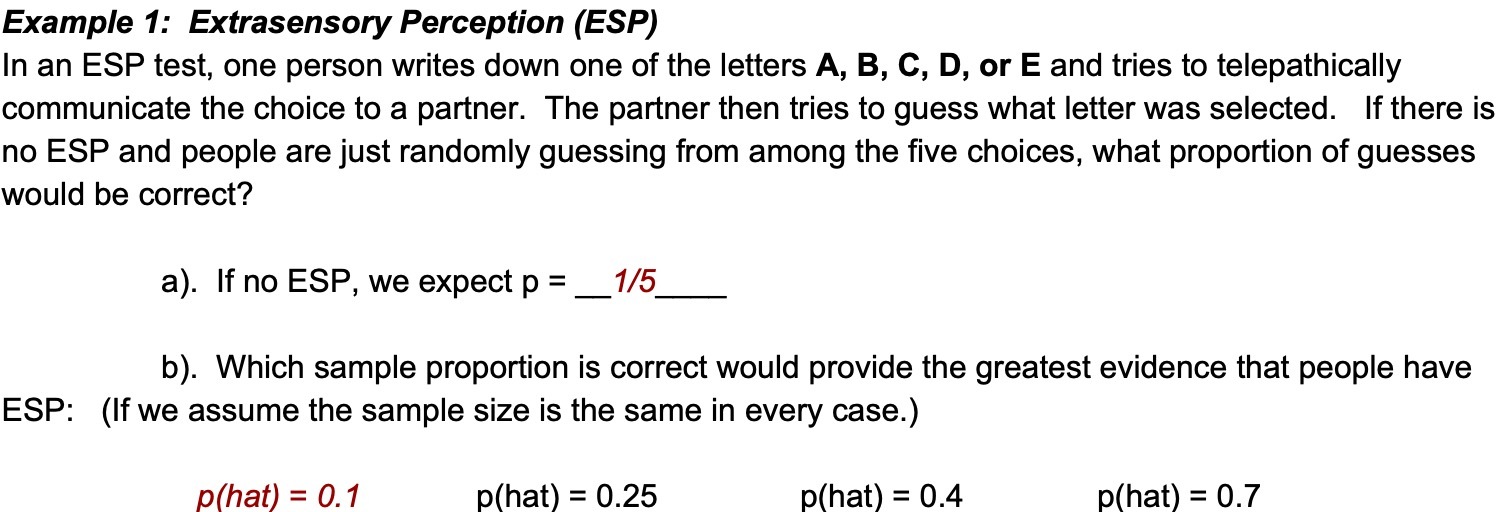
Example 1: Extrasensory Perception (ESP) In an ESP test, one person writes down one of the letters A, B, C, D, or E and tries to telepathically communicate the choice to a partner. The partner then tries to guess what letter was selected. If there is no ESP and people are just randomly guessing from among the five choices, what proportion of guesses would be correct? a). If no ESP, we expect p = _1/5 b). Which sample proportion is correct would provide the greatest evidence that people have ESP: (If we assume the sample size is the same in every case.) p(hat) = 0.1 p(hat) = 0.25 p(hat) = 0.4 p(hat) = 0.7
Step by Step Solution
There are 3 Steps involved in it
1 Expert Approved Answer
Step: 1 Unlock

Question Has Been Solved by an Expert!
Get step-by-step solutions from verified subject matter experts
Step: 2 Unlock
Step: 3 Unlock
 Study Help