







Question: Example 1: Suppose we want to multiply 10.0 0.5 cm by 3.4 0.2 cm. We would do 10 cm x 3.4 cm = 34
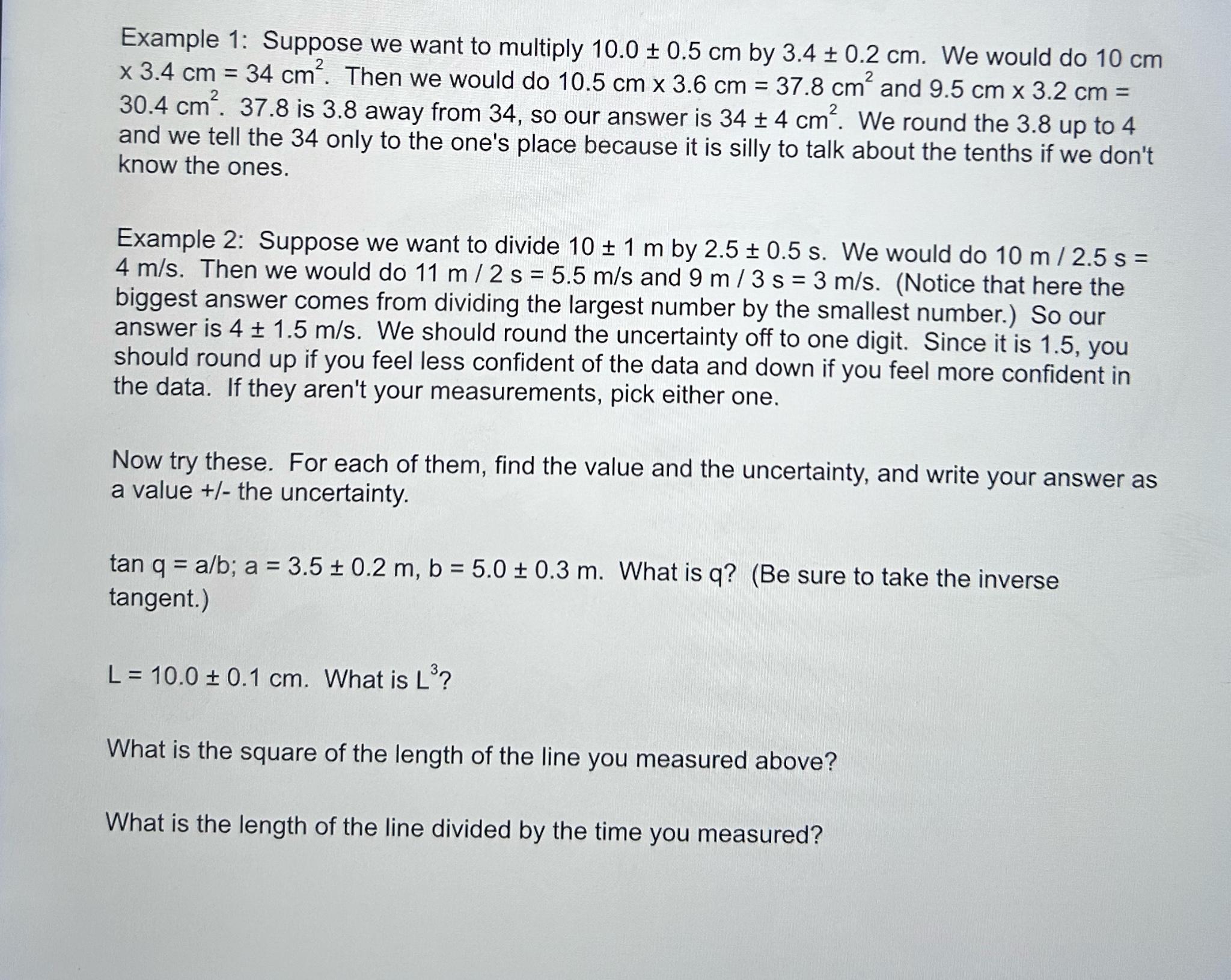
Example 1: Suppose we want to multiply 10.0 0.5 cm by 3.4 0.2 cm. We would do 10 cm x 3.4 cm = 34 cm. Then we would do 10.5 cm x 3.6 cm = 37.8 cm and 9.5 cm x 3.2 cm = 30.4 cm. 37.8 is 3.8 away from 34, so our answer is 34 4 cm. We round the 3.8 up to 4 and we tell the 34 only to the one's place because it is silly to talk about the tenths if we don't know the ones. Example 2: Suppose we want to divide 10 1 m by 2.5 0.5 s. We would do 10 m / 2.5 s = 4 m/s. Then we would do 11 m / 2 s = 5.5 m/s and 9 m / 3 s = 3 m/s. (Notice that here the biggest answer comes from dividing the largest number by the smallest number.) So our answer is 4 1.5 m/s. We should round the uncertainty off to one digit. Since it is 1.5, you should round up if you feel less confident of the data and down if you feel more confident in the data. If they aren't your measurements, pick either one. Now try these. For each of them, find the value and the uncertainty, and write your answer as a value +/- the uncertainty. tan q = a/b; a = 3.5 0.2 m, b = 5.0 0.3 m. What is q? (Be sure to take the inverse tangent.) L= 10.0 0.1 cm. What is L? What is the square of the length of the line you measured above? What is the length of the line divided by the time you measured?
Step by Step Solution
There are 3 Steps involved in it

Get step-by-step solutions from verified subject matter experts
 Study Help