







Question: Example 11.5 This example comes from Rasch et al. (1998, Procedure 4/51/0205, page 476-479). In an experiment to investigate biological pest control the ability
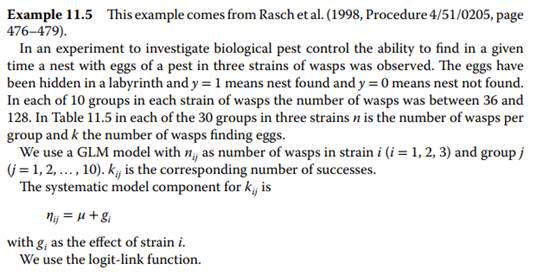
Example 11.5 This example comes from Rasch et al. (1998, Procedure 4/51/0205, page 476-479). In an experiment to investigate biological pest control the ability to find in a given time a nest with eggs of a pest in three strains of wasps was observed. The eggs have been hidden in a labyrinth and y = 1 means nest found and y = 0 means nest not found. In each of 10 groups in each strain of wasps the number of wasps was between 36 and 128. In Table 11.5 in each of the 30 groups in three strains n is the number of wasps per group and k the number of wasps finding eggs. We use a GLM model with n,, as number of wasps in strain i (i = 1, 2, 3) and group j (j=1, 2,..., 10). k, is the corresponding number of successes. The systematic model component for k, is nij = +gi with g, as the effect of strain i. We use the logit-link function.
Step by Step Solution
There are 3 Steps involved in it

Get step-by-step solutions from verified subject matter experts
 Study Help