







Question: Example 15.3 using the 2x2 table. All answers have to be rounded to the 5th decimal. I'm looking for the critical value, expected values, contributions,test
Example 15.3 using the 2x2 table. All answers have to be rounded to the 5th decimal. I'm looking for the critical value, expected values, contributions,test stat, p values, and cramers v,
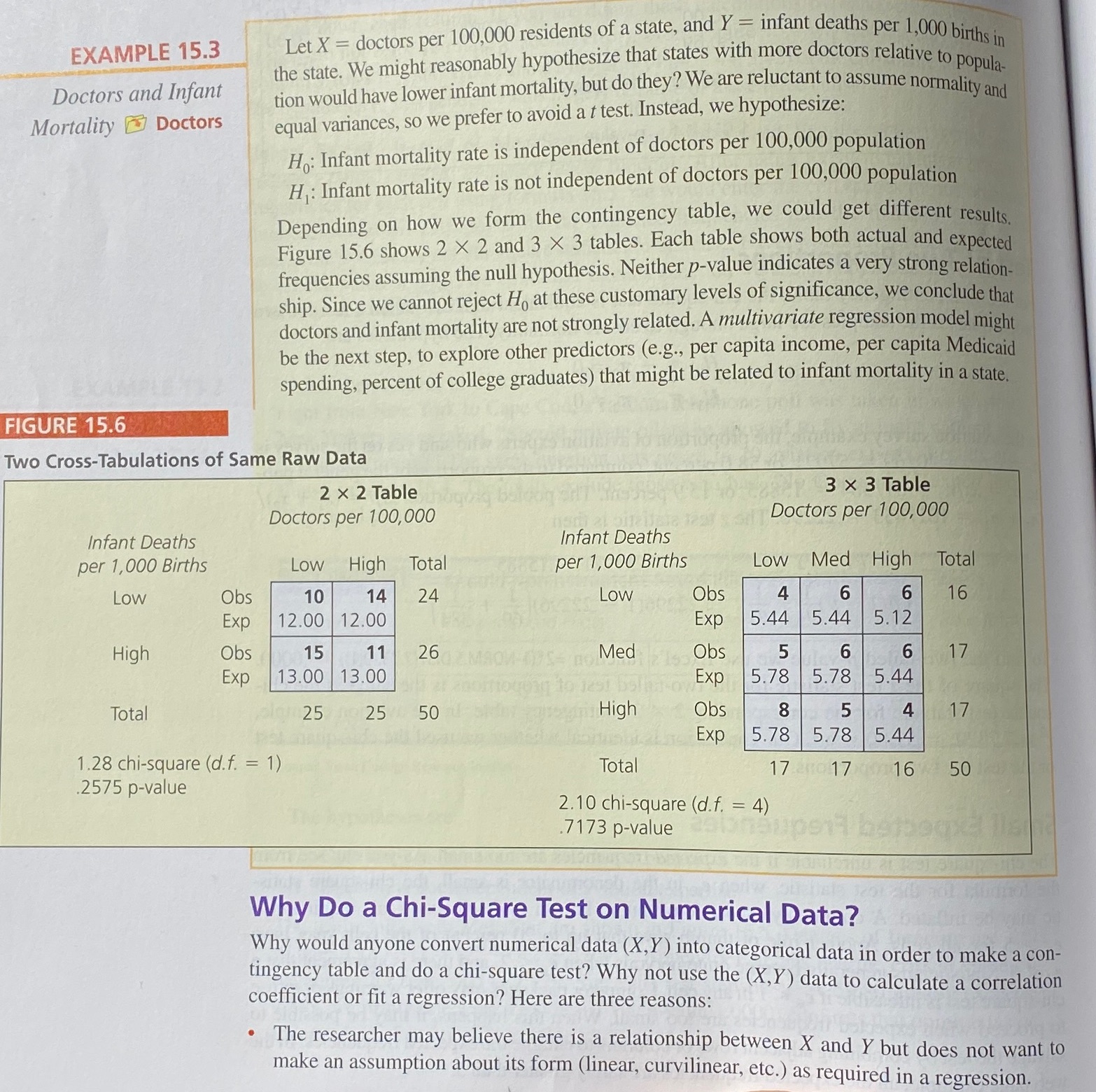
EXAMPLE 15.3 Let X = doctors per 100,000 residents of a state, and Y - infant deaths per 1,000 births in Doctors and Infant the state. We might reasonably hypothesize that states with more doctors relative to popula- tion would have lower infant mortality, but do they? We are reluctant to assume normality and Mortality Doctors equal variances, so we prefer to avoid a t test. Instead, we hypothesize: Ho: Infant mortality rate is independent of doctors per 100,000 population H,: Infant mortality rate is not independent of doctors per 100,000 population Depending on how we form the contingency table, we could get different results. Figure 15.6 shows 2 X 2 and 3 X 3 tables. Each table shows both actual and expected frequencies assuming the null hypothesis. Neither p-value indicates a very strong relation- ship. Since we cannot reject Ho at these customary levels of significance, we conclude that doctors and infant mortality are not strongly related. A multivariate regression model might be the next step, to explore other predictors (e.g., per capita income, per capita Medicaid spending, percent of college graduates) that might be related to infant mortality in a state. FIGURE 15.6 Two Cross-Tabulations of Same Raw Data 2 x 2 Table 3 x 3 Table Doctors per 100,000 Doctors per 100,000 Infant Deaths Infant Deaths per 1,000 Births Low High Total per 1,000 Births Low Med High Total Low Obs 10 14 24 Low Obs 4 6 16 Exp 12.00 12.00 Exp 5.44 5.44 5.12 High Obs 15 11 26 Obs 5 Exp 13.00 13.00 MaON-OPS Med 17 Exp 5.78 5.78 5.44 Total 25 25 50 High Obs 8 5 17 Exp 5.78 5.78 5.44 1.28 chi-square (d.f. = 1) 2575 p-value Total 17 17 16 50 2. 10 chi-square (d.f. = 4) .7173 p-value Why Do a Chi-Square Test on Numerical Data? Why would anyone convert numerical data (X, Y) into categorical data in order to make a con- tingency table and do a chi-square test? Why not use the (X,Y) data to calculate a correlation coefficient or fit a regression? Here are three reasons: The researcher may believe there is a relationship between X and Y but does not want to make an assumption about its form (linear, curvilinear, etc.) as required in a regression
Step by Step Solution
There are 3 Steps involved in it

Get step-by-step solutions from verified subject matter experts
 Study Help