







Question: EXAMPLE 2.2.6 Usually axis position is measured using an encoder, which generates pulses as the axis moves. The number of pulses is proportional to the
EXAMPLE 2.2.6\ Usually axis position is measured using an encoder, which generates pulses as the axis moves.\ The number of pulses is proportional to the displacement of the axis. These pulses are counted\ by the motion controller to keep track of the axis position. Therefore, often motion profiles\ \ are programmed in counts (cts). Given the S-curve velocity profile in Figure 2.11, what is the\ axis position at
t=100ms?\ Distance traveled during
0 can be found from\
s_(0A)=C_(1)(t^(3))/(3)\ where
C_(1)=(a^(2))/(2v_(m)). Substituting the values gives
C_(1)=0.071, and
s_(0A)=80 cts at
t=15.\ Figure 2.11 S-curve velocity profile for Example 2.2.6\ Solution\ We know that\
t_(a)=(2v_(m))/(a)\ Solving for
a :\
a=(2*32)/(30)\ =2.133ct(s)/(m)s^(2)\ Distance traveled during
s_(0B)=C_(1)(t_(a)^(3))/(24)+V_(m)(t-(t_(a))/(2))\ -C_(1)*{t_(a)^(2)(t-(t_(a))/(2))-t_(a)(t^(2)-((t_(a))/(2))^(2))+(1)/(3)(t^(3)-((t_(a))/(2))^(3))}C_(1)=2.133,t_(a)=15,t=30,V_(m)=32s_(0B)=480s_(BC)=32*(100-30)=2240ctsCs_(0C)=480+2240=2720cts(t_(a))/(2) can be found from\ s_(0B)=C_(1)(t_(a)^(3))/(24)+V_(m)(t-(t_(a))/(2))\ -C_(1)*{t_(a)^(2)(t-(t_(a))/(2))-t_(a)(t^(2)-((t_(a))/(2))^(2))+(1)/(3)(t^(3)-((t_(a))/(2))^(3))}\ Substituting C_(1)=2.133,t_(a)=15,t=30,V_(m)=32 gives s_(0B)=480 cts.\ The distance traveled between points B and C can be found from the area of the rectangle\ under the velocity profile as\ s_(BC)=32*(100-30)=2240cts\ Finally, the total distance traveled from points 0 to C is\ s_(0C)=480+2240=2720cts My question is how
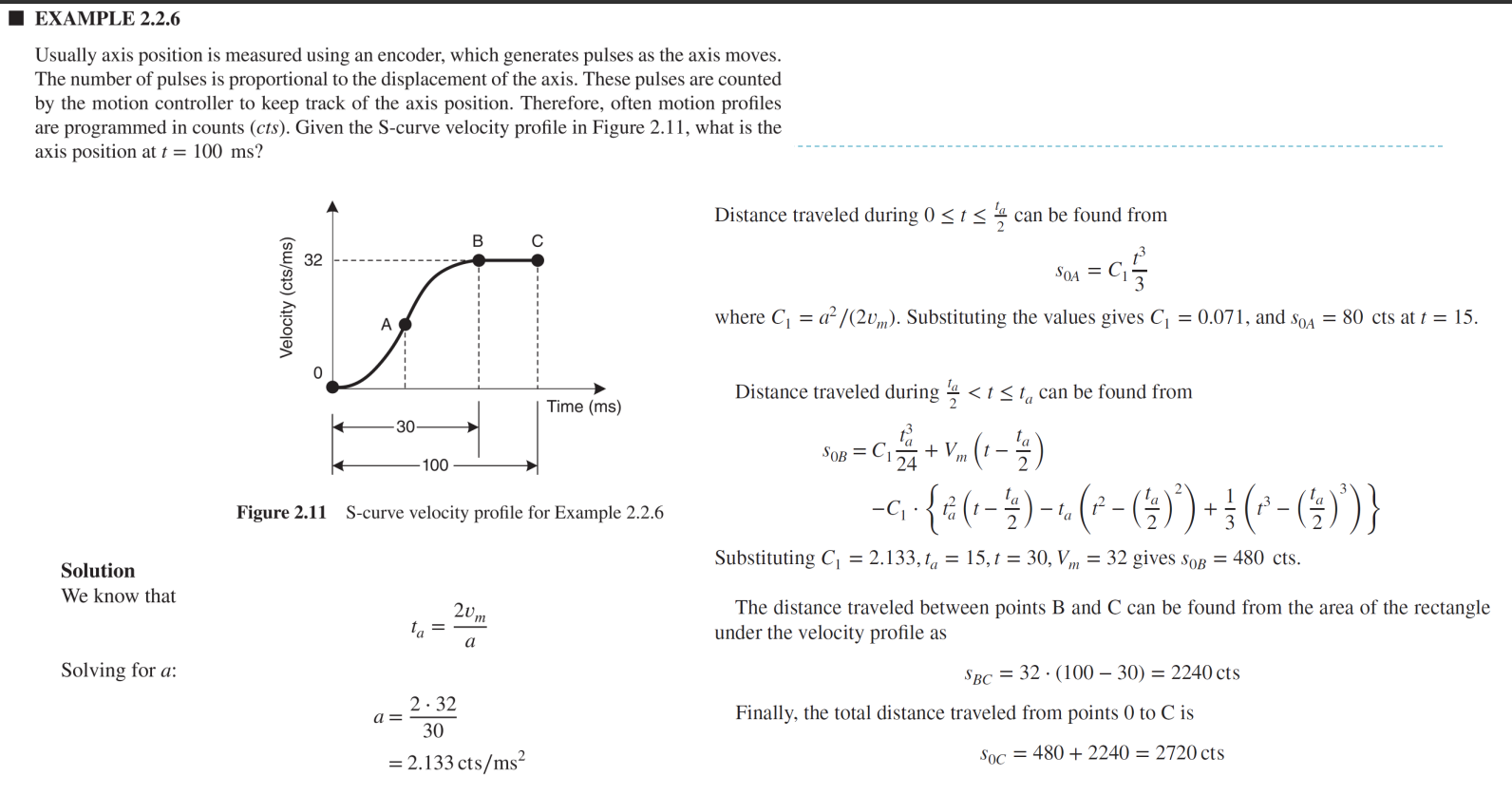
Usually axis position is measured using an encoder, which generates pulses as the axis moves. The number of pulses is proportional to the displacement of the axis. These pulses are counted by the motion controller to keep track of the axis position. Therefore, often motion profiles are programmed in counts (cts). Given the S-curve velocity profile in Figure 2.11, what is the axis position at t=100ms ? Distance traveled during 0t2ta can be found from s0A=C13t3 where C1=a2/(2vm). Substituting the values gives C1=0.071, and s0A=80 cts at t=15. Figure 2.11 S-curve velocity profile for Example 2.2.6 Solution We know that ta=a2vm Solving for a : a=30232=2.133cts/ms2 Distance traveled during 2ta
Step by Step Solution
There are 3 Steps involved in it

Get step-by-step solutions from verified subject matter experts
 Study Help