







Question: Use SQL Language please, show a screen shot for the solution on your computer. 1. Write a SELECT statement that returns the same result set
Use SQL Language please, show a screen shot for the solution on your computer.
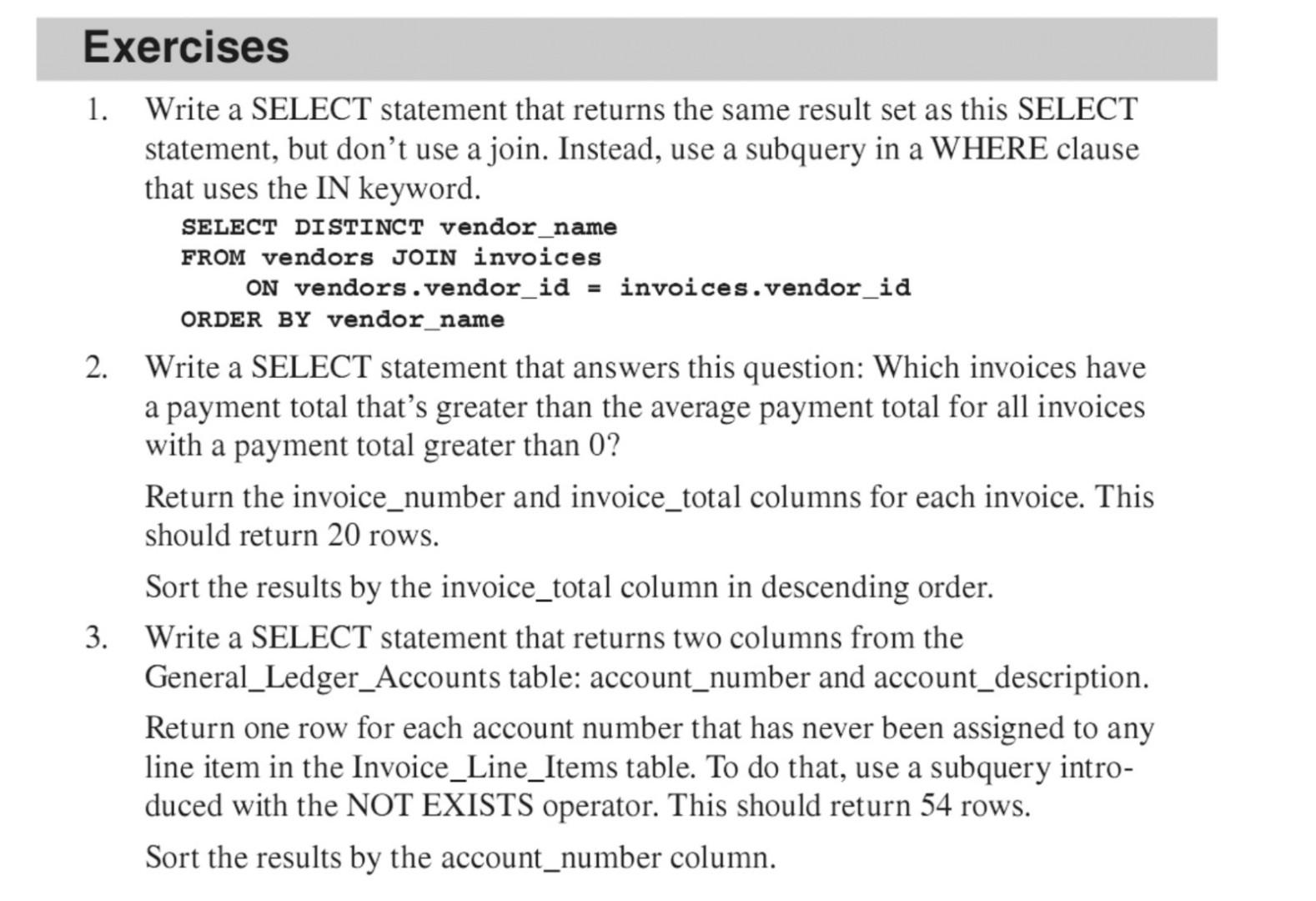
1. Write a SELECT statement that returns the same result set as this SELECT statement, but don't use a join. Instead, use a subquery in a WHERE clause that uses the IN keyword. SELECT DISTINCT vendor_name FROM vendors JOIN invoices on vendors.vendor_id = invoices.vendor_id ORDER BY vendor_name 2. Write a SELECT statement that answers this question: Which invoices have a payment total that's greater than the average payment total for all invoices with a payment total greater than 0 ? Return the invoice_number and invoice_total columns for each invoice. This should return 20 rows. Sort the results by the invoice_total column in descending order. 3. Write a SELECT statement that returns two columns from the General_Ledger_Accounts table: account_number and account_description. Return one row for each account number that has never been assigned to any line item in the Invoice_Line_Items table. To do that, use a subquery introduced with the NOT EXISTS operator. This should return 54 rows. Sort the results by the account_number column
Step by Step Solution
There are 3 Steps involved in it

Get step-by-step solutions from verified subject matter experts
 Study Help