







Question: Example 3 . 5 . Mass flow in a converging nozzle Air is allowed to flow from a large reservoir through a converging nozzle with
Example Mass flow in a converging nozzle
Air is allowed to flow from a large reservoir through a converging nozzle with an exit area of The reservoir is large enough so that negligible changes in reservoir pressure and temperature occur as fluid is exhausted through the nozzle. Assume isentropic steady flow in the nozzle, with kPa and Assume also that air behaves as a perfect gas with constant specific heats; Determine the mass flow through the nozzle for back pressures of and kPa
Convergent Nozzle...
Solution
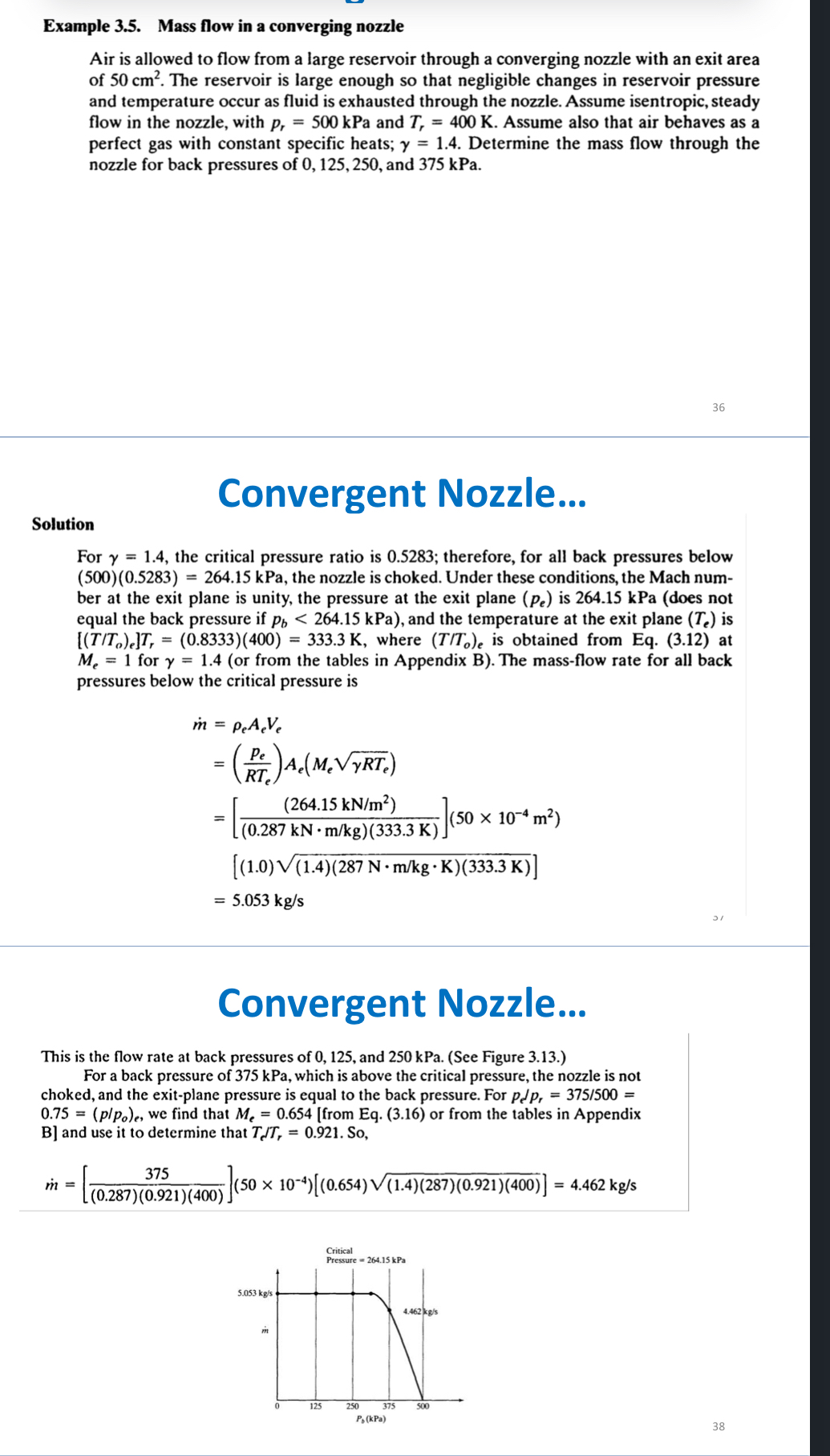
For the critical pressure ratio is ; therefore, for all back pressures below kPa, the nozzle is choked. Under these conditions, the Mach number at the exit plane is unity, the pressure at the exit plane is kPa does not equal the back pressure if kPa and the temperature at the exit plane is where is obtained from Eq at for or from the tables in Appendix B The massflow rate for all back pressures below the critical pressure is
Convergent Nozzle...
This is the flow rate at back pressures of and kPa See Figure
For a back pressure of kPa which is above the critical pressure, the nozzle is not choked, and the exitplane pressure is equal to the back pressure. For we find that from Eq or from the tables in Appendix and use it to determine that So
Step by Step Solution
There are 3 Steps involved in it
1 Expert Approved Answer
Step: 1 Unlock

Question Has Been Solved by an Expert!
Get step-by-step solutions from verified subject matter experts
Step: 2 Unlock
Step: 3 Unlock
 Study Help