







Question: Example 4.20 Let f:(1,infty )->R be defined by f(x)=(1)/(x-1) . If x_(n)=1+(1)/(n) for each n in N , then x_(n)->1 , but f(x_(n))=n for each
Example 4.20 Let
f:(1,\\\\infty )->Rbe defined by
f(x)=(1)/(x-1). If\
x_(n)=1+(1)/(n)for each
nin
N, then
x_(n)->1, but
f(x_(n))=nfor each
n. Hence,\
(f(x_(n)))_(ninN)is not Cauchy. By Theorem 4.5,
fis not uniformly continuous on\
(1,\\\\infty ). [This sequence approach always works when the function has a vertical\ asymptote. The reader should redo Example 4.18 using this approach.]
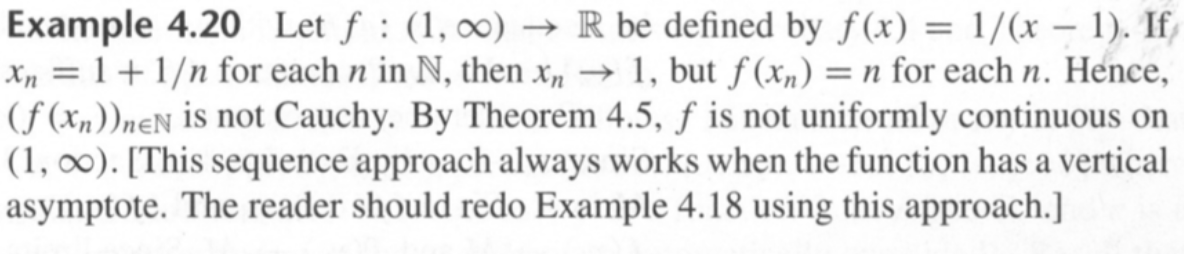
Example 4.20 Let f:(1,)R be defined by f(x)=1/(x1). If xn=1+1 for each n in N, then xn1, but f(xn)=n for each n. Hence, (f(xn))nN is not Cauchy. By Theorem 4.5, f is not uniformly continuous on (1,). [This sequence approach always works when the function has a vertical asymptote. The reader should redo Example 4.18 using this approach.]
Step by Step Solution
There are 3 Steps involved in it

Get step-by-step solutions from verified subject matter experts
 Study Help