







Question: EXAMPLE 4.3 (Application to a gas-liquid system) In a laboratory experiment, the solute A is being absorbed from a mixture with an insoluble gas in
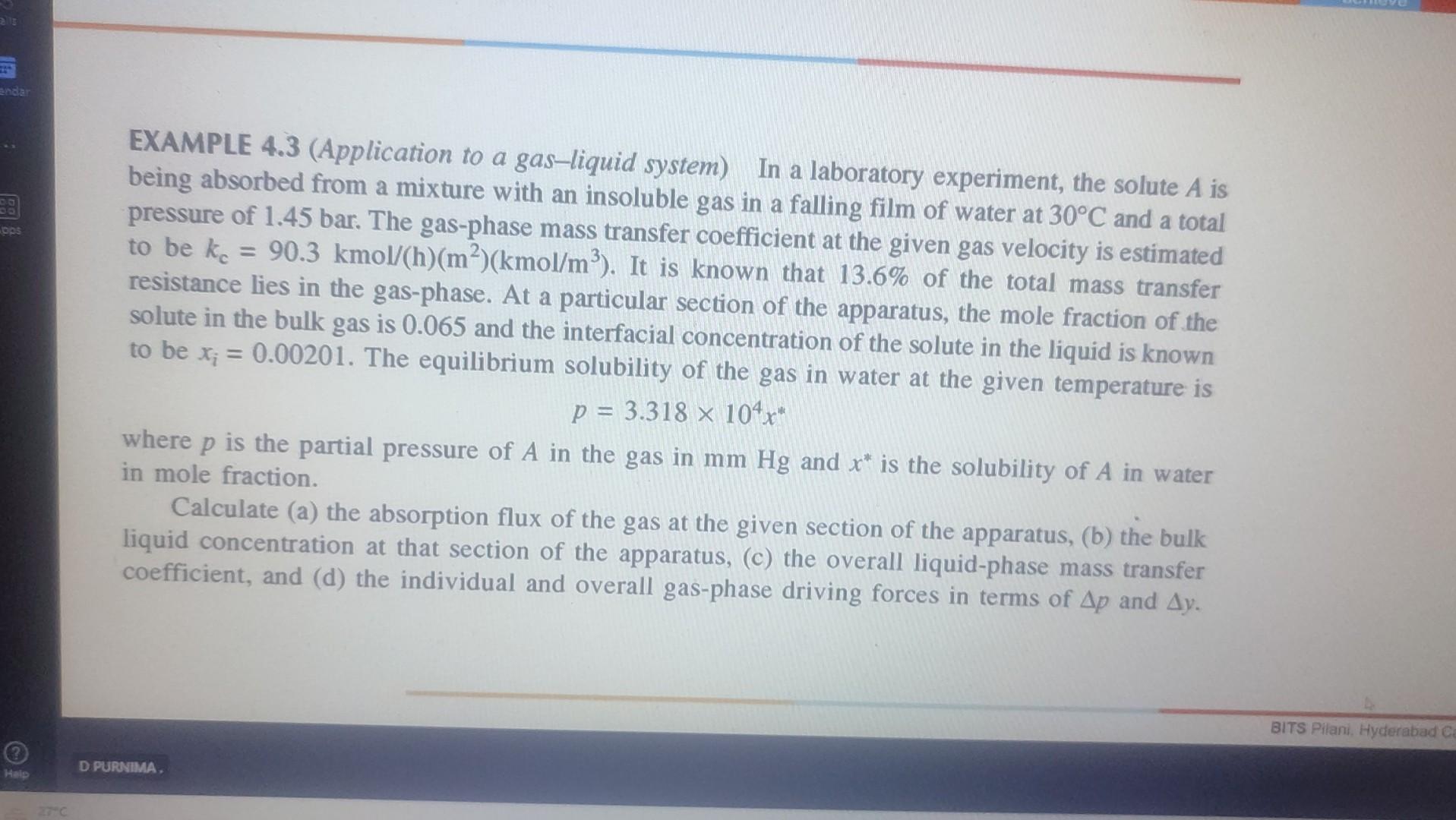
EXAMPLE 4.3 (Application to a gas-liquid system) In a laboratory experiment, the solute A is being absorbed from a mixture with an insoluble gas in a falling film of water at 30C and a total pressure of 1.45 bar. The gas-phase mass transfer coefficient at the given gas velocity is estimated to be kc=90.3kmol/(h)(m2)(kmol/m3). It is known that 13.6% of the total mass transfer resistance lies in the gas-phase. At a particular section of the apparatus, the mole fraction of the solute in the bulk gas is 0.065 and the interfacial concentration of the solute in the liquid is known to be xi=0.00201. The equilibrium solubility of the gas in water at the given temperature is p=3.318104x where p is the partial pressure of A in the gas in mmHg and x is the solubility of A in water in mole fraction. Calculate (a) the absorption flux of the gas at the given section of the apparatus, (b) the bulk liquid concentration at that section of the apparatus, (c) the overall liquid-phase mass transfer coefficient, and (d) the individual and overall gas-phase driving forces in terms of p and y
Step by Step Solution
There are 3 Steps involved in it

Get step-by-step solutions from verified subject matter experts
 Study Help