







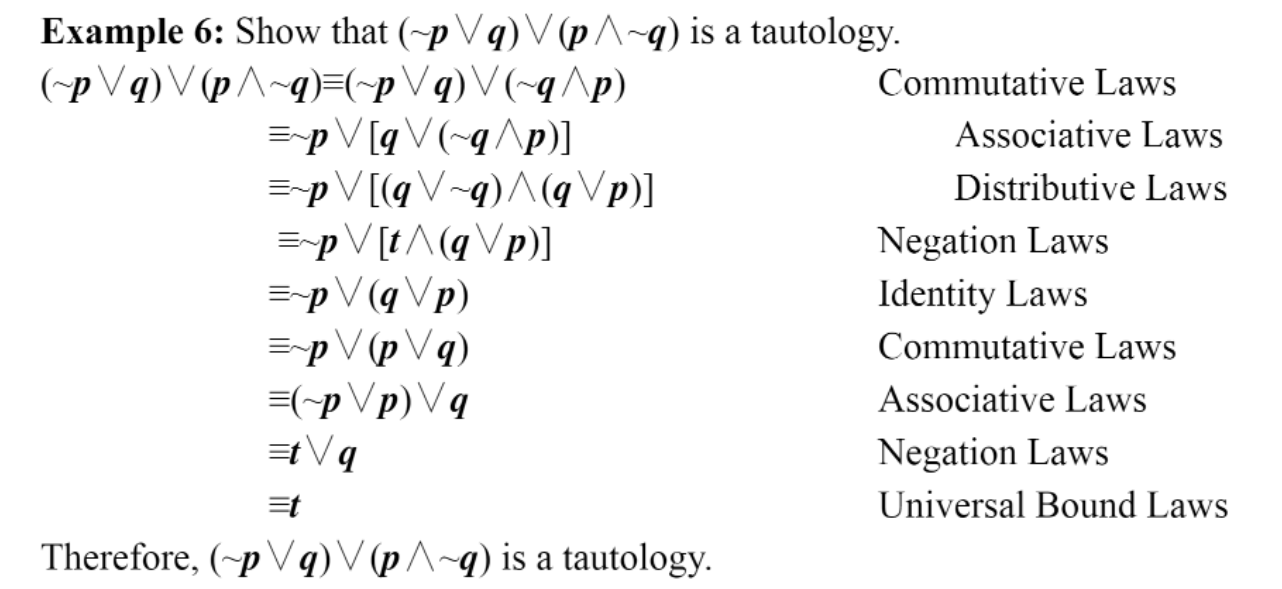
Question: Example 6: Show that (~p V q) V(p/~q) is a tautology. (p q) V(p/ ~q)=(PVq)V(~q/p) Commutative Laws = pV [q V(~q/p)] Associative Laws =~p V
![(p q) V(p/ ~q)=(PVq)V(~q/p) Commutative Laws = pV [q V(~q/p)] Associative Laws](https://dsd5zvtm8ll6.cloudfront.net/si.experts.images/questions/2024/10/6703fc4edc315_4466703fc4ec95e5.jpg)
![=~p V [(q V-q) /(qVp)] Distributive Laws =~PV [t/(q Vp)] Negation Laws](https://dsd5zvtm8ll6.cloudfront.net/si.experts.images/questions/2024/10/6703fc4f37490_4476703fc4f168d5.jpg)
Example 6: Show that (~p V q) V(p/~q) is a tautology. (p q) V(p/ ~q)=(PVq)V(~q/p) Commutative Laws = pV [q V(~q/p)] Associative Laws =~p V [(q V-q) /(qVp)] Distributive Laws =~PV [t/(q Vp)] Negation Laws =~p V (q Vp) Identity Laws =pV (p Vq) Commutative Laws =(~p Vp) Vq Associative Laws =tvq Negation Laws Et Universal Bound Laws Therefore, (~p Vq) V(p/~q) is a tautology.3. Show that (p - q) - r= (pA ~q) Vr using laws of equivalence.\f
Step by Step Solution
There are 3 Steps involved in it
1 Expert Approved Answer
Step: 1 Unlock

Question Has Been Solved by an Expert!
Get step-by-step solutions from verified subject matter experts
Step: 2 Unlock
Step: 3 Unlock
 Study Help