







Question: Example 6-1 A contractor elects to use a bottom dump front excavator with a 1 cubic yard bucked and 10 feet. ideal depth of cut
Example 6-1
A contractor elects to use a bottom dump front excavator with a 1 cubic yard bucked and 10 feet.
ideal depth of cut to perform the excavation for a new motel. The average depth of cut for this. excavation will be 6 feet. The excavated material is common earth. They job conditions are excellent, while management conditions are fair. The job site provides for a 90-degree angle of swing. (a) Calculate the actual production of this shovel in BCY's based on an ideal productivity from table 6-2. Calculate the actual of this shovel in BCY's based on the ideal productivity formula.
Solution:
a.Step 1 -Obtain Ideal Productivity (Table 6-2)
With I cy bucket and material common earth
Ideal Productivity = 175 BCY/hr. 240
Step 2 - Determine efficiency Factor (Table 5-1)
With Fair Management and Excellent Job Conditions
Efficiency Factor = 0.76
Step 3 - Determine Swing/Depth Factor (Table 6-3)
With 90 Angle of Swing and 60% depth of cut (6'/10')
Swing/Depth Factor = 0.91
Step 4 - Calculate. Actual Production
Actual Production = Ideal Production x Efficiency Factor x Swing/Depth Factor
Actual production = 175 BCY/hr. x 0.76 x 0.91 = 121.03 BCY/hr.
b.Step 1 - Obtain Ideal Productivity by Formula.
With: Bucket Fill Factor= 1.10 (Table 6-1)
Swell= 25% (Table 4-1)
Ideal Cycle Time= 20 sec (estimated)
Ideal productivity = ((Bucket Capacity) x (fill Factor) / Ideal Cycle Time
Ideal Productivity = (1 LCY x 1.10 x 3600 sec/hr.) / (20sec x 1.25 BCY/ LCY)
Ideal Productivity =158.4 BCY/hr.
Step 2 - Calculate Actual Production
Actual Production = 158.4 BCY/hr. x 0.76 x 0.91 =109.5 BCY/hr.
Example 6-1 Illustrates that different methods may produce slightly different answers. It should also be noted that most manufactures have there own tables of adjustment factors, and the factors will generally differ slightly between manufacturers.
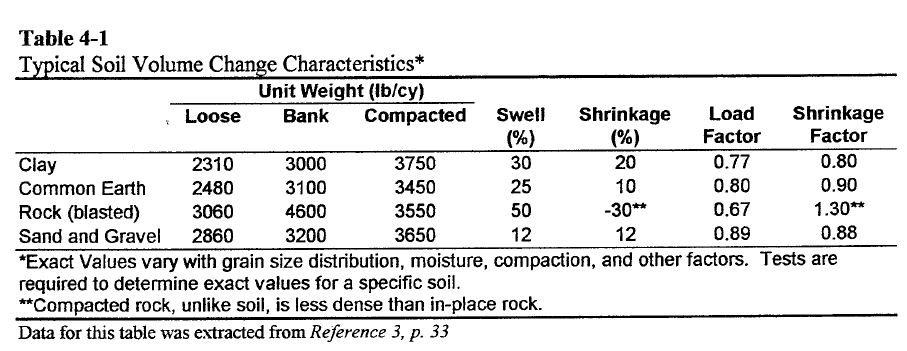
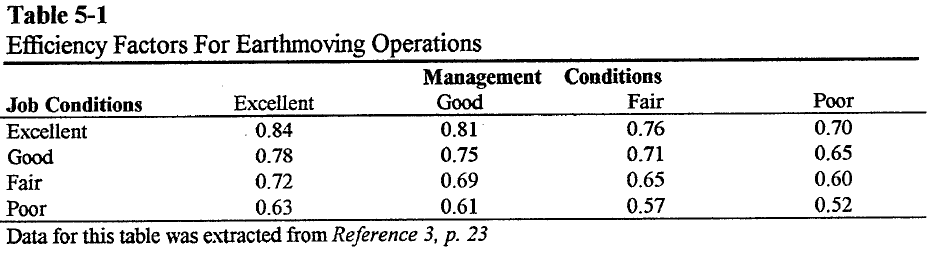
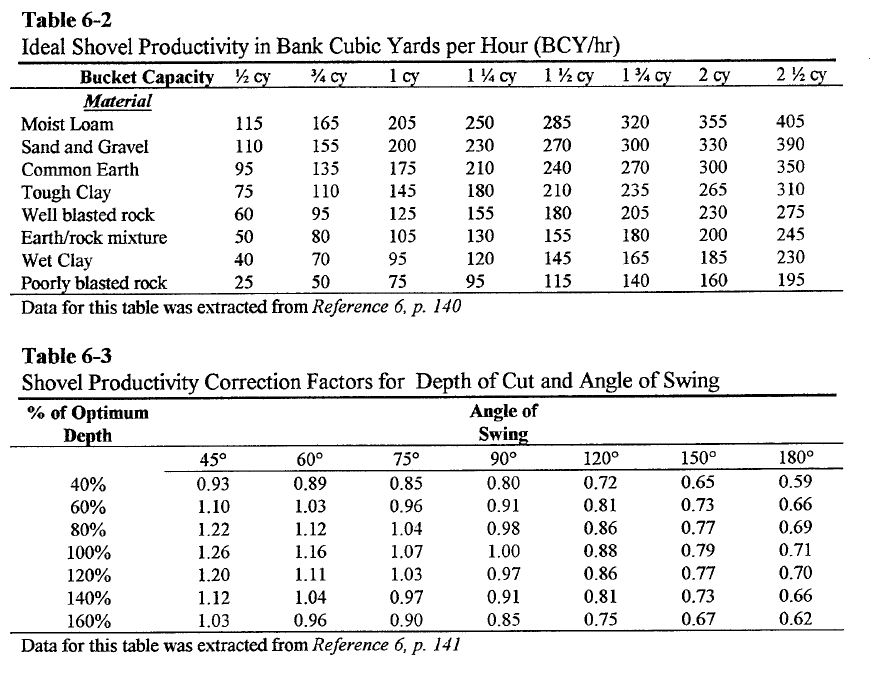
Table 41 Twice] Soil Volume Chinge Characteristics* Unit Weight {threw . Loose Bank Compacted Swell Shrinkage Load Shrinkage 1%} 1%] Factor Factor Clay 2310 3000 3'50 30 20 0.?7 0.00 Common Earth 2430 3100 3450 25 10 0.80 0.90 Rock (blasted) 3060 4600 3550 50 -30** 0.67 1.30\" Sand and Gravel 2860 3200 3350 12 12 0.89 0.33 \"Exact Values vary with grain size distribution. moisture. compaction, and other factors. Tests are required to determine exact values for a specic soil. \"Compacted rock, unlike soil, is less dense than int-place rock. Data for this table was extracted from Reference 3, p. 33 Table 5-1 Eficicncy Factors For Earthmoving Operations Management Conditions Job Conditions Excellent Good Fair Poor Excellent . 0.84 0.31 ' 0.76 0.70 Good 0-73 0.75 0.71 0.65 Fair 0.72 0.69 0.65 0.60 Poor 0.63 0.61 0.57 0.52 Data for this table was extracted from Reference 3, p. 23 \f
Step by Step Solution
There are 3 Steps involved in it

Get step-by-step solutions from verified subject matter experts
 Study Help