







Question: EXAMPLE 9.9. Consider a company that is going to build a new manufacturing system and would like to determine the long-run (steady-state) mean hourly throughput
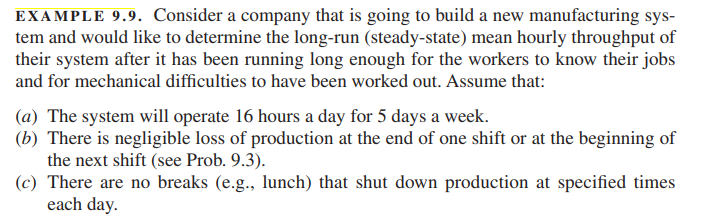

EXAMPLE 9.9. Consider a company that is going to build a new manufacturing system and would like to determine the long-run (steady-state) mean hourly throughput of their system after it has been running long enough for the workers to know their jobs and for mechanical difficulties to have been worked out. Assume that: (a) The system will operate 16 hours a day for 5 days a week. (b) There is negligible loss of production at the end of one shift or at the beginning of the next shift (see Prob. 9.3). (c) There are no breaks (e.g., lunch) that shut down production at specified times each day. 9.4. Suppose in Example 9.9 that we would like to estimate the steady-state mean total time in system of a part. Does our approach to simulating the manufacturing system present a problem? EXAMPLE 9.9. Consider a company that is going to build a new manufacturing system and would like to determine the long-run (steady-state) mean hourly throughput of their system after it has been running long enough for the workers to know their jobs and for mechanical difficulties to have been worked out. Assume that: (a) The system will operate 16 hours a day for 5 days a week. (b) There is negligible loss of production at the end of one shift or at the beginning of the next shift (see Prob. 9.3). (c) There are no breaks (e.g., lunch) that shut down production at specified times each day. 9.4. Suppose in Example 9.9 that we would like to estimate the steady-state mean total time in system of a part. Does our approach to simulating the manufacturing system present a
Step by Step Solution
There are 3 Steps involved in it

Get step-by-step solutions from verified subject matter experts
 Study Help