







Question: Example Class 1 1 true false true false 2 3 4 a. Classify (false,4) with Nearest-Neighbour b. Classify (false,4) with 3NN c. Compute a prototype
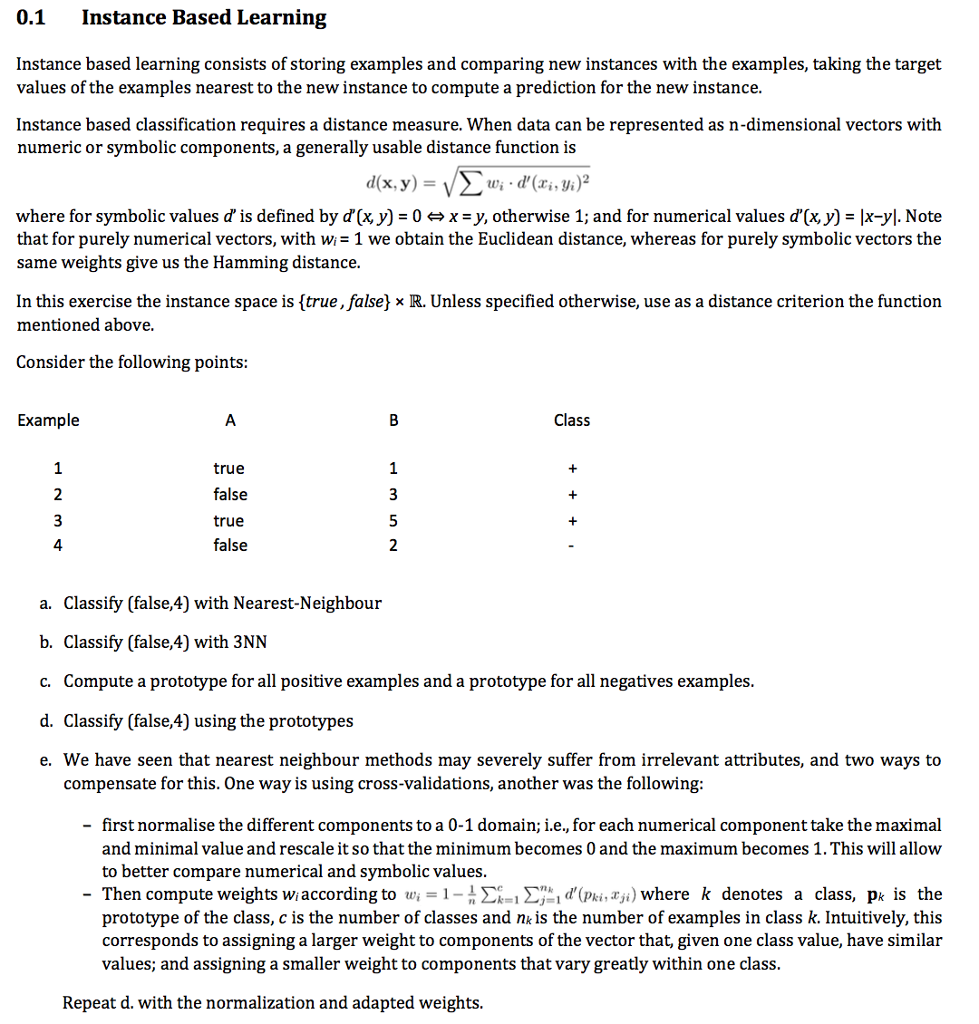
Example Class 1 1 true false true false 2 3 4 a. Classify (false,4) with Nearest-Neighbour b. Classify (false,4) with 3NN c. Compute a prototype for all positive examples and a prototype for all negatives examples. d. Classify (false,4) using the prototypes e. We have seen that nearest neighbour methods may severely suffer from irrelevant attributes, and two ways to compensate for this. One way is using cross-validations, another was the following first normalise the different components to a 0-1 domain; i.e., for each numerical component take the maximal and minimal value and rescale it so that the minimum becomes 0 and the maximum becomes 1. This will allow to better compare numerical and symbolic values Then compute weights w, according to wi=1-1 1 d'(pki,Zji) where k denotes a class, pk is the prototype of the class, c is the number of classes and nk is the number of examples in class k. Intuitively, this corresponds to assigning a larger weight to components of the vector that, given one class value, have similar values; and assigning a smaller weight to components that vary greatly within one class Repeat d. with the normalization and adapted weights Example Class 1 1 true false true false 2 3 4 a. Classify (false,4) with Nearest-Neighbour b. Classify (false,4) with 3NN c. Compute a prototype for all positive examples and a prototype for all negatives examples. d. Classify (false,4) using the prototypes e. We have seen that nearest neighbour methods may severely suffer from irrelevant attributes, and two ways to compensate for this. One way is using cross-validations, another was the following first normalise the different components to a 0-1 domain; i.e., for each numerical component take the maximal and minimal value and rescale it so that the minimum becomes 0 and the maximum becomes 1. This will allow to better compare numerical and symbolic values Then compute weights w, according to wi=1-1 1 d'(pki,Zji) where k denotes a class, pk is the prototype of the class, c is the number of classes and nk is the number of examples in class k. Intuitively, this corresponds to assigning a larger weight to components of the vector that, given one class value, have similar values; and assigning a smaller weight to components that vary greatly within one class Repeat d. with the normalization and adapted weights
Step by Step Solution
There are 3 Steps involved in it

Get step-by-step solutions from verified subject matter experts
 Study Help