







Question: Example Problem Final Velocity After Uniform Acceleration If a car with a velocity of 2.0 m/s at t = 0 accelerates at a rate of
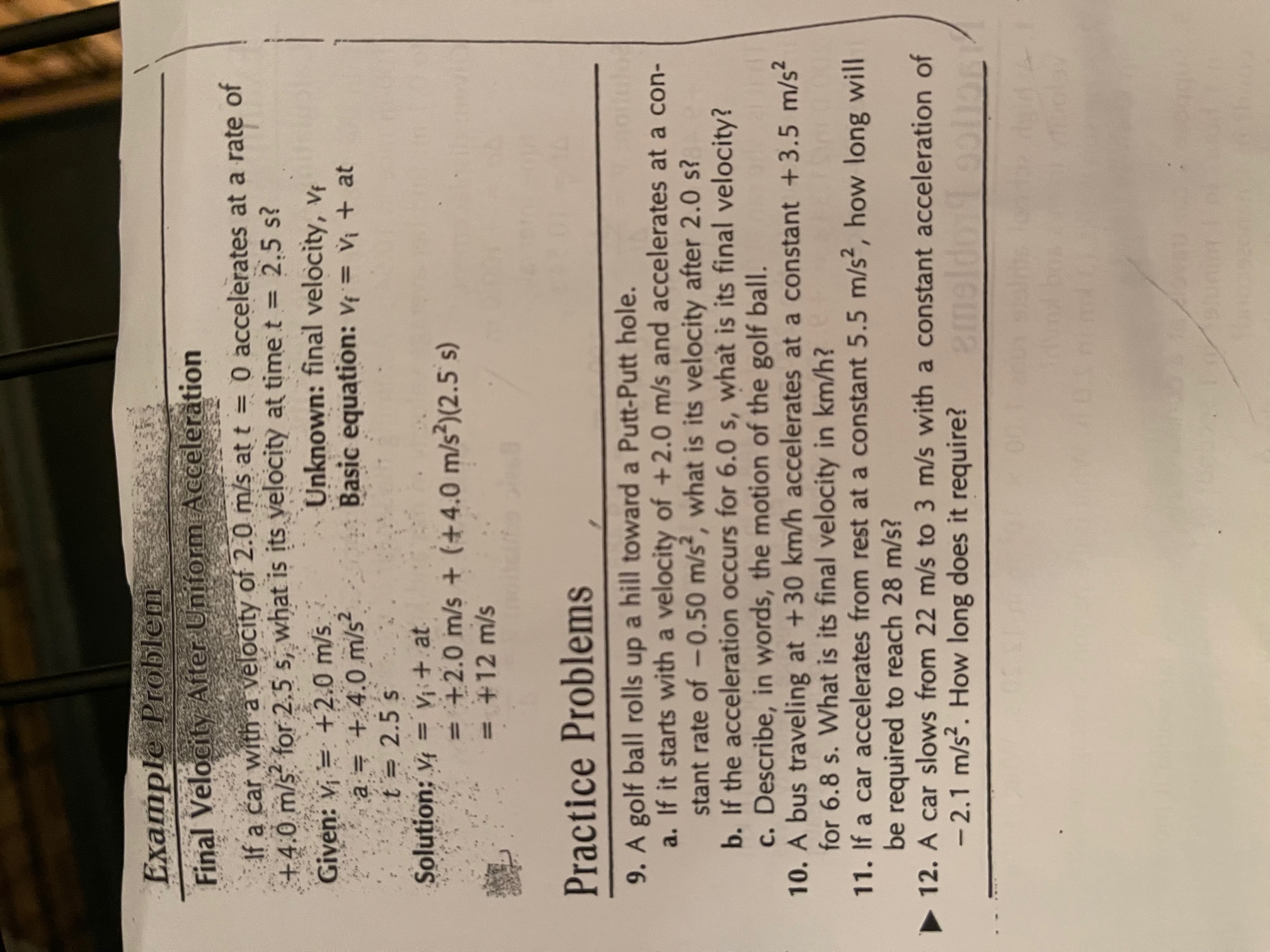
Example Problem Final Velocity After Uniform Acceleration If a car with a velocity of 2.0 m/s at t = 0 accelerates at a rate of + 4:0 m/s? for 2.5 s, what is its velocity at time t = 2.5 s? Given: Vi = + 2.0 m/s. Unknown: final velocity, Vf a = + 4.0 m/s Basic equation: Vf = Vi + at it = 2.5 s Solution; Wf = Viit at = +2.0 m/s + (+4.0 m/s?)(2.5's) = +12 m/s Practice Problems 9. A golf ball rolls up a hill toward a Putt-Putt hole. a. If it starts with a velocity of + 2.0 m/s and accelerates at a con- stant rate of -0.50 m/s', what is its velocity after 2.0 s? b. If the acceleration occurs for 6.0 s, what is its final velocity? c. Describe, in words, the motion of the golf ball. 10. A bus traveling at + 30 km/h accelerates at a constant + 3.5 m/s for 6.8 s. What is its final velocity in km/h? 11. If a car accelerates from rest at a constant 5.5 m/s, how long will be required to reach 28 m/s? 12. A car slows from 22 m/s to 3 m/s with a constant acceleration of -2.1 m/s2. How long does it require
Step by Step Solution
There are 3 Steps involved in it

Get step-by-step solutions from verified subject matter experts
 Study Help