







Question: Solution: From the equation: a = fi we can derive a formula to be used in solving for the final velocity. That would be v,
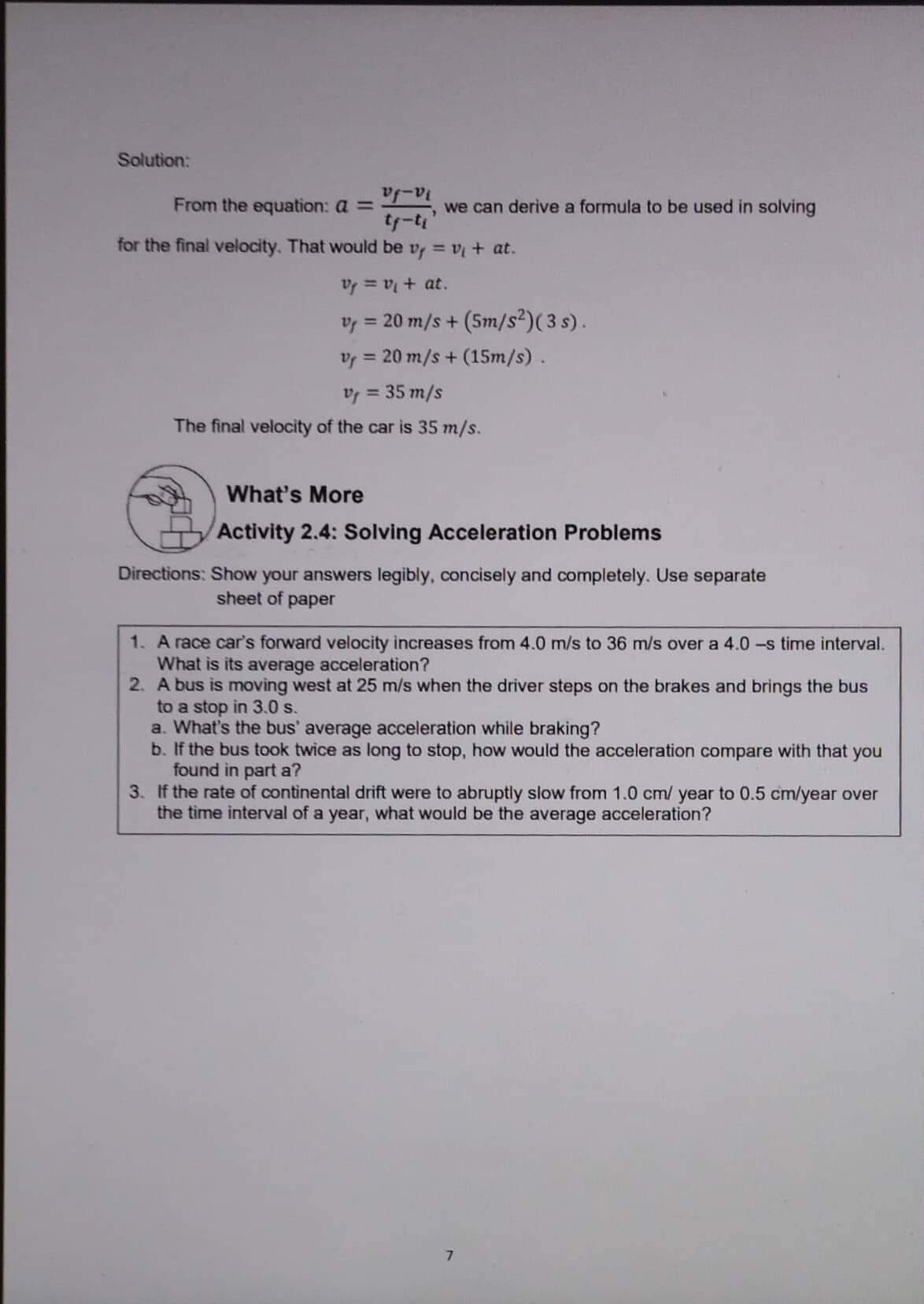
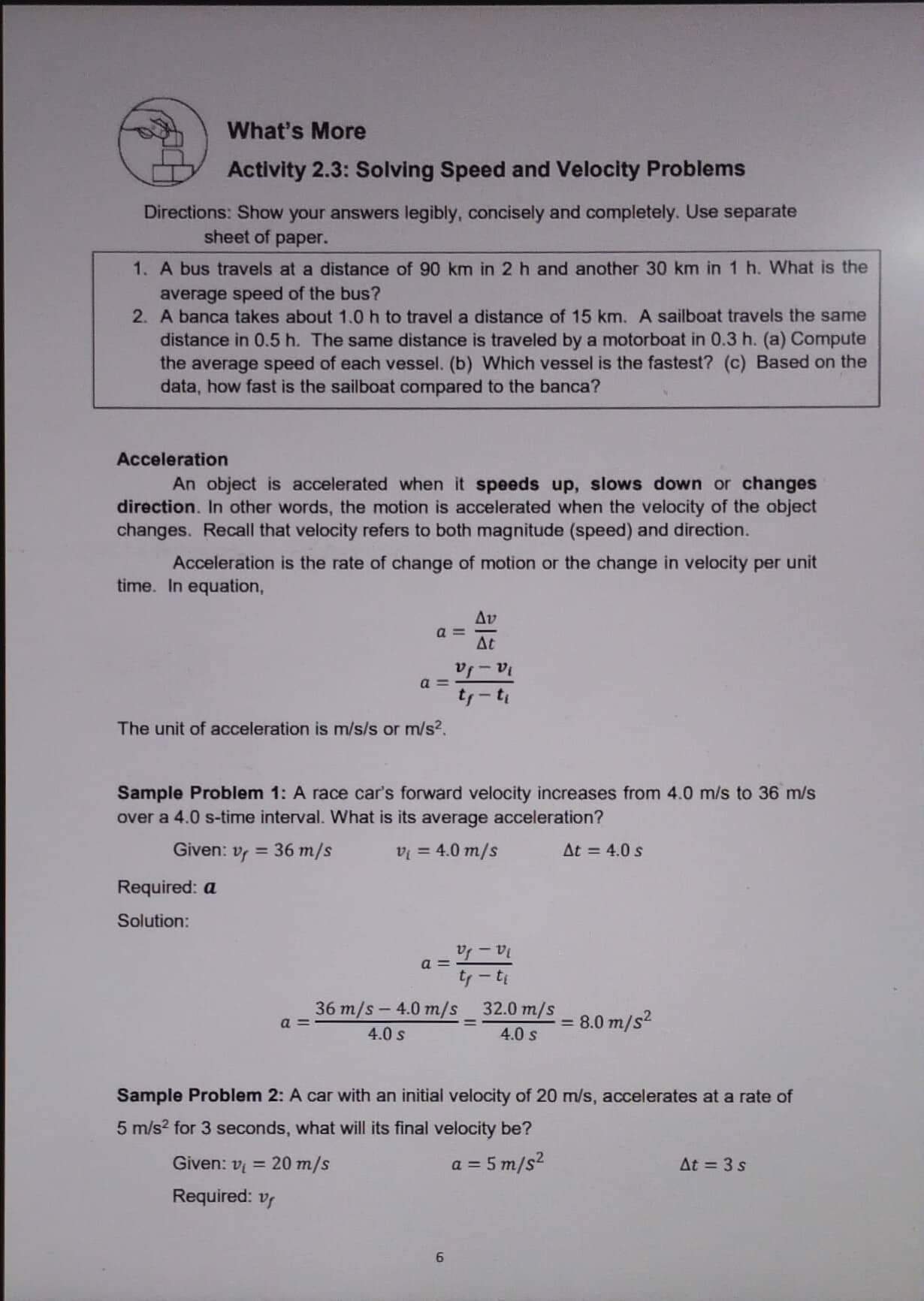
Solution: From the equation: a = fi we can derive a formula to be used in solving for the final velocity. That would be v, = v, + at. up = vit at. Uf = 20 m/s + (5m/52) ( 3 s) . Uf = 20 m/s + (15m/s) . vy = 35 m/s The final velocity of the car is 35 m/s. What's More Activity 2.4: Solving Acceleration Problems Directions: Show your answers legibly, concisely and completely. Use separate sheet of paper 1. A race car's forward velocity increases from 4.0 m/s to 36 m/s over a 4.0 -s time interval. What is its average acceleration? 2. A bus is moving west at 25 m/s when the driver steps on the brakes and brings the bus to a stop in 3.0 s. a. What's the bus' average acceleration while braking? b. If the bus took twice as long to stop, how would the acceleration compare with that you found in part a? 3. If the rate of continental drift were to abruptly slow from 1.0 cm/ year to 0.5 cm/year over the time interval of a year, what would be the average acceleration?What's More Activity 2.3: Solving Speed and Velocity Problems Directions: Show your answers legibly, concisely and completely. Use separate sheet of paper. 1. A bus travels at a distance of 90 km in 2 h and another 30 km in 1 h. What is the average speed of the bus? 2. A banca takes about 1.0 h to travel a distance of 15 km. A sailboat travels the same distance in 0.5 h. The same distance is traveled by a motorboat in 0.3 h. (a) Compute the average speed of each vessel. (b) Which vessel is the fastest? (c) Based on the data, how fast is the sailboat compared to the banca? Acceleration An object is accelerated when it speeds up, slows down or changes direction. In other words, the motion is accelerated when the velocity of the object changes. Recall that velocity refers to both magnitude (speed) and direction. Acceleration is the rate of change of motion or the change in velocity per unit time. In equation, Av At a= ty - ti The unit of acceleration is m/s/s or m/s?. Sample Problem 1: A race car's forward velocity increases from 4.0 m/s to 36 m/s over a 4.0 s-time interval. What is its average acceleration? Given: vy = 36 m/s V1 = 4.0 m/s At = 4.0 s Required: a Solution: a =- ty - ti a = - 36 m/s - 4.0 m/s 32.0 m/S - 8.0 m/Sz 4.0 s 4.0 s Sample Problem 2: A car with an initial velocity of 20 m/s, accelerates at a rate of 5 m/s2 for 3 seconds, what will its final velocity be? Given: vi = 20 m/s a = 5m/$2 At = 3 s Required: vs 6
Step by Step Solution
There are 3 Steps involved in it

Get step-by-step solutions from verified subject matter experts
 Study Help