







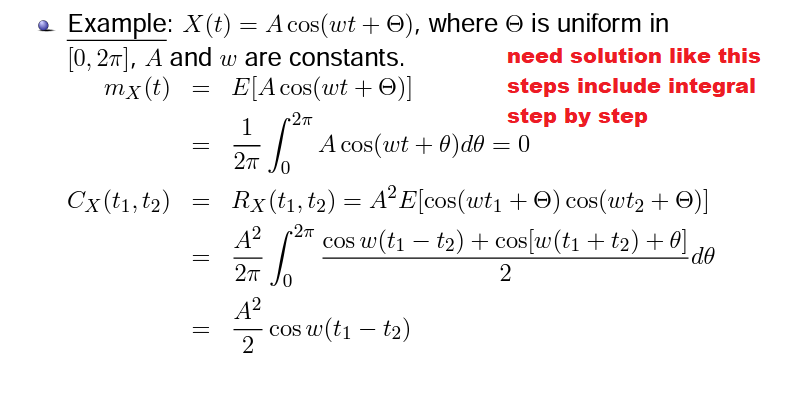
Question: Example: X(t) = Acos(wt + (), where @ is uniform in [0, 27], A and w are constants. need solution like this mx(t) = E
![[0, 27], A and w are constants. need solution like this mx(t)](https://s3.amazonaws.com/si.experts.images/answers/2024/06/667e36a3612ae_555667e36a33e242.jpg)
![= E A cos(wt + 9)] steps include integral 2 TT step](https://s3.amazonaws.com/si.experts.images/answers/2024/06/667e36a3b6504_555667e36a3a257f.jpg)
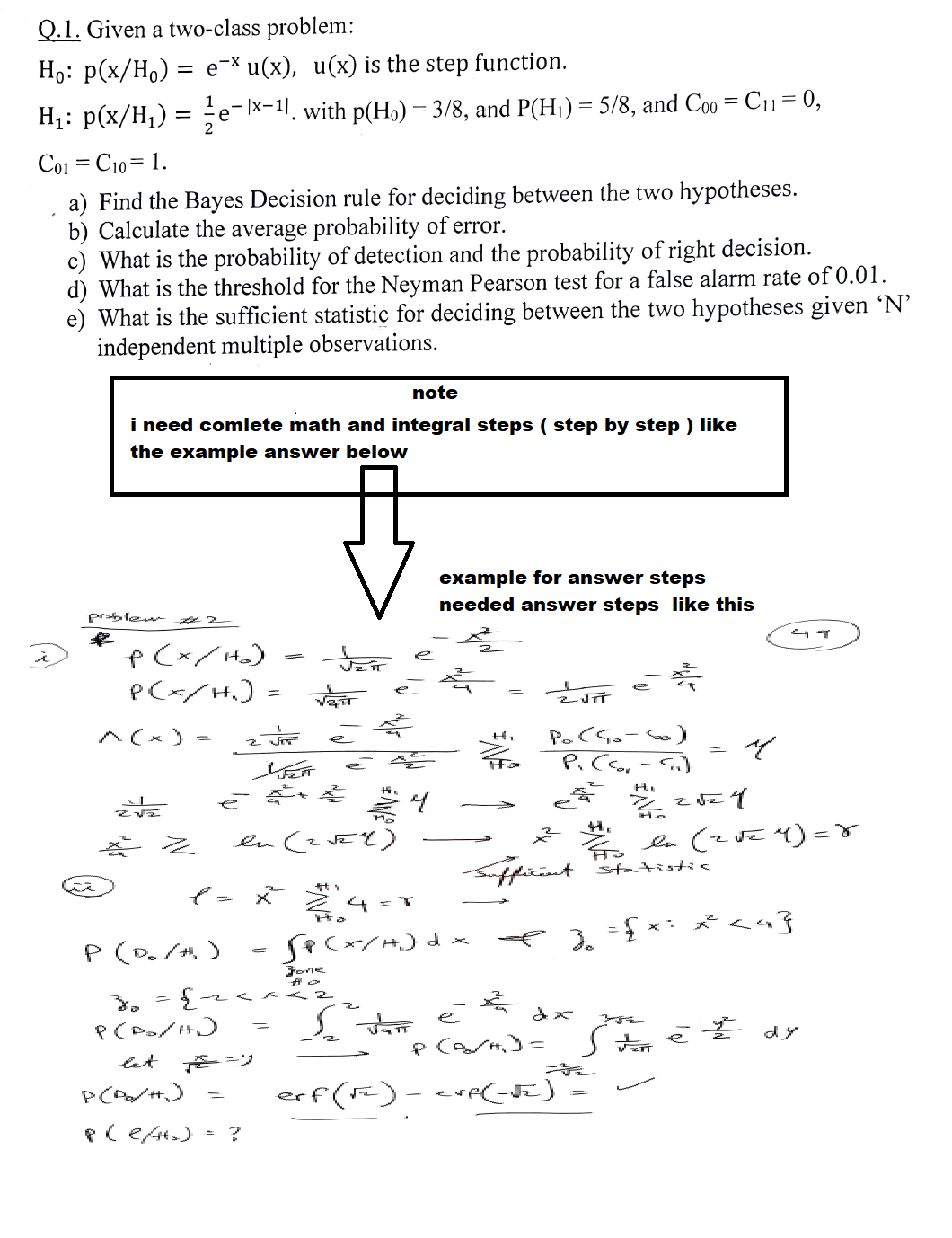
Example: X(t) = Acos(wt + (), where @ is uniform in [0, 27], A and w are constants. need solution like this mx(t) = E A cos(wt + 9)] steps include integral 2 TT step by step = A cos( wt + 0)de = 0 27 Jo Cx (t1, t2) = Rx(t1, t2) = A' E[cos(wt1 + () cos(wt2 + 9)] A2 cos w(t1 - t2) + cos|w (t1 + t2) + 0 = de 2TT Jo 2 A2 = cos w(t1 - t2) 2Q.1. Given a two-class problem: Ho: p(x/Ho) = e-xu(x), u(x) is the step function. H1: p(x/H,) = =e- (x-1/. with p(Ho) = 3/8, and P(H1) = 5/8, and Coo = Cl1 = 0, CO1 = C10 = 1. a) Find the Bayes Decision rule for deciding between the two hypotheses. b) Calculate the average probability of error. c) What is the probability of detection and the probability of right decision. d) What is the threshold for the Neyman Pearson test for a false alarm rate of 0.01. e) What is the sufficient statistic for deciding between the two hypotheses given 'N' independent multiple observations. note i need comlete math and integral steps ( step by step ) like the example answer below example for answer steps problem # 2 needed answer steps like this p ( x / 12 ) = Jzi e P ( * / H . ) = VATT e - JIT M ( X ) = 2 Un e e 22124 H . Fo # ( 212 4 ) =7 statistic f = x Z P (D. / M ) = Tome 2 = e to dox y ez dy P ( part ) = erf ( F ) - exp (-12 ) : p ( e/( ) =
Step by Step Solution
There are 3 Steps involved in it

Get step-by-step solutions from verified subject matter experts
 Study Help