







Question: Exercise 1 (10 points) Let us consider two mutually exclusive investment projects with the same three-year lifetime. Project A requires an initial investment of 10,000
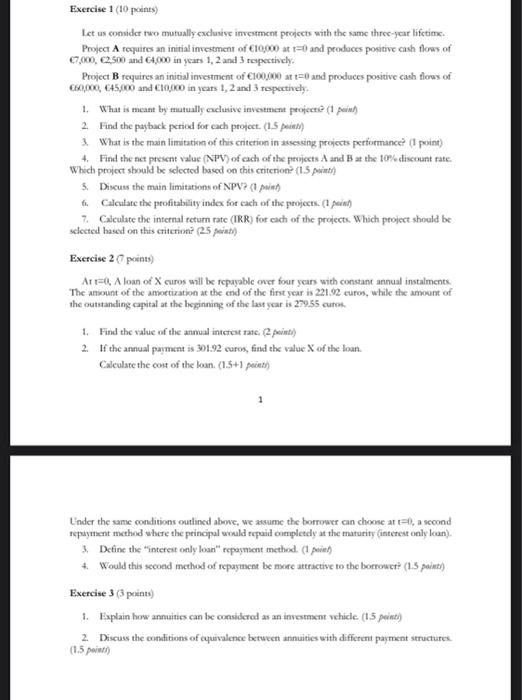
Exercise 1 (10 points) Let us consider two mutually exclusive investment projects with the same three-year lifetime. Project A requires an initial investment of 10,000 at 1-0 and produces positive cash flows of 7,000, 2,500 and 4,000 in years 1, 2 and 3 respectively. Project B requires an initial investment of 100,000 at 1-0 and produces positive cash flows of 60,000, 45,000 and 10,000 in years 1, 2 and 3 respectively. 1. What is meant by mutually exclusive investment projects (1 paint) 2. Find the payback period for each project. (1.5 point) 3. What is the main limitation of this criterion in assessing projects performance? (1 point) 4. Find the net present value (NPV) of each of the projects A and B at the 10% discount rate. Which project should be selected based on this criterion? (1.5 point) 5. Discuss the main limitations of NPV? (1 point) 6. Calculate the profitability index for each of the projects. (1 point) 7. Calculate the internal return rate (IRR) for each of the projects. Which project should be selected based on this criterion? (25 point) Exercise 27 points) Art=0, A loan of X curos will be repayable over four years with constant annual instalments The amount of the amortization at the end of the first year is 221.92 euros, while the amount of the outstanding capital at the beginning of the last year is 279.55 euros. 1. Find the value of the annual interest rate. (2 point) 2. If the annual payment is 301.92 euros, find the value X of the loan. Calculate the cost of the loan. (1.5+1 point) 1 Under the same conditions outlined above, we assume the borrower can choose at t=0), a second repayment method where the principal would repaid completely at the maturity (interest only loan). 3 Define the "interest only loan" repayment method. (1 point) 4. Would this second method of repayment be more attractive to the borrower? (1.5 point) Exercise 3 (3 points) 1. Explain how annuities can be considered as an investment vehicle. (1.5 point) 2. Discuss the conditions of equivalence between annuities with different payment structures. (1.5 points)
Step by Step Solution
There are 3 Steps involved in it

Get step-by-step solutions from verified subject matter experts
 Study Help