







Question: Exercise 1 (10 points) Model at the transaction level in SystemC a module representing a timer/counter which: 1. implements a free-running 32-bit (1.e. unsigned int)
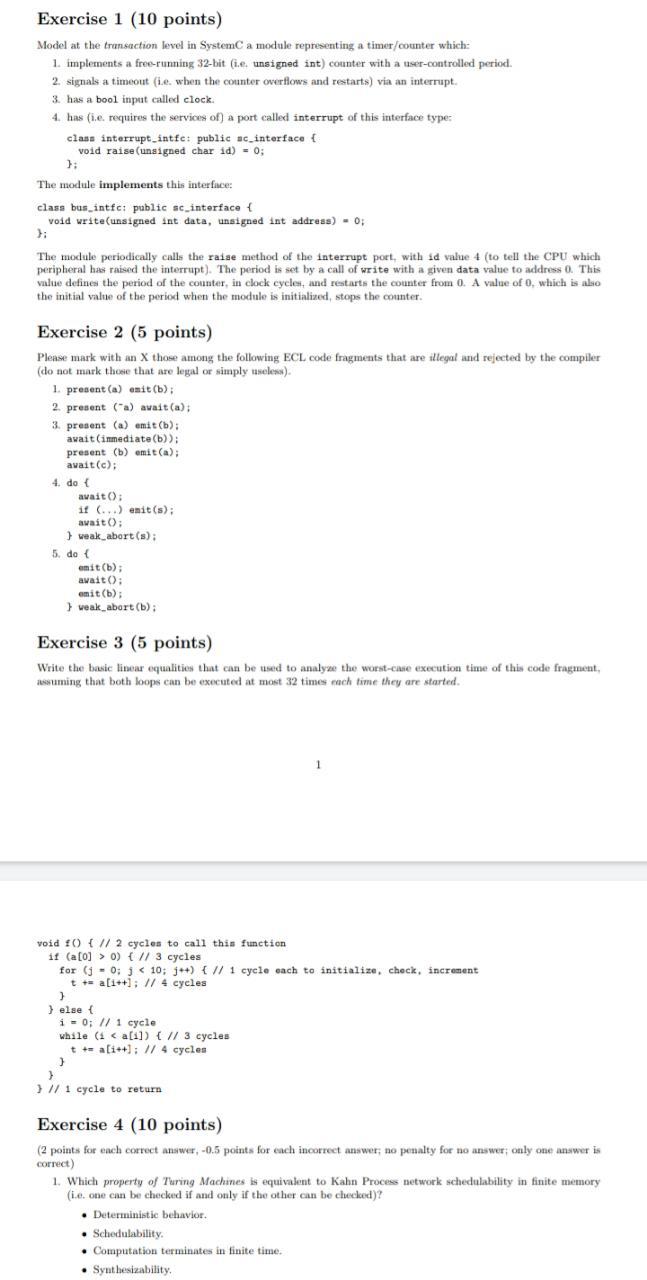
Exercise 1 (10 points) Model at the transaction level in SystemC a module representing a timer/counter which: 1. implements a free-running 32-bit (1.e. unsigned int) counter with a user-controlled period. 2 signals a timeout (e. when the counter overflows and restarts) via an interrupt. 3. has a bool input called clock. 4. has (1.e. requires the services of) a port called interrupt of this interface typer class interrupt_intfc: public sc_interface { void raise (unsigned char id) = 0; The module implements this interface: class bus_intfc: public sc_interface { void write(unsigned int data, unsigned int address) - 0 The module periodically calls the raise method of the interrupt port, with id value 4 (to tell the CPU which peripheral has raised the interrupt). The period is set by a call of write with a given data value address 0. This value defines the period of the counter, in clock cycles, and restarts the counter from 0. A value of 0, which is also the initial value of the period when the module is initialized, stops the counter. Exercise 2 (5 points) Please mark with an X those among the following ECL code fragments that are illegal and rejected by the compiler (do not mark those that are legal or simply useless). 1. present (a) esit(b): 2 present (-a) avait(a): 3. present (a) emit(b); await immediate(b)); present (b) emit(); avait(c): 4. do avait() if (...) ent(s); await(); weak_abort(s); 5. do emit(b): await(); emit(); weak_abort(b): Exercise 3 (5 points) Write the basic linear equlities that can be used to analyze the worst-cinte execution time of this code fragment, assuming that both loops can be executed at most 32 times each time they are started void 0 { // 2 cycles to call this function if (a[0] > 0) { // 3 cycles for (j 0; j } // 1 cycle to return Exercise 4 (10 points) (2 points for each correct answer, -0.5 points for each incorrect answer: no penalty for no answer; only one answer is correct) 1. Which property of Turing Machines is equivalent to Kahn Process network schedulability in finite memory (i... one can be checked if and only if the other can be checked)? Deterministic behavior. Schedulability Computation terminates in finite time. Synthesizability. Exercise 1 (10 points) Model at the transaction level in SystemC a module representing a timer/counter which: 1. implements a free-running 32-bit (1.e. unsigned int) counter with a user-controlled period. 2 signals a timeout (e. when the counter overflows and restarts) via an interrupt. 3. has a bool input called clock. 4. has (1.e. requires the services of) a port called interrupt of this interface typer class interrupt_intfc: public sc_interface { void raise (unsigned char id) = 0; The module implements this interface: class bus_intfc: public sc_interface { void write(unsigned int data, unsigned int address) - 0 The module periodically calls the raise method of the interrupt port, with id value 4 (to tell the CPU which peripheral has raised the interrupt). The period is set by a call of write with a given data value address 0. This value defines the period of the counter, in clock cycles, and restarts the counter from 0. A value of 0, which is also the initial value of the period when the module is initialized, stops the counter. Exercise 2 (5 points) Please mark with an X those among the following ECL code fragments that are illegal and rejected by the compiler (do not mark those that are legal or simply useless). 1. present (a) esit(b): 2 present (-a) avait(a): 3. present (a) emit(b); await immediate(b)); present (b) emit(); avait(c): 4. do avait() if (...) ent(s); await(); weak_abort(s); 5. do emit(b): await(); emit(); weak_abort(b): Exercise 3 (5 points) Write the basic linear equlities that can be used to analyze the worst-cinte execution time of this code fragment, assuming that both loops can be executed at most 32 times each time they are started void 0 { // 2 cycles to call this function if (a[0] > 0) { // 3 cycles for (j 0; j } // 1 cycle to return Exercise 4 (10 points) (2 points for each correct answer, -0.5 points for each incorrect answer: no penalty for no answer; only one answer is correct) 1. Which property of Turing Machines is equivalent to Kahn Process network schedulability in finite memory (i... one can be checked if and only if the other can be checked)? Deterministic behavior. Schedulability Computation terminates in finite time. Synthesizability
Step by Step Solution
There are 3 Steps involved in it

Get step-by-step solutions from verified subject matter experts
 Study Help