







Question: Exercise 1. Consider some benchmark computation consisting of floating-point (fp) operations and non-fp operations. Let's look at how speedup behaves when we incorporate the faster
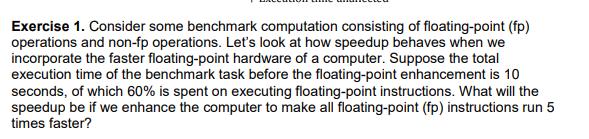
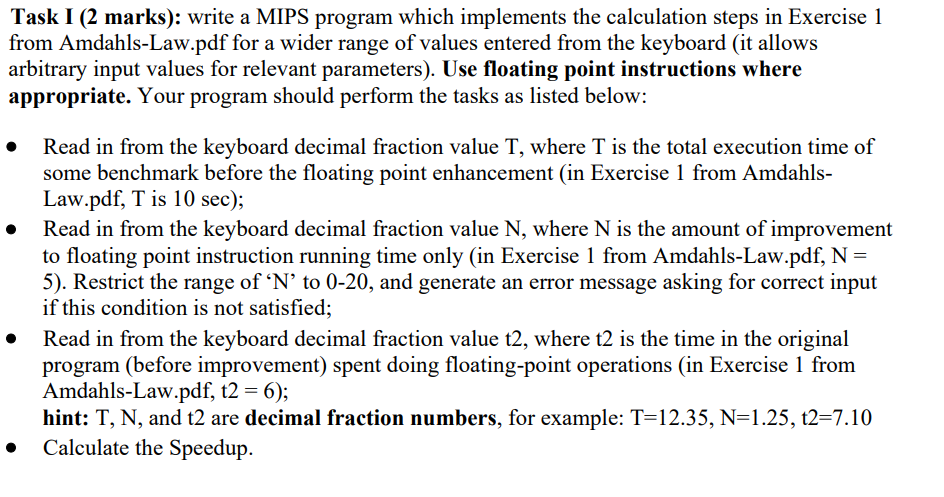
Exercise 1. Consider some benchmark computation consisting of floating-point (fp) operations and non-fp operations. Let's look at how speedup behaves when we incorporate the faster floating-point hardware of a computer. Suppose the total execution time of the benchmark task before the floating-point enhancement is 10 seconds, of which 60% is spent on executing floating-point instructions. What will the speedup be if we enhance the computer to make all floating-point (fp) instructions run 5 times faster? Task I (2 marks): write a MIPS program which implements the calculation steps in Exercise 1 from Amdahls-Law.pdf for a wider range of values entered from the keyboard (it allows arbitrary input values for relevant parameters). Use floating point instructions where appropriate. Your program should perform the tasks as listed below: Read in from the keyboard decimal fraction value T, where T is the total execution time of some benchmark before the floating point enhancement (in Exercise 1 from Amdahls- Law.pdf, T is 10 sec); Read in from the keyboard decimal fraction value N, where N is the amount of improvement to floating point instruction running time only (in Exercise 1 from Amdahls-Law.pdf, N= 5). Restrict the range of N to 0-20, and generate an error message asking for correct input if this condition is not satisfied; Read in from the keyboard decimal fraction value t2, where t2 is the time in the original program (before improvement) spent doing floating-point operations (in Exercise 1 from Amdahls-Law.pdf, t2 = 6); hint: T, N, and t2 are decimal fraction numbers, for example: T=12.35, N=1.25, t2=7.10 Calculate the Speedup. Exercise 1. Consider some benchmark computation consisting of floating-point (fp) operations and non-fp operations. Let's look at how speedup behaves when we incorporate the faster floating-point hardware of a computer. Suppose the total execution time of the benchmark task before the floating-point enhancement is 10 seconds, of which 60% is spent on executing floating-point instructions. What will the speedup be if we enhance the computer to make all floating-point (fp) instructions run 5 times faster? Task I (2 marks): write a MIPS program which implements the calculation steps in Exercise 1 from Amdahls-Law.pdf for a wider range of values entered from the keyboard (it allows arbitrary input values for relevant parameters). Use floating point instructions where appropriate. Your program should perform the tasks as listed below: Read in from the keyboard decimal fraction value T, where T is the total execution time of some benchmark before the floating point enhancement (in Exercise 1 from Amdahls- Law.pdf, T is 10 sec); Read in from the keyboard decimal fraction value N, where N is the amount of improvement to floating point instruction running time only (in Exercise 1 from Amdahls-Law.pdf, N= 5). Restrict the range of N to 0-20, and generate an error message asking for correct input if this condition is not satisfied; Read in from the keyboard decimal fraction value t2, where t2 is the time in the original program (before improvement) spent doing floating-point operations (in Exercise 1 from Amdahls-Law.pdf, t2 = 6); hint: T, N, and t2 are decimal fraction numbers, for example: T=12.35, N=1.25, t2=7.10 Calculate the Speedup
Step by Step Solution
There are 3 Steps involved in it

Get step-by-step solutions from verified subject matter experts
 Study Help