







Question: Exercise 1: Money Demand Consider a two-period, general equilibrium, endowment economy with no government and fixed labor supply (just like the one we studied
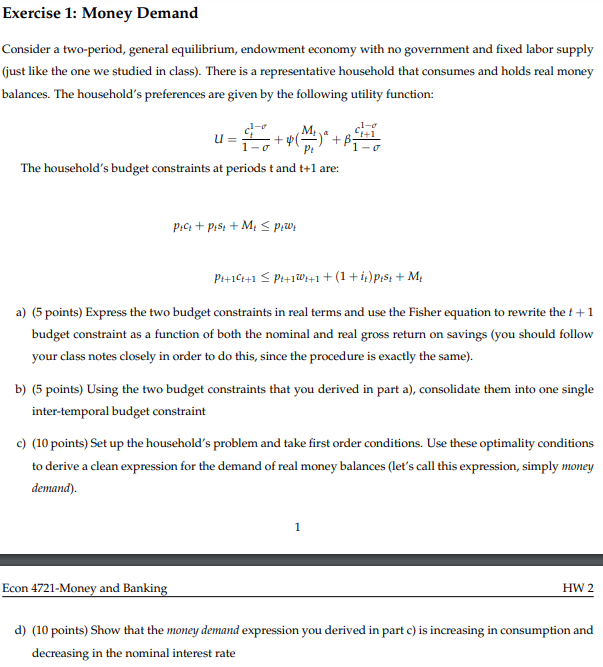
Exercise 1: Money Demand Consider a two-period, general equilibrium, endowment economy with no government and fixed labor supply (just like the one we studied in class). There is a representative household that consumes and holds real money balances. The household's preferences are given by the following utility function: 1-0 Mt Pt The household's budget constraints at periods t and t+1 are: Pict + P+St+Mt PEWE Pt+1+1 P+1+1+(1+i)ps; + M a) (5 points) Express the two budget constraints in real terms and use the Fisher equation to rewrite the t+1 budget constraint as a function of both the nominal and real gross return on savings (you should follow your class notes closely in order to do this, since the procedure is exactly the same). b) (5 points) Using the two budget constraints that you derived in part a), consolidate them into one single inter-temporal budget constraint c) (10 points) Set up the household's problem and take first order conditions. Use these optimality conditions to derive a clean expression for the demand of real money balances (let's call this expression, simply money demand). 1 Econ 4721-Money and Banking HW 2 d) (10 points) Show that the money demand expression you derived in part c) is increasing in consumption and decreasing in the nominal interest rate
Step by Step Solution
There are 3 Steps involved in it

Get step-by-step solutions from verified subject matter experts
 Study Help