







Question: Exercise 1: Show by parameterization of the path that the integral of the vector eld W[X] = 121); [3] makes F[X] -dX ab 0 when
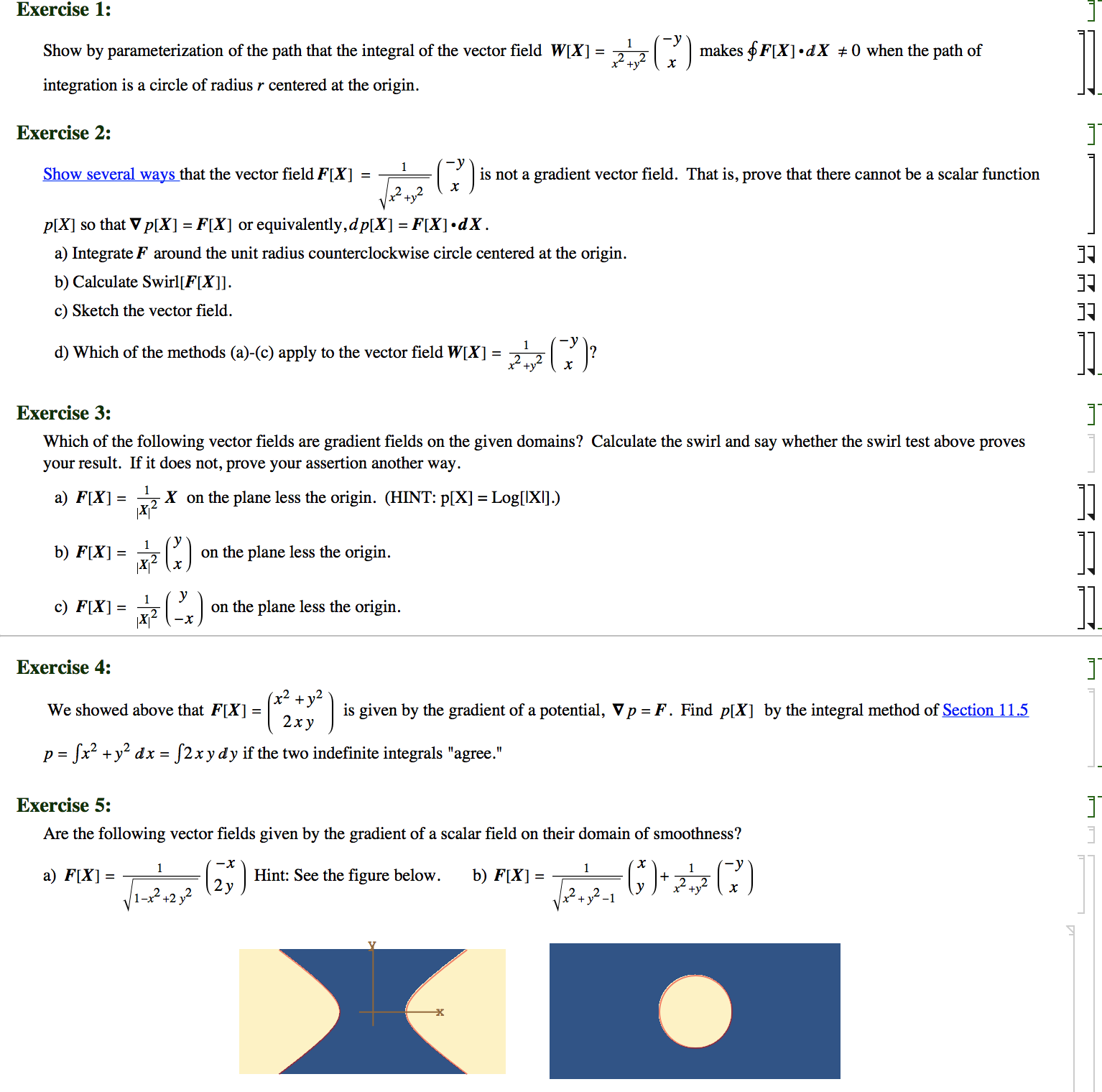
Exercise 1: Show by parameterization of the path that the integral of the vector eld W[X] = 121); [3] makes F[X] -dX ab 0 when the path of + integration is a circle of radius r centered at the origin. Exercise 2: Show several ways that the vector eld F [X ] = 1 [y ] is not a gradient vector eld. That is, prove that there cannot be a scalar function p[X] so that Vp[X] = F[X] or equivalently,dp[X] = F[X] odX. a) Integrate F around the unit radius counterclockwise circle centered at the origin. b) Calculate Swirl [F [X l]. c) Sketch the vector eld. d) Which of the methods (a)-(c) apply to the vector eld W[X] = 1:21);2 [y ]? + Exercise 3: Which of the following vector elds are gradient elds on the given domains? Calculate the swirl and say whether the swirl test above proves your result. Ifit does not, prove your assertion another way. a) F[X] = i X on the plane less the origin. (HJNT: p[X] = Log[IXI].) | l b) F[X] = % [i] on the plane less the origin. E c) F[X] = 1 [jx] on the plane less the origin. Exercise 4: x2 +y2 We showed above that F[X] = [ ] is given by the gradient of a potential, V p = F. Find p[X] by the integral method of Section 11.5 2x y p = fxz +y2 dx = f2xy (1'); if the two indefinite integrals "agree." Exercise 5: Are the following vector elds given by the gradient of a scalar eld on their domain of smoothness? x 2y x Hint: See thegure below. b) F[X] = [y ]+xz+y2 [:3] a) F[X]= 1[ 1haze)? fl; fl; fl; 1
Step by Step Solution
There are 3 Steps involved in it

Get step-by-step solutions from verified subject matter experts
 Study Help